












2026-10-14
Select language:

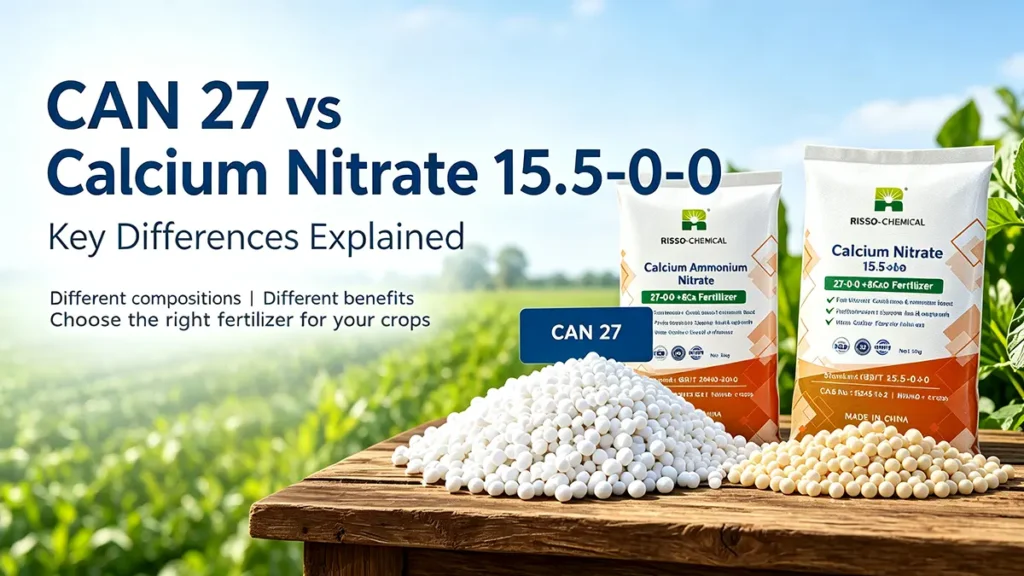
CAN 27 and calcium nitrate 15.5-0-0 are both nitrogen fertilizers associated with calcium nutrition, but they have different chemical compositions, nutrient concentrations and typical applications.
CAN 27 is primarily a granular nitrogen fertilizer containing both nitrate-N and ammonium-N, while calcium nitrate 15.5-0-0 is a highly soluble fertilizer supplying predominantly nitrate nitrogen together with a substantial amount of soluble calcium.
For fertilizer buyers, the important question is therefore not simply which product contains more nitrogen. The better comparison considers nitrogen form, calcium concentration, application method, solubility, crop requirements, fertilizer rate and cost per unit of nutrient supplied.
For international buyers evaluating CAN 27 specifications, Risso can provide product specifications and technical documentation for comparison, including nitrogen content, calcium content, particle size, packaging and quality parameters.
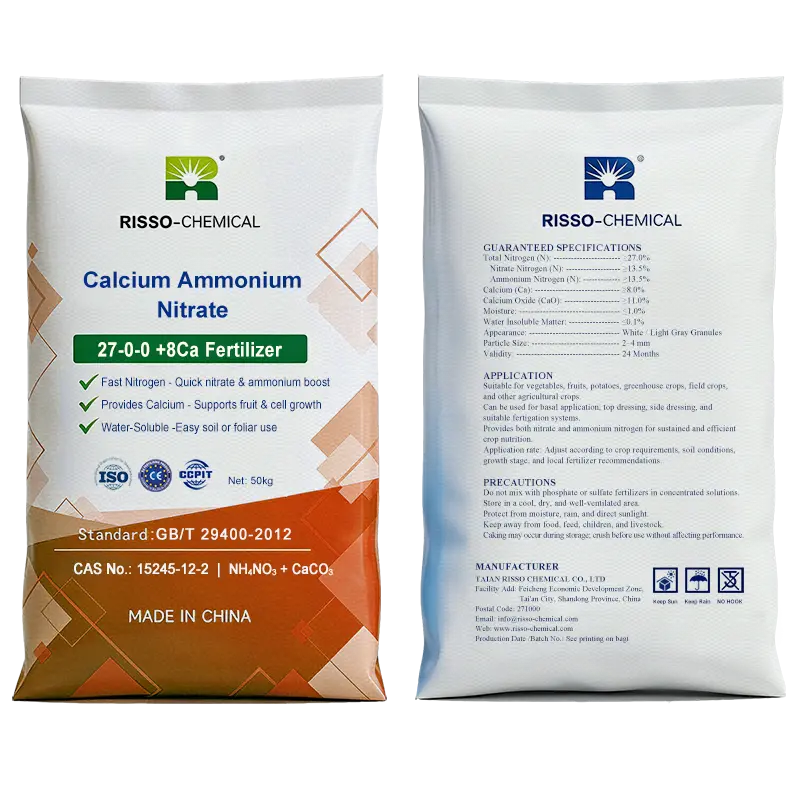
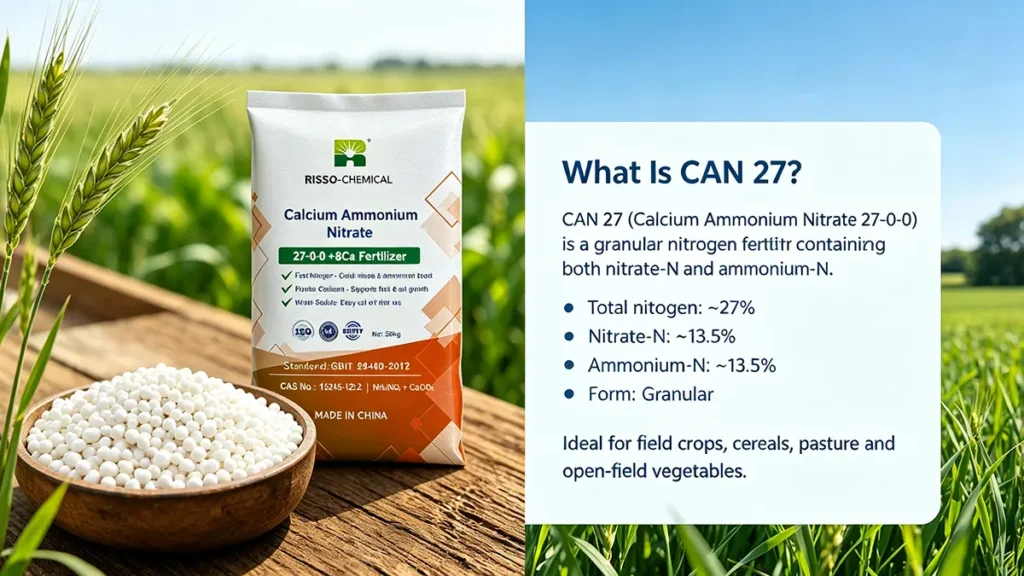
A conventional CAN 27 grade commonly provides nitrogen in two forms:
The calcium and magnesium content depends on the specific formulation and manufacturer. Carbonate materials such as calcium carbonate or dolomite may be incorporated during production.
For example, one commercial CAN 27 specification lists 27% total N, including 13.5% nitrate-N and 13.5% ammonium-N, together with calcium and magnesium.
The combination of nitrate and ammonium nitrogen makes CAN 27 suitable for conventional soil fertilization, particularly:
The primary function of CAN 27 is efficient nitrogen delivery through granular soil application, rather than providing a high concentration of soluble calcium.
The exact specification can vary by manufacturer and product grade.
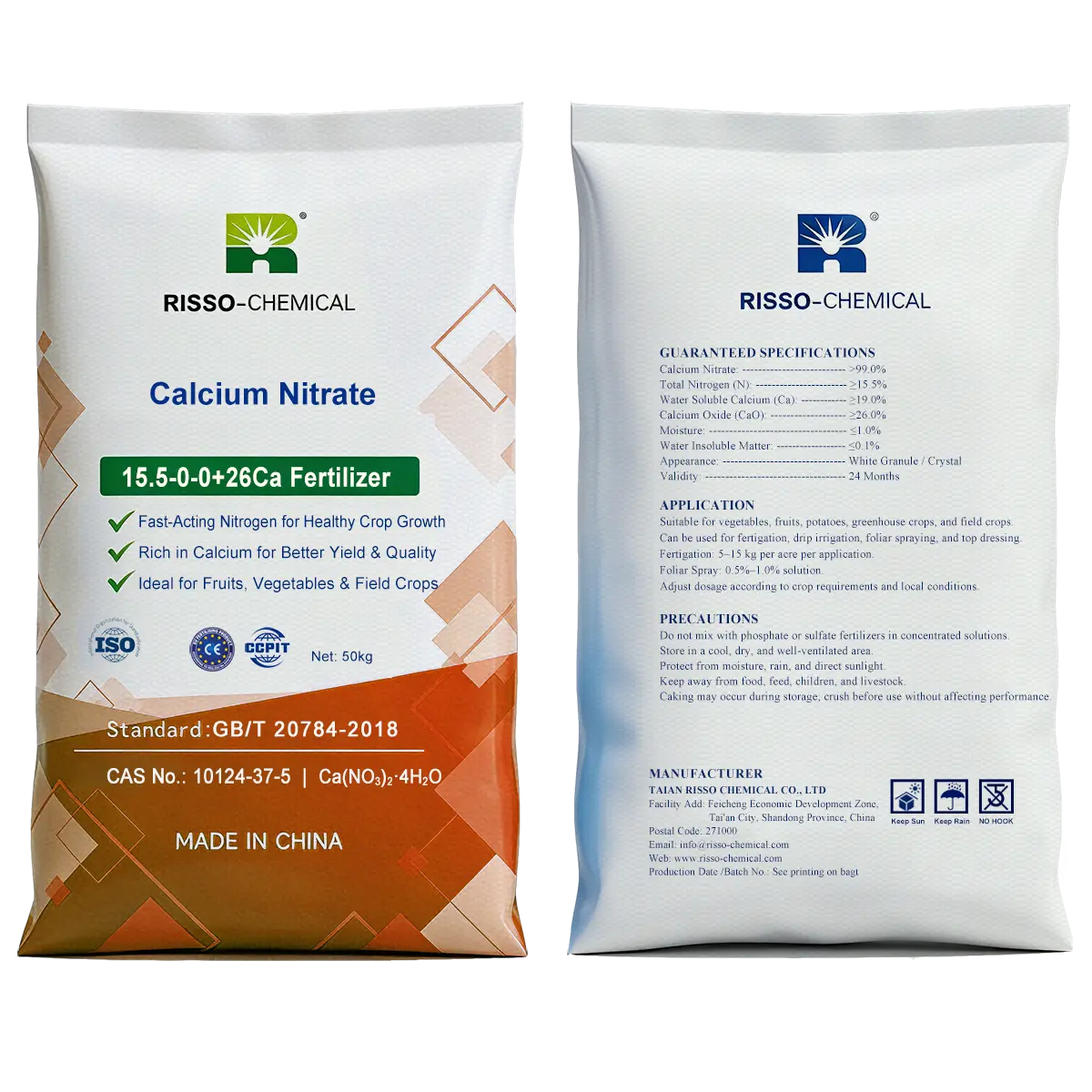
Compared with CAN 27, calcium nitrate contains a much larger proportion of nitrate nitrogen and significantly more soluble calcium.
Its high solubility makes it particularly relevant to:Commercial calcium nitrate specifications commonly identify the product as a soluble source of both nitrate nitrogen and calcium.
| Parameter | CAN 27 | Calcium Nitrate 15.5-0-0 |
|---|---|---|
| Fertilizer grade | 27-0-0 | 15.5-0-0 |
| Total nitrogen | ~27% | ~15.5% |
| Nitrate-N | ~13.5% | ~14.4% |
| Ammonium-N | ~13.5% | ~1.1% |
| Calcium | Formulation-dependent | ~19% |
| CaO | Formulation-dependent | ~26.5% |
| Main physical form | Granular | Soluble granules/crystals |
| Nitrogen profile | Nitrate + ammonium | Predominantly nitrate |
| Calcium supply | Relatively low | High |
| Typical application | Soil application | Fertigation and soil application |
| Main use | Nitrogen fertilization | N + soluble calcium nutrition |
CAN 27 contains substantially more total nitrogen, but its nitrate-N content per 100 kg can be similar to calcium nitrate.
For example:This difference explains why the two products should not be evaluated simply by comparing their total nitrogen percentages.
Nitrate-N (NO₃-N) is directly available for plant uptake. Ammonium-N (NH₄-N) can also be absorbed by plants and can undergo nitrification in the soil, depending on temperature, moisture, aeration and microbial activity.
This combination gives CAN 27 a useful nitrogen profile for many soil-applied crops.
It is particularly relevant where growers want a granular nitrogen fertilizer containing both nitrate and ammonium forms rather than a predominantly nitrate-based fertilizer.
Therefore, its nitrogen supply is strongly nitrate-dominant.
This characteristic is particularly useful in systems where growers are managing nutrient concentrations through irrigation water and require a soluble nitrate source.
The difference can be summarized simply:
CAN 27 → higher total N, with both nitrate and ammonium nitrogen
Calcium nitrate → lower total N, but predominantly nitrate-N plus soluble calcium
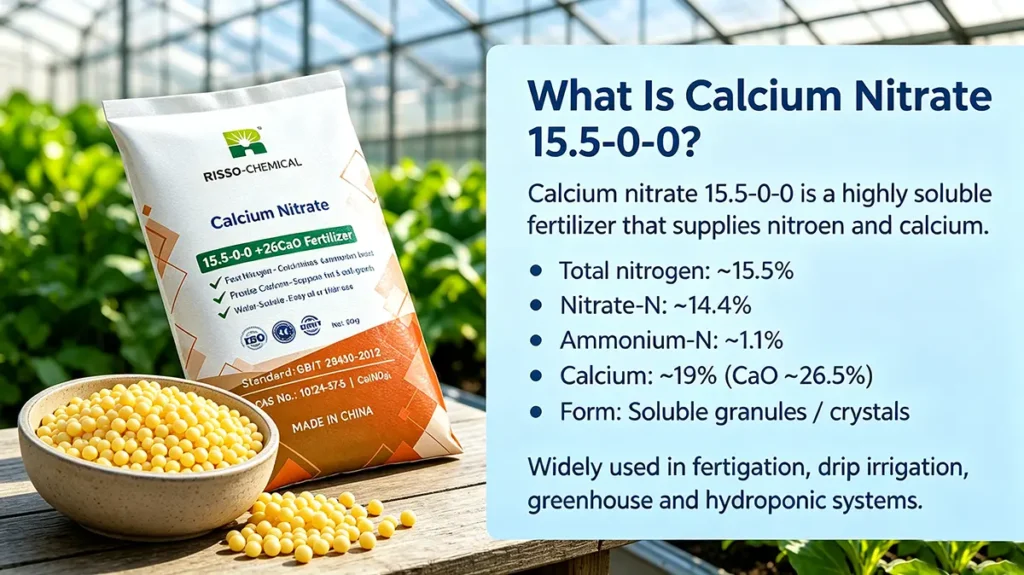
A typical calcium nitrate 15.5-0-0 product supplies approximately 19% Ca.
Therefore:
100 kg calcium nitrate → approximately 19 kg Ca
By comparison, conventional CAN 27 usually contains a considerably lower calcium concentration, and the actual value depends on the formulation.
For example, commercial CAN 27 products may specify calcium around 4% or provide calcium through carbonate components at different concentrations.
Consequently, buyers should never assume that all CAN 27 products have the same calcium specification.
If the main requirement is nitrogen fertilization, CAN 27 provides substantially more total N per tonne.
This makes the economic comparison more meaningful when expressed as:Rather than simply comparing the price per tonne of fertilizer.
This allows nitrogen and calcium to be delivered directly through irrigation water.
For intensive horticultural production, this can make it easier to adjust nutrient concentration according to crop growth stage and irrigation requirements.
It should not automatically be treated as equivalent to a fully soluble fertigation-grade calcium nitrate.
For any proposed fertigation use, buyers should verify:The product name alone is not sufficient to establish fertigation suitability.
Therefore, approximately 275 kg more calcium nitrate would be required to supply the same 100 kg of total nitrogen.
However, this calculation does not mean CAN 27 is automatically more economical.
Calcium nitrate is also supplying approximately 19% calcium, while CAN 27 provides much less calcium.
The correct economic comparison depends on the nutrient target.
For a nitrogen-only program:
Cost/kg N = Fertilizer price per kg ÷ nitrogen fraction
For a combined nitrogen and calcium program, buyers should also consider:
Cost/kg Ca = Fertilizer price per kg ÷ calcium fraction
This approach provides a more useful basis for commercial fertilizer procurement.
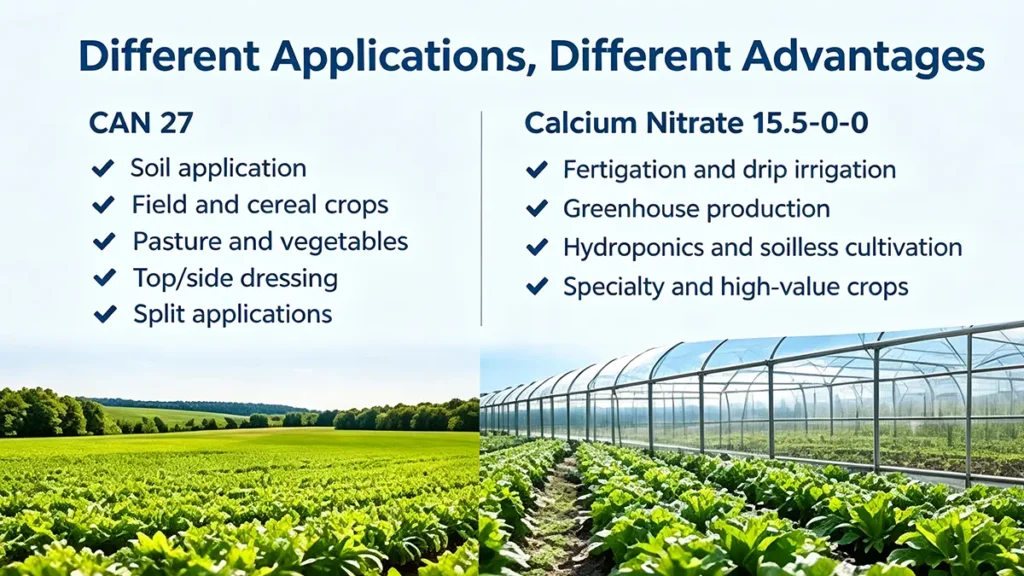
Its relatively high nitrogen concentration makes it suitable where substantial quantities of nitrogen must be distributed efficiently over large areas.
CAN 27 can be particularly practical for top dressing because it provides readily available nitrate-N together with ammonium-N in a granular product.
In these systems, calcium nitrate can be incorporated into a wider nutrient-management program rather than used simply as a nitrogen fertilizer.
The final application rate should be determined from crop nutrient demand, soil or substrate analysis, irrigation water composition and the overall fertilizer program.
Granule size distribution and physical strength are important for mechanical spreading.
Proper packaging and dry storage help maintain product quality and prevent caking.
Calcium can react with phosphate or sulfate ions and form poorly soluble compounds. For this reason, calcium nitrate is commonly managed separately from concentrated phosphate or sulfate fertilizer solutions.
Actual compatibility depends on:A small-scale compatibility test is advisable before preparing concentrated stock solutions for commercial fertigation.
The most useful way to think about the difference is:
CAN 27 is primarily a high-analysis granular nitrogen fertilizer, while calcium nitrate 15.5-0-0 is a soluble nitrogen-and-calcium fertilizer.
No.
CAN 27 normally contains approximately 27% total nitrogen, with nitrate and ammonium nitrogen in roughly equal proportions.
Calcium nitrate 15.5-0-0 contains approximately 15.5% total nitrogen, predominantly as nitrate-N, together with approximately 19% calcium in a typical grade.
CAN 27 contains more total nitrogen per kilogram of fertilizer.
At 100 kg fertilizer:
Calcium nitrate generally contains substantially more calcium.
A typical calcium nitrate grade contains approximately 19% Ca, whereas calcium levels in CAN 27 vary according to formulation.
Yes.
A conventional CAN 27 grade generally contains approximately 13.5% nitrate-N and 13.5% ammonium-N.
Yes.
Its high water solubility makes calcium nitrate one of the commonly used nitrogen and calcium fertilizers for fertigation, greenhouse and soilless production.
Not as a direct one-to-one replacement.
CAN 27 provides considerably more total nitrogen per kilogram, while calcium nitrate provides substantially more soluble calcium and a predominantly nitrate-based nitrogen supply.
The appropriate choice depends on the crop, nutrient requirement and application system.
The answer depends on the production system.
For open-field vegetable production where granular nitrogen is the primary requirement, CAN 27 may be appropriate.
For greenhouse vegetables, hydroponics or fertigation programs requiring soluble calcium and nitrate-N, calcium nitrate may be more relevant.
The decision should be based on crop demand, irrigation method, soil or substrate conditions and water chemistry.
CAN 27 provides approximately 27% total nitrogen, normally divided between nitrate-N and ammonium-N. Its higher nitrogen concentration and granular form make it particularly suitable for field fertilization, top dressing and large-scale nitrogen management.
Calcium nitrate 15.5-0-0 provides approximately 15.5% total nitrogen, predominantly as nitrate-N, together with approximately 19% calcium in a typical grade. Its high solubility makes it particularly suitable for fertigation, greenhouse production, hydroponics and specialty-crop nutrition.
The key differences can be summarized as follows:| Key factor | CAN 27 | Calcium Nitrate 15.5-0-0 |
|---|---|---|
| Total N | Higher | Lower |
| Nitrate-N | ~13.5% | ~14.4% |
| Ammonium-N | ~13.5% | ~1.1% |
| Calcium | Lower / formulation-dependent | ~19% |
| Solubility | Formulation-dependent | High |
| Main application | Soil/field | Fertigation and specialty crops |
| Main nutrient role | Nitrogen | Nitrogen + calcium |
Risso supports international fertilizer buyers with technical product information for specification-based evaluation, allowing CAN 27 and other fertilizer grades to be compared according to measurable parameters rather than product names alone.
In practical terms, the choice is simple:
Choose CAN 27 when high-analysis granular nitrogen is the main requirement. Choose calcium nitrate when the program requires predominantly nitrate nitrogen together with a significant supply of soluble calcium.
The correct product is ultimately determined by the crop, nutrient target, application system, water or soil conditions, and cost per unit of nutrient delivered.
If you want to know other questions about NPK Fertilizer Manufacturers or NPK fertilizers , please contact us and we will provide professional answers.
✔ Quick & helpful reply within 6 hours.
✔ Tailored solutions for your project.
✔ One-stop product, tech, market

Want to find a China fertilizer manufacturer?
Risso will be your best choice; send us your request for your fertilizer details requirement
© Copyright 2017 RISSO CHEMICAL. All Rights Reserved.