















2026-10-21
Select language:

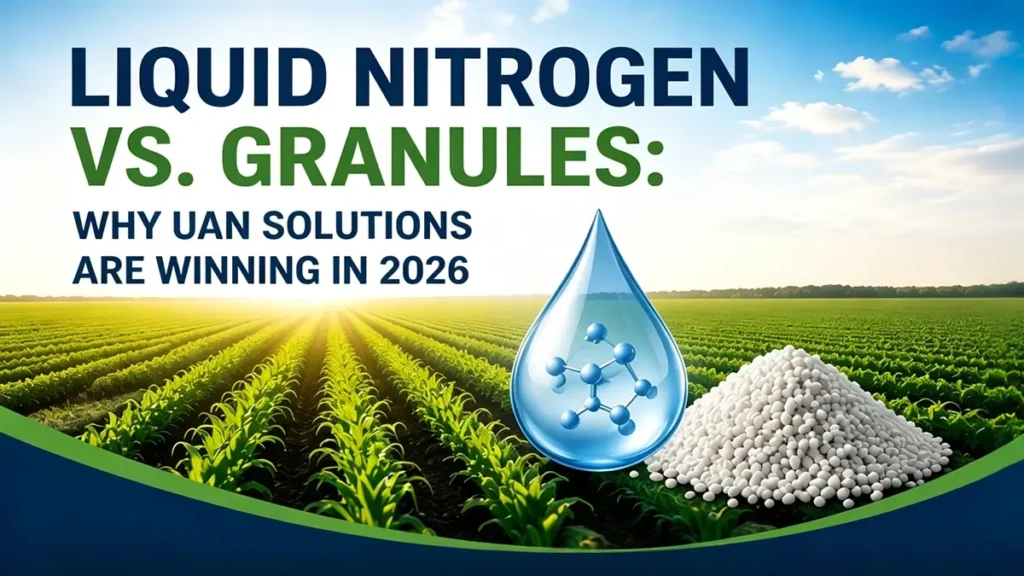
Nitrogen fertilizers remain one of the most critical inputs in global agriculture. However, in 2026, the industry is rapidly transitioning from traditional granular fertilizers toward more efficient liquid nitrogen fertilizer solutions. Among these, Urea Ammonium Nitrate (UAN) fertilizer has emerged as one of the fastest-growing nitrogen products for modern farming systems.
Farmers today face increasing pressure to improve crop yields, reduce nutrient loss, optimize fertilizer application timing, and meet stricter environmental regulations. As precision agriculture technologies become more advanced, liquid UAN fertilizer solutions are proving to be more adaptable and efficient than conventional granular nitrogen fertilizers.
Large-scale growers increasingly prefer UAN 32 and UAN 28 solutions because they support precision nutrient management, fertigation systems, variable-rate application technology, and sustainable farming practices. This shift is especially noticeable in corn production, wheat farming, and high-value specialty crop operations where nitrogen use efficiency is directly tied to profitability.
As a professional supplier focused on modern agricultural nutrient solutions, Risso continues to monitor the rapid development of liquid fertilizer technologies and sustainable nitrogen management systems worldwide.
UAN (Urea Ammonium Nitrate) is a liquid nitrogen fertilizer produced by dissolving urea and ammonium nitrate into water. It contains three forms of nitrogen:
The most common grades include:
Because UAN fertilizer contains multiple nitrogen sources, crops benefit from both immediate nitrogen availability and longer-term nutrient release.
Compared with solid nitrogen fertilizers, liquid UAN solutions offer several operational advantages:
These characteristics make UAN one of the most important liquid fertilizer solutions in modern agriculture.
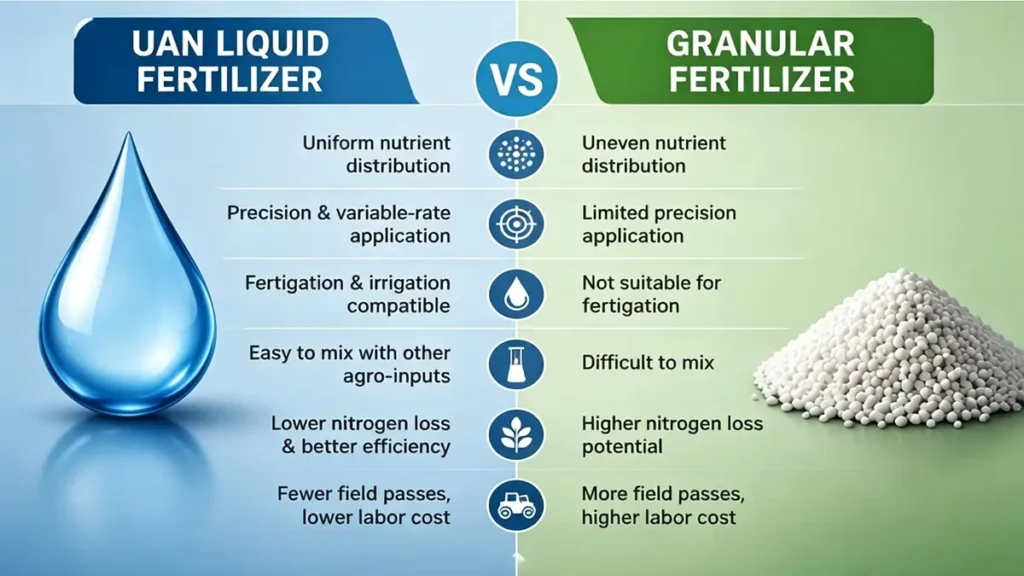
Granular fertilizers such as urea and ammonium nitrate are traditionally broadcast over fields using spreaders. While effective, this method may result in uneven distribution and nitrogen loss under certain weather conditions.
Liquid UAN fertilizer can be:
This flexibility improves nutrient timing and reduces unnecessary fertilizer waste.
| Feature | UAN Liquid Fertilizer | Granular Fertilizer |
|---|---|---|
| Nutrient Uniformity | Excellent | Moderate |
| Precision Application | High | Limited |
| Fertigation Compatibility | Excellent | Poor |
| Variable-Rate Technology | Fully Compatible | Limited |
| Mixing with Crop Protection Products | Easy | Difficult |
| Split Applications | Highly Flexible | Less Flexible |
| Nitrogen Use Efficiency | Higher | Moderate |
Nitrogen use efficiency (NUE) has become a central focus in modern agriculture. Excess nitrogen loss not only reduces profitability but also increases environmental risks.
Liquid UAN fertilizer solutions allow farmers to apply nitrogen more accurately throughout the crop growth cycle. Instead of a single heavy application, growers can use split nitrogen applications to match crop nutrient demand more precisely.
This strategy helps:
Enhanced-efficiency nitrogen systems continue gaining popularity because they support sustainable agriculture while maintaining strong yields.
One of the biggest reasons UAN solutions are outperforming granular fertilizers in 2026 is the rapid expansion of precision agriculture technologies.
Modern farms increasingly rely on:
Liquid nitrogen fertilizer integrates naturally into these systems, making UAN an ideal solution for precision farming operations.
Farmers using precision liquid fertilizer systems often achieve:
Labor shortages and rising fuel prices continue to challenge agricultural operations worldwide. Liquid UAN fertilizer helps reduce operational costs by minimizing field passes.
Growers can often combine UAN applications with:
This reduces:
For large-scale commercial agriculture, operational efficiency is becoming just as important as fertilizer cost itself.
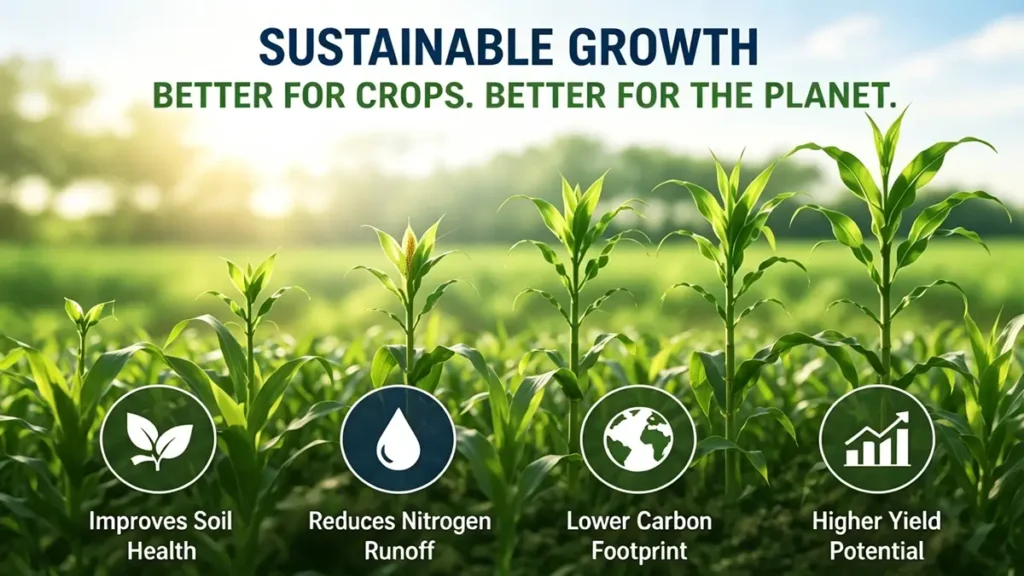
Precision nutrient management is becoming the foundation of sustainable farming.
Liquid fertilizer systems allow growers to apply nutrients at the right:
This “4R Nutrient Stewardship” approach improves both economic and environmental performance.
UAN solutions are especially valuable in fertigation systems because they dissolve completely and distribute evenly through irrigation networks. As drip irrigation and smart irrigation systems expand globally, demand for liquid nitrogen fertilizer continues increasing.
Midway through this transformation, companies such as Risso are paying close attention to innovations in liquid fertilizer compatibility, precision nutrient delivery, and environmentally responsible agricultural inputs.
Traditional granular urea fertilizers may experience significant ammonia volatilization when surface-applied without incorporation.
Liquid UAN fertilizer reduces this risk through:
Excess fertilizer runoff contributes to groundwater contamination and eutrophication. Precision liquid nitrogen application helps minimize nutrient movement beyond the crop root zone.
Sustainable agriculture initiatives are accelerating demand for low-carbon fertilizer products. Modern UAN production technologies increasingly focus on:
These factors are becoming increasingly important for food supply chains focused on ESG goals and regenerative agriculture programs.
Liquid UAN fertilizer provides growers with greater flexibility during unpredictable weather conditions.
Farmers can adjust application timing based on:
Accurate nitrogen timing often leads to:
Liquid fertilizer spraying systems can cover large acreages quickly, improving efficiency during narrow planting and fertilization windows.
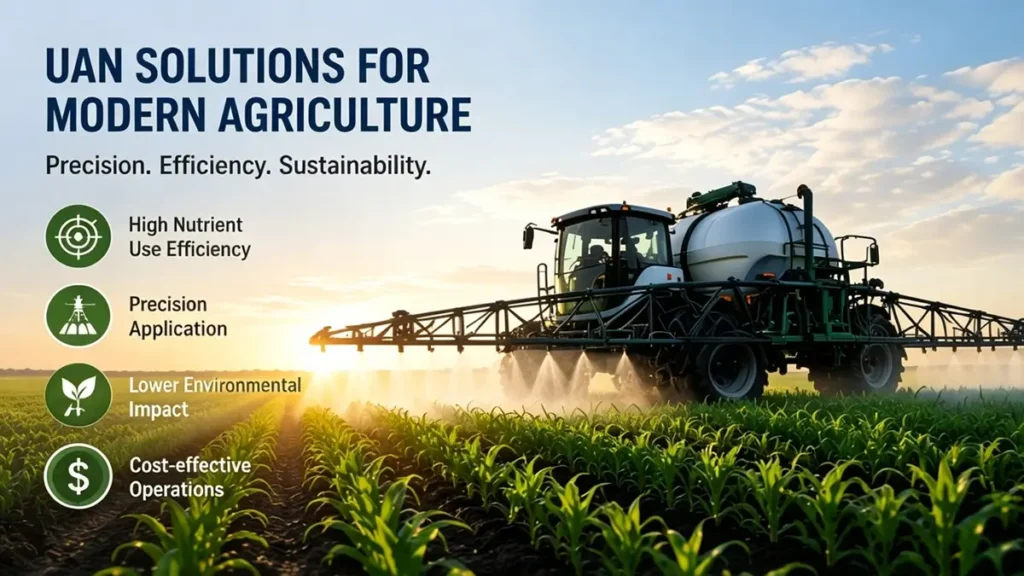
Corn is one of the largest users of UAN 32 fertilizer because of its high nitrogen demand during rapid vegetative growth stages.
Split liquid nitrogen applications improve wheat protein development while optimizing nitrogen efficiency.
Potato growers increasingly adopt low-carbon UAN solutions to support sustainable crop programs and improve nutrient precision.
High-value crops benefit from the precision and flexibility of liquid fertigation systems.f its high nitrogen demand during rapid vegetative growth stages.
Although UAN fertilizer solutions offer many advantages, growers should also consider several operational factors.
Liquid fertilizer requires:
Because UAN contains water, transportation costs may be higher compared with dry nitrogen fertilizers in some regions.
Nitrogen fertilizer prices remain sensitive to:
Despite these challenges, the long-term advantages of liquid nitrogen management continue driving UAN market expansion.
Despite these challenges, the long-term advantages of liquid nitrogen management continue driving UAN market expansion.
Several long-term trends continue strengthening the global UAN fertilizer market:
Precision farming technologies strongly favor liquid fertilizer systems.
Governments worldwide increasingly support improved nitrogen efficiency and environmentally responsible fertilization programs.
Growing populations require higher agricultural productivity and more efficient nutrient management.
The expansion of fertigation and drip irrigation systems directly increases demand for liquid nitrogen fertilizers.
Food producers and agricultural suppliers increasingly prioritize low-carbon fertilizer solutions.
These trends indicate that UAN fertilizers will continue gaining market share throughout the decade.
The future of agriculture is becoming increasingly:
Liquid UAN fertilizer aligns perfectly with these long-term agricultural trends.
Future developments likely include:
As farms become more technologically advanced, liquid fertilizer systems will play an even larger role in sustainable crop production.
Toward the future of efficient nitrogen management, Risso continues focusing on innovative agricultural chemical solutions designed to support modern farming efficiency, sustainable fertilizer strategies, and global crop productivity.
In 2026, the comparison between liquid nitrogen fertilizer and traditional granular fertilizers increasingly favors UAN solutions.
UAN fertilizers offer several critical advantages:
As agriculture moves toward sustainability, smart farming, and precision nutrient delivery, liquid nitrogen fertilizer solutions are becoming essential tools for modern crop production.
For growers seeking improved yields, lower nitrogen loss, and better long-term profitability, UAN fertilizer solutions represent one of the most effective and future-ready nitrogen management strategies available today.
UAN (Urea Ammonium Nitrate) is a liquid nitrogen fertilizer widely used in modern agriculture. It provides fast nutrient absorption, high nitrogen use efficiency, and excellent compatibility with precision farming and fertigation systems.
UAN liquid fertilizer offers more uniform nutrient distribution, flexible application timing, and better precision application compared to traditional granular fertilizers. It is especially effective for modern crop management and large-scale farming operations.
The most common UAN fertilizer grades are UAN 28, UAN 30, and UAN 32. Among them, UAN 32 fertilizer is widely used for corn, wheat, and other high-nitrogen-demand crops.
UAN fertilizer demand is growing in 2026 because farmers need more efficient nitrogen management, precision agriculture compatibility, reduced environmental impact, and improved crop yield performance.
UAN fertilizer helps reduce nitrogen loss, improve nutrient efficiency, and support precision nutrient management. It is an important solution for sustainable farming and environmentally responsible agriculture.
If you want to know other questions about nitrogen fertilizer, please contact us and we will provide professional answers.
✔ Quick & helpful reply within 6 hours.
✔ Tailored solutions for your project.
✔ One-stop product, tech, market

Want to find a China fertilizer manufacturer?
Risso will be your best choice; send us your request for your fertilizer details requirement
© Copyright 2017 RISSO CHEMICAL. All Rights Reserved.