
















2026-10-21
Select language:

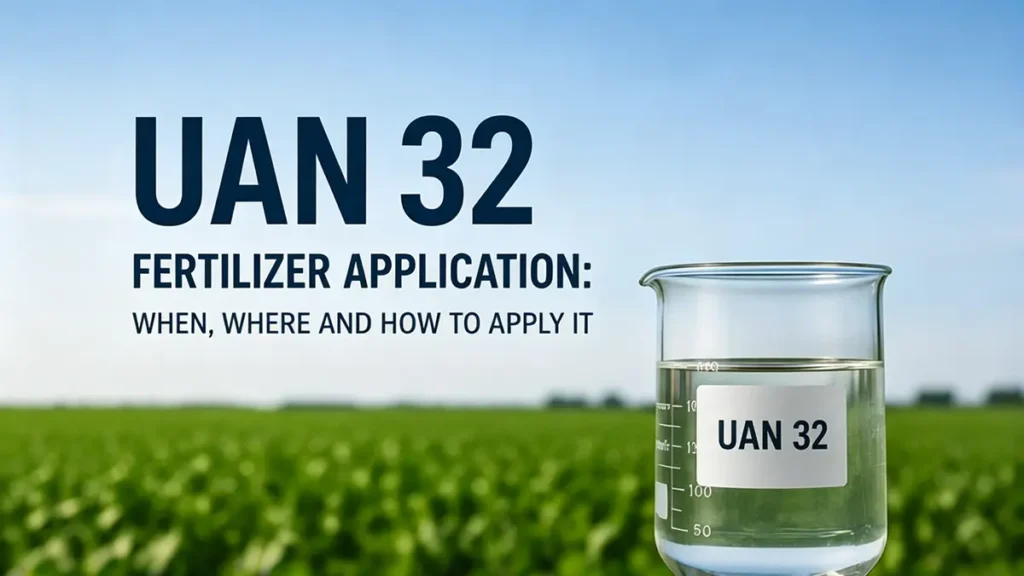
UAN 32 is one of the most widely used liquid nitrogen fertilizers for commercial crop production. Commonly identified as 32-0-0, UAN 32 supplies nitrogen in nitrate, ammonium, and urea forms, making it suitable for pre-plant, planting, sidedress, and fertigation applications.
The main question is not simply whether UAN 32 can be applied to a crop. The more important question is how, when, and where to place it so that the crop can access the nitrogen while unnecessary nitrogen losses are minimized.
Application timing, soil conditions, crop growth stage, placement method, weather, residue cover, and the crop’s nitrogen requirement all affect the performance of UAN 32.
This guide explains the practical considerations for UAN 32 fertilizer application, including application timing, surface application, injection, sidedressing, fertigation, application rates, and nitrogen loss management.
For commercial farms, distributors, and agricultural buyers, Risso supplies UAN 32 solution for agricultural applications and can provide product specifications and technical documentation to support fertilizer planning. Actual application practices should always be adjusted to the crop, soil, climate, equipment, and local agronomic recommendations.
The best timing depends on when the crop needs nitrogen, soil conditions, expected weather, and the risk of nitrogen loss.
In general, UAN 32 can be used in several application windows:
Pre-plant application can work well when soil conditions and weather allow the fertilizer to be incorporated or moved into the soil before significant nitrogen loss occurs.
Iowa State University notes that UAN can be broadcast and incorporated before planting, while injection can also reduce losses compared with leaving the fertilizer on the soil surface.
Direct contact between concentrated fertilizer and seed should generally be avoided unless the application system and rate are specifically designed for that purpose.
Instead of applying the entire nitrogen requirement before planting, growers can apply part of the nitrogen closer to the period of peak crop demand.
This approach can reduce the amount of nitrogen exposed to loss before the crop needs it. Extension guidance from Iowa State University specifically identifies sidedress injection of UAN as a preferred option for post-plant nitrogen application in corn.
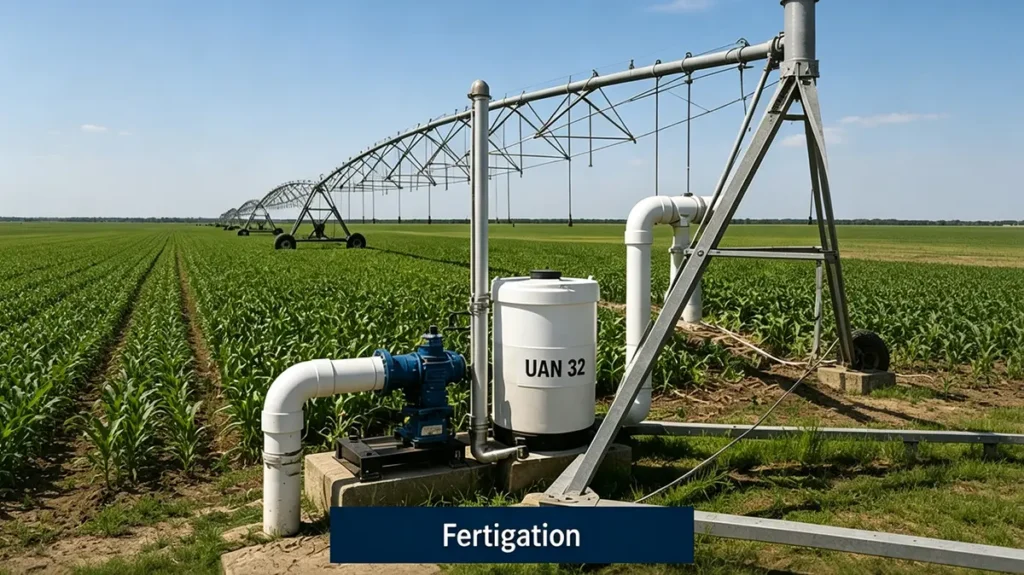
This allows nitrogen to be distributed with irrigation water and can be useful where fertigation equipment is available.
For commercial systems, injection rate, irrigation volume, fertilizer concentration, and crop nitrogen requirements need to be calculated together.
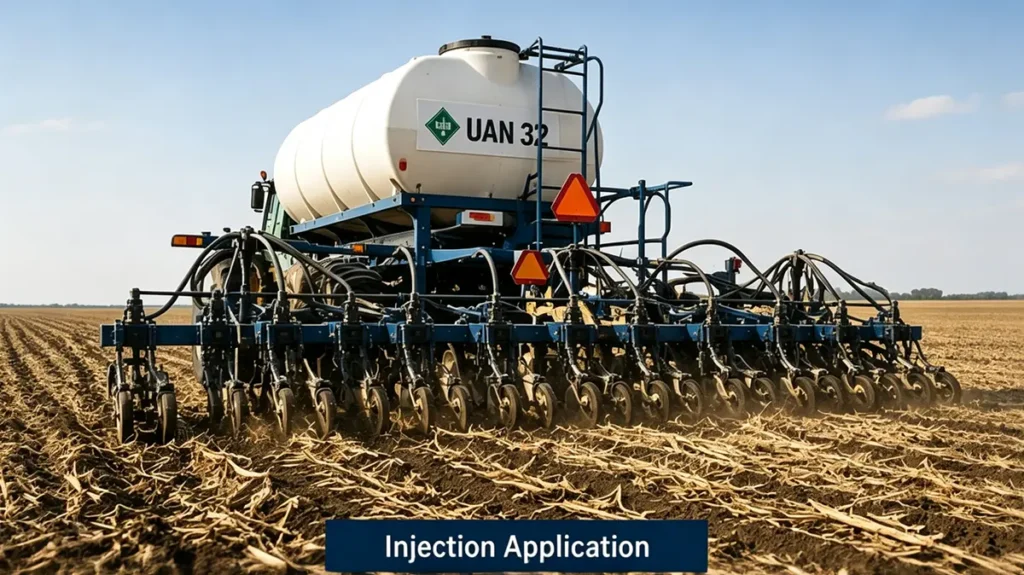
UAN 32 may be:
The appropriate method depends on the crop and field conditions.
For fields with substantial crop residue, surface broadcasting can increase the risk of nitrogen remaining on residue rather than reaching the soil. Missouri Extension recommends surface banding or injection when UAN is used in high-residue systems, with injection providing the strongest protection against residue interception and volatilization.
This is generally one of the most effective methods for reducing contact between UAN and crop residue and limiting ammonia volatilization from its urea component.
Injection can be particularly useful for:The injection equipment should be adjusted to provide uniform placement without excessive soil disturbance or root damage.
For UAN 32, this can reduce fertilizer contact with crop residue compared with broadcast application.
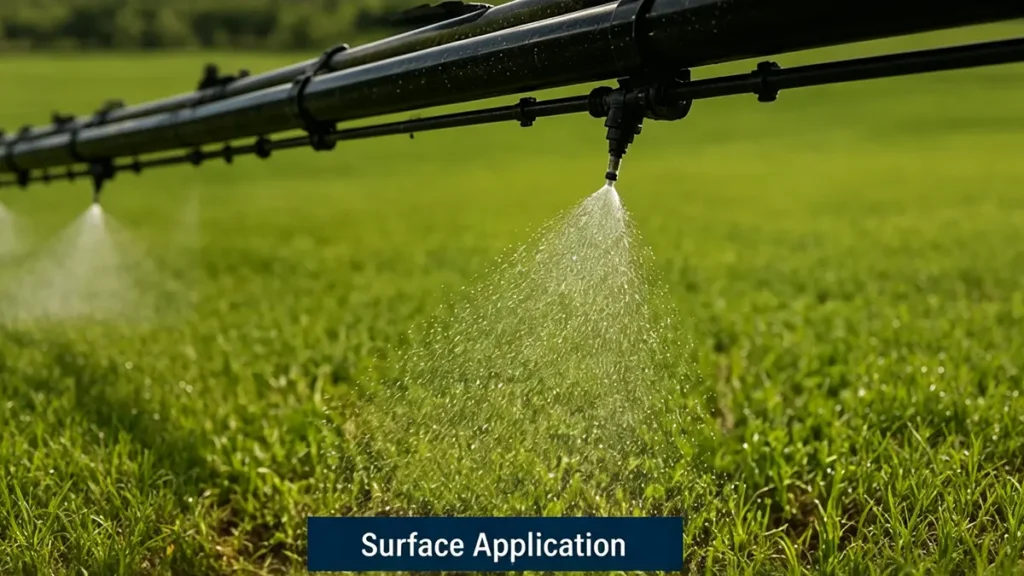
It is often a practical alternative when injection equipment is unavailable or unsuitable.
Iowa State University identifies surface-dribbled UAN as a useful sidedress option, while injection generally provides greater protection against surface nitrogen losses.
Broadcast applications are generally less desirable when:
Missouri Extension specifically advises against broadcasting UAN on high-residue surfaces because of potential nitrogen losses and recommends banding or injection where appropriate.
It can be used with suitable systems such as center pivots and other irrigation equipment designed for fertilizer injection.
The application rate should be calculated from the required nitrogen amount, UAN 32 density, fertilizer concentration, irrigation flow rate, and application time.
For example, University of Florida guidance uses a UAN 32 density of approximately 11.08 lb/gal at 68°F and approximately 3.55 lb of nitrogen per gallon for application calculations. Actual product density should be taken from the supplier’s specification because it can vary by product and temperature.
However, applying nitrogen too far ahead of crop demand is not always advantageous.
Nitrogen that remains in the soil for a long period before crop uptake can be exposed to:Iowa State University recommends avoiding unnecessary early UAN applications and notes that incorporating or injecting UAN can reduce volatilization compared with leaving it on the surface.
For this reason, pre-plant application should be based on both crop nitrogen demand and local soil conditions, rather than simply applying fertilizer as early as possible.
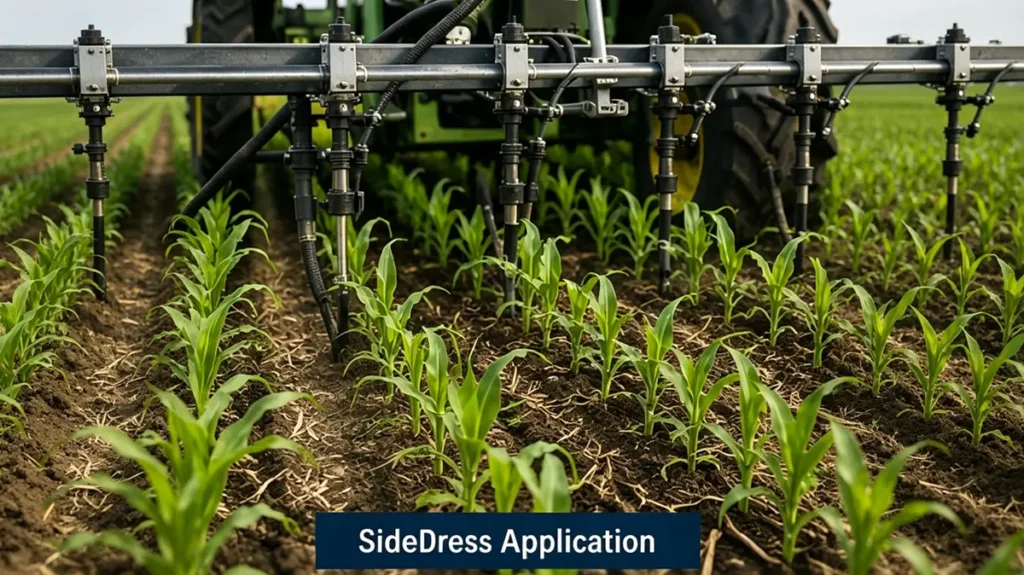
This is particularly important for crops such as corn, where nitrogen demand increases significantly during vegetative growth.
UAN 32 can be:Iowa State University notes that UAN injection can be performed between every row or every other row in suitable corn systems.
The application equipment should be selected according to crop height, row spacing, soil moisture, and field conditions.
Instead of applying all nitrogen at once, growers can distribute nitrogen over several irrigation events according to crop demand.
This approach can help manage nitrogen more precisely when the irrigation system provides good control over application timing and uniformity.
A basic calculation is:
Required UAN 32 volume = Required nitrogen ÷ Nitrogen supplied per unit of UAN 32
Because UAN 32 is a liquid product, both nitrogen concentration and density are needed for accurate volume calculations.
For example, if a product supplies approximately 3.55 lb of nitrogen per gallon, applying 50 lb N/acre would require approximately:
50 ÷ 3.55 = 14.1 gallons of UAN 32 per acre
This is only a calculation example, not a universal agronomic recommendation. The actual nitrogen requirement should be determined from crop demand, soil testing, previous applications, expected yield, and local agronomic guidance.
The calculation requires:
For liquid fertilizer, California Department of Food and Agriculture training materials provide the following general calculation:
Fertilizer application = [Required N × 100] ÷ [% N × fertilizer density]
This allows the required nitrogen rate to be converted into a liquid fertilizer volume.
For UAN 32, the exact density should be taken from the product label or current supplier specification.
The approximate application volume is:
100 ÷ (0.32 × 11.0) = 28.4 gallons/acre
Again, this is a mathematical example rather than a recommended crop rate.
The actual nitrogen requirement should be determined from the crop’s nutrient management plan.
Because approximately half of UAN nitrogen is supplied in urea form, surface-applied UAN can be subject to ammonia volatilization.
Several factors can increase the risk:Iowa State University notes that approximately ¼–½ inch of rainfall within about two days can eliminate much of the volatilization concern for surface-applied UAN in certain pre-plant situations, although actual conditions vary.
The product label and local agronomic recommendations should be followed when using an inhibitor.
For post-emergence applications, placement becomes increasingly important as the crop develops.
Surface spraying directly onto plant foliage can cause leaf injury because concentrated UAN is a fertilizer salt solution. Iowa State University recommends avoiding broadcast UAN on larger corn and using injection or dribble placement for later applications.
Because wheat has a relatively high nitrogen demand during key growth stages, split nitrogen applications may be useful where supported by local agronomic recommendations.
The same basic principles apply:
Match nitrogen supply with crop demand and select an application method that limits unnecessary nitrogen loss.
The exact rate and timing should be based on crop-specific recommendations rather than a universal UAN 32 rate.
However, precision technology does not automatically improve nitrogen use efficiency.
The agronomic decision still comes first:
How much nitrogen does the crop need, and when does it need it?
Technology then helps deliver that nitrogen more accurately.
Choose the method that fits the crop and field conditions.
A practical decision can be made by considering four factors:
Crop demand
When will the crop need nitrogen?
Soil conditions
Is the soil likely to retain nitrogen, or is there a risk of leaching, runoff, or denitrification?
Weather
Will rainfall or irrigation move surface-applied UAN into the soil, or will warm and dry conditions increase volatilization?
Application equipment
Can the fertilizer be injected, banded, broadcast, or fertigated accurately?
For example, a high-residue no-till corn field may favor injection or surface dribbling, while an irrigated vegetable operation may benefit from carefully managed fertigation. The same UAN 32 product can therefore be used differently depending on the production system.
For many field crops, injection or surface banding can reduce the exposure of UAN to crop residue and the atmosphere, while split applications can help bring nitrogen supply closer to periods of high crop demand.
The correct application rate should always be calculated from the crop’s actual nitrogen requirement, not simply from the concentration of UAN 32.
For commercial growers and fertilizer buyers, selecting a reliable UAN 32 supplier is also part of good nitrogen management. Risso provides UAN 32 fertilizer for agricultural markets with product specifications and technical documentation to support different application and supply requirements.
The goal of UAN 32 application is not simply to apply more nitrogen. It is to place the right amount of nitrogen in the right place at the right time for the crop to use it efficiently.
If you want to know other questions about NPK Fertilizer Manufacturers or NPK fertilizers , please contact us and we will provide professional answers.
✔ Quick & helpful reply within 6 hours.
✔ Tailored solutions for your project.
✔ One-stop product, tech, market

Want to find a China fertilizer manufacturer?
Risso will be your best choice; send us your request for your fertilizer details requirement
© Copyright 2017 RISSO CHEMICAL. All Rights Reserved.