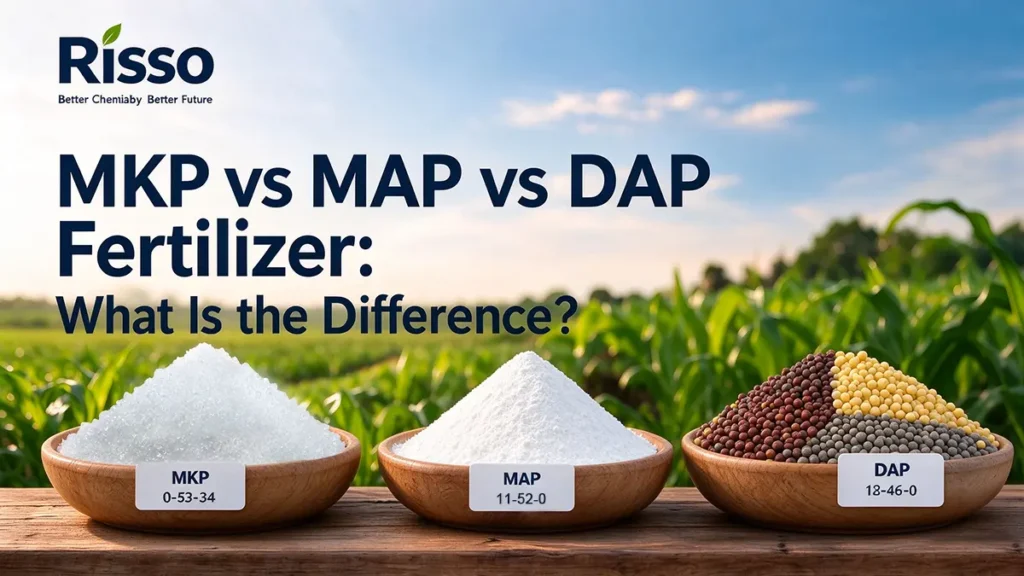
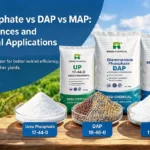
MKP, MAP, and DAP are three widely used phosphate fertilizers, but they differ in nutrient composition, chemical properties, solubility, and application methods. Choosing the right fertilizer depends on whether a crop needs phosphorus and potassium, phosphorus and nitrogen, or a concentrated source of both nitrogen and phosphorus for soil application.
MKP 0-52-34 supplies phosphorus and potassium without nitrogen; MAP is commonly available as 11-52-0 granular fertilizer or 12-61-0 water-soluble fertilizer; and DAP 18-46-0 supplies nitrogen and phosphorus in a concentrated granular form. These differences determine how each product fits into soil fertilization, fertigation, hydroponics, and fertilizer manufacturing.
For growers, fertilizer distributors, and agricultural input buyers, understanding MKP vs MAP vs DAP is essential for selecting a suitable phosphate source, managing nutrient ratios, and avoiding application problems such as seedling injury or phosphate precipitation in irrigation systems.
At Risso, fertilizer selection begins with the intended application, nutrient requirements, and product specifications. Understanding the differences between these three phosphate fertilizers helps buyers match the correct grade to their agricultural or fertilizer-production needs.
1. MKP vs MAP vs DAP: Key Differences
The main difference between MKP, MAP, and DAP is the combination of nutrients each fertilizer supplies. Although all three provide phosphorus, they are not direct substitutes in every fertilizer program.
| Property | MKP | MAP | DAP |
|---|
| Full name | Monopotassium phosphate | Monoammonium phosphate | Diammonium phosphate |
| Chemical formula | KH₂PO₄ | NH₄H₂PO₄ | (NH₄)₂HPO₄ |
| Common fertilizer grade | 0-52-34 | 11-52-0 or 12-61-0 | 18-46-0 |
| Nitrogen (N) | 0% | 11–12% | 18% |
| Phosphate (P₂O₅) | 52% | 52–61% | 46% |
| Potash (K₂O) | 34% | 0% | 0% |
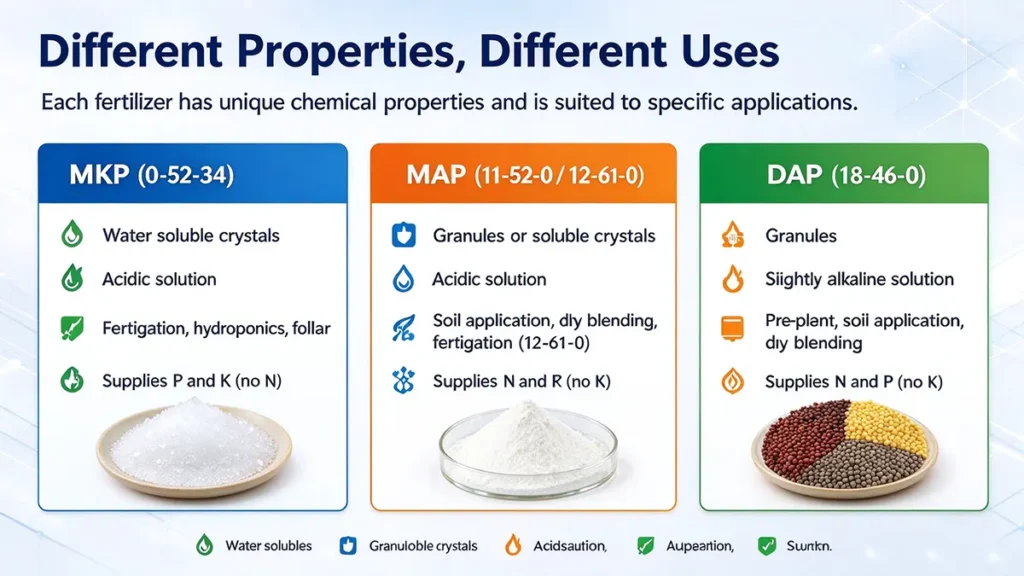
| Main nutrients supplied | Phosphorus and potassium | Nitrogen and phosphorus | Nitrogen and phosphorus |
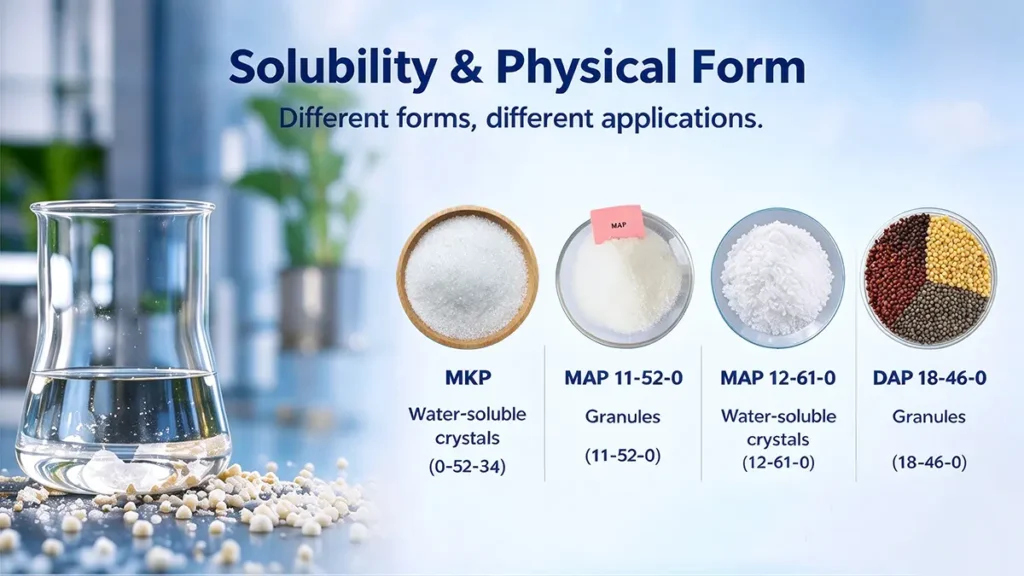
| Common physical form | Water-soluble crystals | Granules or soluble crystals | Primarily granules |
| Typical applications | Fertigation, hydroponics, foliar nutrition | Soil application, dry blending, fertigation with suitable grades | Pre-plant fertilization, soil application, dry blending |
| General solution reaction | Acidic | Acidic | Slightly alkaline |
Grades represent nominal nutrient percentages by weight using the conventional N–P₂O₅–K₂O labeling system. Commercial specifications vary by product and manufacturer.
Which fertilizer should you choose?
-
MKP 0-52-34: Best suited to programs requiring phosphorus and potassium without additional nitrogen.
-
MAP 11-52-0 or 12-61-0: Suitable when both ammonium nitrogen and phosphorus are required, with the specific grade selected according to the application method.
-
DAP 18-46-0: Commonly used when a concentrated granular source of nitrogen and phosphorus is needed for conventional soil fertilization.
The right choice depends on soil test results, crop nutrient demand, fertilizer placement, irrigation-water quality, and the total cost of the nutrient program.
2. What Is MKP Fertilizer?
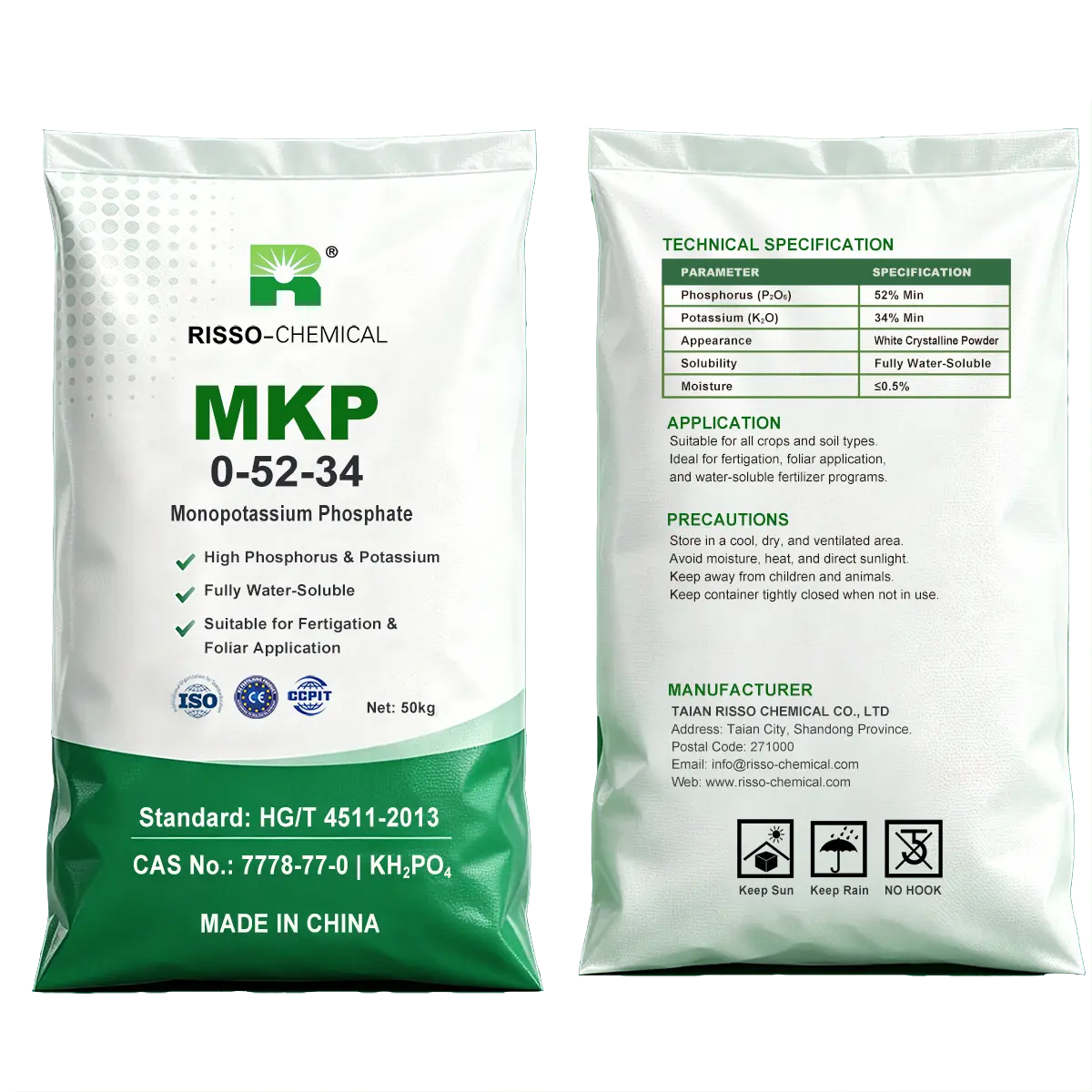
MKP fertilizer, or monopotassium phosphate, is a water-soluble phosphate and potassium fertilizer with the chemical formula KH₂PO₄. Its standard agricultural grade is 0-52-34, containing 52% P₂O₅ and 34% K₂O, with no nitrogen.
Although fertilizer labels express phosphorus and potassium as oxide equivalents, MKP supplies approximately 22.7% elemental phosphorus and 28.2% elemental potassium.
Main characteristics of MKP fertilizer
-
Provides phosphorus and potassium without introducing nitrogen.
-
Offers high water solubility in suitable commercial grades.
-
Can be used in fertigation, hydroponics, and selected foliar fertilizer programs.
-
Is suitable for producing water-soluble NPK formulations that require a nitrogen-free P and K source.
Common applications of MKP 0-52-34
Fertigation and drip irrigation: Water-soluble MKP can deliver phosphorus and potassium through irrigation systems when the product meets the system’s solubility and purity requirements.
Hydroponics and greenhouse cultivation: MKP allows growers to adjust phosphorus and potassium independently of nitrogen, making it useful in carefully managed nutrient solutions.
Foliar fertilization: MKP can supply phosphorus and potassium through foliar applications when supported by crop-specific recommendations. Concentration, temperature, water quality, and leaf sensitivity must be considered to reduce the risk of leaf injury.
Water-soluble fertilizer manufacturing: MKP is used in specialty NPK formulations where high phosphorus and potassium concentrations are needed without nitrogen.
When is MKP the better option?
MKP is particularly useful when the crop already receives sufficient nitrogen from other sources but still requires phosphorus and potassium. For example, in a fertigation program, the grower can adjust the P and K supply without increasing the nitrogen input.
However, MKP is not automatically the most economical phosphorus source for bulk field application. Where nitrogen and phosphorus are both required, MAP or DAP may provide a more practical nutrient combination.
For buyers evaluating water-soluble phosphate fertilizers, Risso provides a relevant reference through its
MKP 0-52-34 fertilizer product page. The actual nutrient guarantee, solubility, and impurity limits should be confirmed using the applicable product technical data sheet (TDS).
3. What Is MAP Fertilizer?
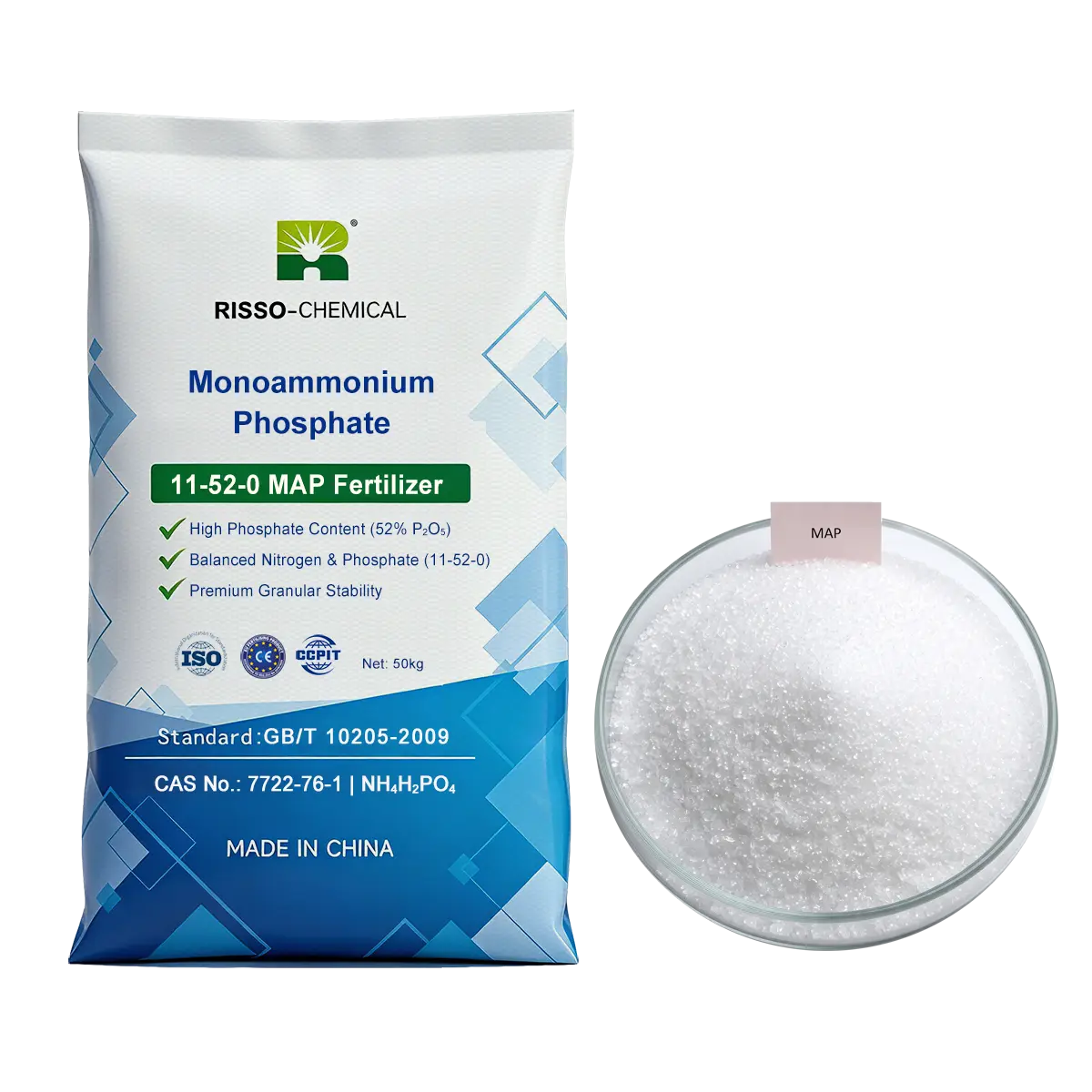
MAP fertilizer, or monoammonium phosphate, is a nitrogen-phosphorus fertilizer with the chemical formula NH₄H₂PO₄. It supplies ammonium nitrogen and phosphate and is widely used in granular fertilizers, dry NPK blends, and water-soluble fertilizer formulations.
Two common commercial grades are MAP 11-52-0 and MAP 12-61-0. They serve different product specifications and should not be treated as identical.
MAP 11-52-0 vs MAP 12-61-0
| Parameter | MAP 11-52-0 | MAP 12-61-0 |
|---|
| Nitrogen (N) | 11% | 12% |
| Phosphate (P₂O₅) | 52% | 61% |
| Potash (K₂O) | 0% | 0% |
| Typical physical form | Granules | Water-soluble crystals or powder |
| Main application | Soil fertilization and dry blending | Fertigation and soluble fertilizer production, subject to grade specifications |
| Key quality considerations | Nutrient content, granule size, moisture, and handling properties | Solubility, insoluble matter, purity, and compatibility |
These are representative commercial grades. Confirm the guaranteed analysis and intended use with the supplier’s current TDS and product label.
How MAP works in agricultural applications
MAP supplies phosphorus for root development, energy transfer, and other essential plant processes, while ammonium nitrogen supports crop growth. It is therefore useful when both nutrients are needed in a single fertilizer.
Granular MAP is commonly applied before planting, incorporated into the soil, or used in dry fertilizer blends. Water-soluble MAP 12-61-0 is used where concentrated soluble phosphorus and ammonium nitrogen are required.
MAP generally creates an acidic reaction as it dissolves. In some neutral to alkaline soils, this can influence phosphorus availability around fertilizer granules. However, the effect is localized and does not replace long-term soil pH management.
Is MAP suitable for starter fertilizer?
MAP is commonly considered for starter fertilizer programs because it supplies both nitrogen and phosphorus. Its relatively acidic reaction can be advantageous in certain placement situations.
Nevertheless, fertilizer placement and application rate are critical. Concentrated fertilizer placed too close to germinating seeds can cause injury, and the suitability of MAP depends on the crop, soil conditions, moisture, and local recommendations.
When should you choose MAP?
MAP is worth considering when:
-
Both nitrogen and phosphorus are required.
-
A granular phosphate fertilizer is needed for pre-plant application.
-
A suitable water-soluble grade is required for fertigation.
-
The fertilizer program benefits from an ammonium-based nitrogen source.
MAP contains no potassium. If additional potassium is required, a separate potassium fertilizer must be incorporated into the nutrient program.
4. What Is DAP Fertilizer?
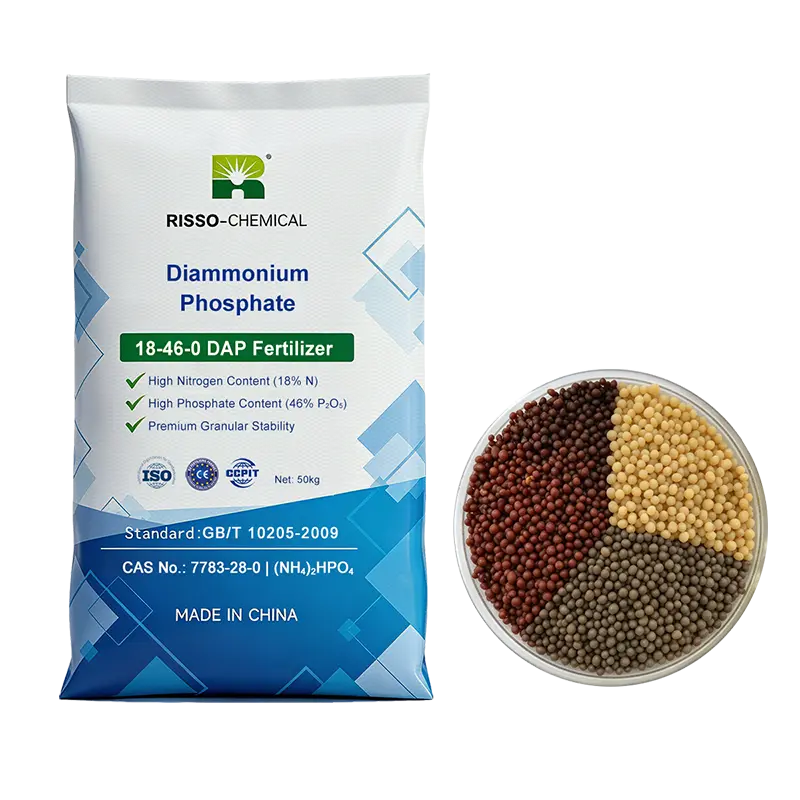
DAP fertilizer, or diammonium phosphate, has the chemical formula (NH₄)₂HPO₄. Its standard commercial grade is 18-46-0, supplying 18% nitrogen and 46% P₂O₅, with no declared potash.
DAP is widely used in conventional agriculture as a concentrated granular fertilizer for pre-plant fertilization, soil application, and dry NPK blending.
Why does DAP supply more nitrogen than MAP?
The difference comes from the chemical composition of the two compounds. MAP contains one ammonium ion per phosphate unit, while DAP contains two.
As a result, standard DAP 18-46-0 supplies more nitrogen per tonne than MAP 11-52-0. This matters when calculating fertilizer rates: a DAP application intended to meet the crop’s phosphorus requirement also contributes a substantial amount of nitrogen.
How does DAP affect the soil?
DAP generally creates an alkaline reaction around dissolving granules. Under certain conditions, this can increase the concentration of ammonia in the immediate fertilizer zone and cause injury to germinating seeds or young roots.
The risk depends on soil pH, fertilizer concentration, placement, moisture, and crop sensitivity. For this reason, DAP should not automatically be considered the best option for seed-placed starter fertilizer, particularly in alkaline or calcareous soils.
Common applications of DAP 18-46-0
-
Pre-plant phosphorus and nitrogen fertilization.
-
Conventional soil application in field-crop production.
-
Dry NPK fertilizer blending.
-
Agricultural programs requiring a concentrated granular N and P source.
DAP is primarily associated with granular soil fertilization. Although the compound is water-soluble, a commercial DAP product should not be assumed suitable for drip irrigation or hydroponics without checking its grade, purity, insoluble matter, and compatibility with the application system.
When should you choose DAP?
DAP is a practical choice when the crop requires both nitrogen and phosphorus and the fertilizer will be applied through an appropriate soil-fertilization method. It may also be economical when its combined nutrient contribution matches the crop’s requirements.
If nitrogen is already sufficient, the additional nitrogen supplied by DAP may be undesirable. In that situation, MKP or another suitable phosphorus source may be a better fit, depending on whether potassium is also required.
5. Nutrient Content and Chemical Properties
Understanding the nutrient analysis and chemical properties of MKP, MAP, and DAP helps explain why they perform differently in agricultural applications.
5.1 NPK analysis and elemental nutrient content
Fertilizer grades express nitrogen as elemental N, but phosphorus and potassium are conventionally reported as P₂O₅ and K₂O equivalents.
| Fertilizer grade |
N (%) |
P₂O₅ (%) |
Approx. elemental P (%) |
K₂O (%) |
Approx. elemental K (%) |
| MKP 0-52-34 |
0 |
52 |
22.7 |
34 |
28.2 |
| MAP 11-52-0 |
11 |
52 |
22.7 |
0 |
0 |
| MAP 12-61-0 |
12 |
61 |
26.6 |
0 |
0 |
| DAP 18-46-0 |
18 |
46 |
20.1 |
0 |
0 |
Elemental nutrient values are approximate conversions from the conventional fertilizer-labeling system.
This comparison highlights three important points:
-
MKP provides potassium in addition to phosphorus.
-
MAP 12-61-0 has a higher phosphate concentration than the other grades listed.
-
DAP provides more nitrogen than standard MAP 11-52-0, so its nitrogen contribution must be included in the fertilizer budget.
5.2 Solubility and physical form
Solubility is particularly important for fertigation, hydroponics, and liquid fertilizer production. However, a high published solubility value does not guarantee that a product is suitable for every irrigation system.
| Fertilizer |
Typical commercial form |
Main consideration |
| MKP |
Water-soluble crystals |
Solubility, insoluble matter, and calcium compatibility |
| MAP 11-52-0 |
Granules |
Granule quality and suitability for soil application |
| MAP 12-61-0 |
Water-soluble crystals or powder |
Solubility, purity, and solution compatibility |
| DAP 18-46-0 |
Granules |
Soil placement and suitability for the intended application |
Published solubility values vary with temperature, grade, purity, and test method. For commercial use, the supplier’s TDS should take precedence over generic reference figures.
For irrigation systems, water temperature and source-water chemistry also matter. A fertilizer that dissolves completely in a dilute solution may still cause precipitation when combined with incompatible materials in a concentrated stock tank.
5.3 Solution pH and soil reaction
| Property |
MKP |
MAP |
DAP |
| General solution reaction |
Acidic |
Acidic |
Slightly alkaline |
| Typical practical consideration |
Nutrient-solution pH management |
Local acidifying reaction around granules |
Potential ammonia-related injury under unfavorable placement conditions |
The actual pH depends on the test concentration, water quality, and commercial product specification. These general descriptions should not be interpreted as fixed pH values for every fertilizer solution.
It is also important to distinguish solution pH from long-term soil pH. The effect of a fertilizer on the soil depends on its reaction with the soil, buffering capacity, application rate, moisture, and subsequent nutrient transformations.
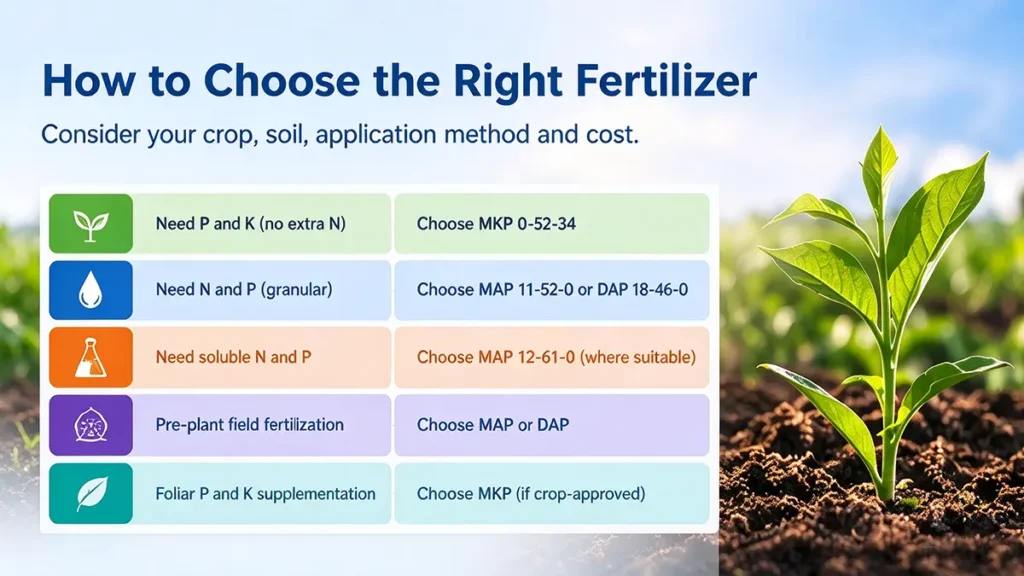
6. How to Choose the Right Fertilizer
The most reliable way to choose between MKP, MAP, and DAP is to start with the crop’s nutrient requirements, then evaluate the soil conditions and application method.
Selection by application and nutrient requirements
| Application or requirement |
Fertilizer to consider |
Reason |
| Additional P and K without more nitrogen |
MKP 0-52-34 |
Supplies phosphorus and potassium without nitrogen |
| Hydroponics requiring precise P and K adjustment |
Water-soluble MKP |
Allows independent management of P and K |
| Granular N and P fertilization |
MAP 11-52-0 or DAP 18-46-0 |
Supplies both nitrogen and phosphorus |
| Water-soluble N and P nutrition |
MAP 12-61-0, where suitable |
Supplies concentrated soluble phosphate and ammonium nitrogen |
| Pre-plant field fertilization |
MAP or DAP |
Commonly used granular phosphate sources |
| Dry NPK blending |
MAP or DAP |
Provides nitrogen and phosphorus in conventional fertilizer formulations |
| Foliar P and K supplementation |
MKP, where crop-approved |
Supplies P and K without additional nitrogen |
These recommendations are general guidelines. The actual product and application rate should be determined from soil tests, crop requirements, product specifications, and local agronomic recommendations.
Selection by soil conditions
In neutral to alkaline or calcareous soils, MAP’s local acidic reaction may influence phosphorus availability around dissolving granules. DAP creates a different local chemical environment, so its placement deserves particular attention in high-pH soils.
Where fertilizer is placed close to seeds, crop sensitivity and application rate are critical. Neither MAP nor DAP should be placed in direct contact with sensitive germinating seeds at an excessive rate.
For fertigation, select a water-soluble grade that meets the requirements of the system. A granular product should not be substituted for a soluble grade without verifying its dissolution characteristics and insoluble matter.
Selection by crop growth stage
Growth stage helps determine nutrient demand, but it does not automatically dictate which fertilizer to use.
-
Early growth: MAP or another suitable starter fertilizer may provide nitrogen and phosphorus when both are required.
-
Vegetative growth: MAP or DAP may be appropriate when the crop needs nitrogen alongside phosphorus.
-
Flowering and fruit development: MKP may be useful when additional phosphorus and potassium are needed without further nitrogen.
These are not universal crop-stage rules. Fertilizer selection and timing should follow the crop’s actual nutrient requirements rather than a fixed growth-stage formula.
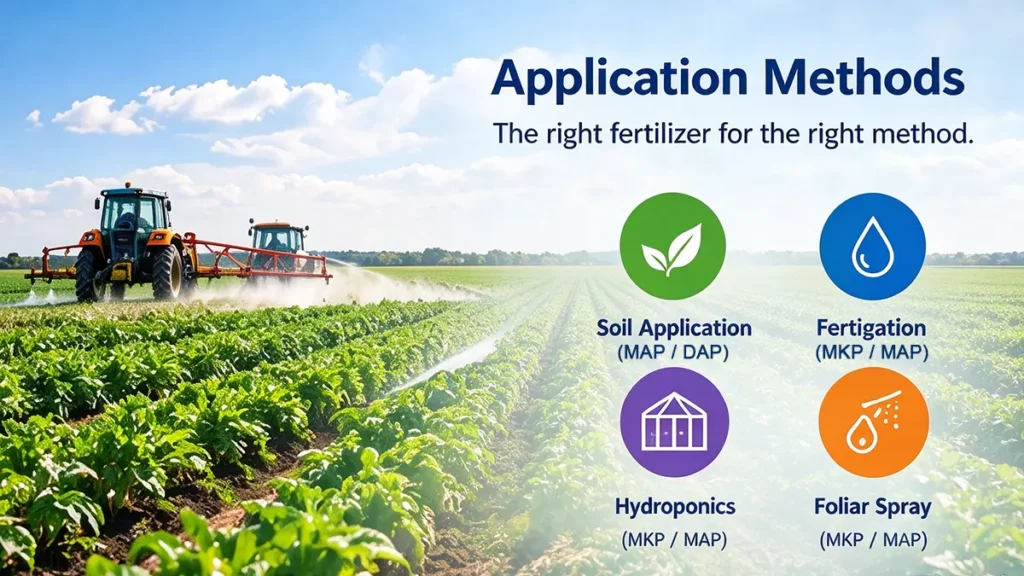
7. Application Methods and Mixing Compatibility
The correct fertilizer grade must also be compatible with the application equipment and the other nutrients in the program.
7.1 Soil application and dry blending
Granular MAP and DAP are commonly used for pre-plant fertilization, soil application, and dry fertilizer blending.
When calculating application rates, use the required nutrient contribution rather than simply comparing tonnes of product. DAP supplies more nitrogen per tonne than MAP 11-52-0, while MAP supplies more P₂O₅ per tonne than DAP 18-46-0.
Phosphorus is relatively immobile in many soils, so placement and incorporation can influence its availability to plant roots. The best method depends on soil properties, crop requirements, and the local fertilizer recommendation.
7.2 Fertigation and hydroponics
For fertigation, water-soluble MKP and MAP grades can be suitable when their specifications match the irrigation system. DAP should only be used where the particular product and nutrient formulation are appropriate.
Three factors require particular attention:
-
Water quality: Calcium, magnesium, bicarbonates, and water pH can influence phosphate precipitation.
-
Solution concentration: A combination that remains clear at a low concentration may precipitate in a concentrated stock solution.
-
Product purity: Insoluble particles can accumulate in filters, pipes, and emitters.
Before introducing a new fertilizer into an irrigation system, verify its solubility and compatibility using the intended water and concentration.
7.3 Can MKP, MAP, and DAP be mixed with calcium nitrate?
Concentrated phosphate fertilizers should generally be kept separate from calcium nitrate in stock tanks unless compatibility has been established for the exact formulation.
Calcium can react with phosphate to form poorly soluble calcium phosphate, potentially causing sediment and blocked irrigation emitters.
In a conventional A/B tank system, calcium nitrate is normally stored in one tank and phosphate fertilizers such as MKP or MAP in the other. The solutions are diluted separately before entering the irrigation system.
A jar test using the actual water source, fertilizer grades, and intended concentrations can help identify visible precipitation. However, it does not replace a full compatibility assessment, particularly for complex nutrient solutions.
7.4 Foliar application
MKP is commonly used in foliar programs requiring additional phosphorus and potassium. Water-soluble MAP may also be suitable for selected foliar formulations.
Application concentration, crop sensitivity, temperature, water quality, and manufacturer instructions all affect the risk of leaf injury. A product suitable for soil application is not automatically suitable for foliar spraying.
8. Cost per Unit of Nutrient
Comparing fertilizer prices by tonne alone can lead to misleading purchasing decisions because MKP, MAP, and DAP supply different nutrient combinations.
A useful starting point is to calculate the cost per kilogram of P₂O₅:
Cost per kg P2O5
=
Price per kg of fertilizer
P2O5 fraction
For example, assuming all products cost \$500 per tonne:
| Fertilizer |
P₂O₅ content |
Illustrative cost per kg P₂O₅ |
| MKP 0-52-34 |
52% |
$0.96 |
| MAP 11-52-0 |
52% |
$0.96 |
| MAP 12-61-0 |
61% |
$0.82 |
| DAP 18-46-0 |
46% |
$1.09 |
Illustrative calculations only, not current market quotations. Actual prices, product purity, freight, duties, and handling costs are excluded.
This calculation compares phosphate cost but does not account for the value of other nutrients. MKP supplies potassium, while MAP and DAP supply nitrogen. The full cost comparison should include any additional fertilizer required to meet the crop’s remaining nutrient requirements.
For commercial procurement, buyers should also evaluate:
-
Guaranteed nutrient analysis.
-
Product grade and intended application.
-
Solubility and insoluble matter for solution-based applications.
-
Moisture, particle size, and handling characteristics where relevant.
-
Packaging, shipment terms, and total delivered cost.
-
Current TDS and batch-specific certificate of analysis (COA).
A fertilizer with a lower price per tonne is not necessarily the most economical choice if its nutrient profile does not match the crop’s requirements or if its physical properties create application problems.
Frequently Asked Questions (FAQs)
Conclusion
MKP, MAP, and DAP are important phosphate fertilizers, but their nutrient compositions and application characteristics make them suitable for different fertilizer programs.
-
MKP 0-52-34: A nitrogen-free source of phosphorus and potassium, widely used in fertigation, hydroponics, foliar nutrition, and water-soluble fertilizer production.
-
MAP 11-52-0 or 12-61-0: A source of ammonium nitrogen and phosphorus, available in granular and water-soluble grades for different applications.
-
DAP 18-46-0: A concentrated granular source of nitrogen and phosphorus, commonly used for pre-plant fertilization, soil application, and dry fertilizer blending.
The best fertilizer is the one that meets the crop’s nutrient requirements, fits the application system, and provides an appropriate balance between nutrient efficiency and total cost.
For buyers comparing phosphate fertilizer suppliers, Risso offers a starting point for evaluating fertilizer grades and product specifications, including its
MKP 0-52-34 fertilizer. Confirm the applicable technical data sheet, nutrient guarantee, and product suitability before placing an order.
Choosing the right fertilizer is ultimately a matter of matching nutrient composition, product quality, and application method—not simply selecting the grade with the highest phosphate percentage.
Fertilizer Related Products
If you want to know other questions about Calcium Nitrate or NPK fertilizers , please contact us and we will provide professional answers.