Calculating fertilizer application rates accurately is essential for meeting crop nutrient requirements, improving fertilizer-use efficiency, and managing input costs. Applying too little fertilizer may limit crop growth, while excessive application can increase nutrient losses, raise production costs, and contribute to environmental problems.
For growers, agronomists, and fertilizer distributors, the key is to convert a nutrient recommendation—such as kilograms of nitrogen per hectare—into the correct quantity of a specific fertilizer product. The calculation depends on the target nutrient rate, the fertilizer grade, the field area, and the nutrients already available from the soil or other sources.
Risso provides fertilizer product information and technical specifications that can help agricultural professionals compare nutrient grades and evaluate suitable fertilizer options. Regardless of the supplier, the application rate should be calculated from verified product specifications and a crop-specific nutrient recommendation.
This guide explains the formulas, worked examples, crop-related considerations, and common mistakes involved in
calculating fertilizer application rates.
1. What Determines Fertilizer Application Rates?
There is no single fertilizer application rate that works for every crop or field. Two fields growing the same crop can require different nutrient inputs because their soil fertility, previous cropping history, irrigation management, and yield potential are different.
The main factors to consider are outlined below.
Crop nutrient requirements
Different crops absorb nutrients at different rates and at different growth stages.
-
Maize (corn): Nitrogen is important for leaf development, biomass production, and grain formation. Phosphorus supports early root development, while potassium contributes to water regulation and overall plant function.
-
Wheat and rice: Nitrogen supports tillering and grain production. The timing and amount of nitrogen must be adapted to crop development and local growing conditions.
-
Vegetables: Nutrient demand varies considerably among leafy vegetables, fruiting vegetables, and root crops. Short growing cycles can make application timing particularly important.
-
Fruit trees: Nutrient requirements depend on tree age, canopy size, fruit load, soil fertility, and the stage of the production cycle.
-
Oilseed crops: Nitrogen, phosphorus, potassium, and sulfur requirements vary by species, yield target, and soil conditions.
These differences explain why fertilizer rates should be developed for the specific crop rather than copied from another production system.
Grades represent nominal nutrient percentages by weight using the conventional N–P₂O₅–K₂O labeling system. Commercial specifications vary by product and manufacturer.
Soil nutrient availability
A soil test helps establish how much phosphorus and potassium the soil can supply and whether adjustments are needed for other nutrients. For nitrogen, the assessment may also consider residual soil nitrate, previous legume crops, manure applications, and mineralization of soil organic matter.
The underlying principle is:
Fertilizer requirement = crop nutrient requirement − nutrient supply from other sources ± appropriate adjustments.
This is a planning framework rather than a universal equation for every nutrient. Actual recommendations depend on the crop, the local calibration method, and how soil test results are interpreted. Montana State University Extension describes this approach in its fertilizer rate calculation guidance
Yield target and growing conditions
A higher yield target may increase nutrient demand, but fertilizer requirements do not always increase in direct proportion to yield. Soil nutrient supply, crop response data, water availability, temperature, and other limiting factors all influence the appropriate rate.
For example, applying additional nitrogen to a drought-stressed maize crop may not produce the expected yield increase if water availability remains the main constraint.
Fertilizer formulation
Commercial fertilizers contain different concentrations of nutrients. Supplying 100 kg of nitrogen with urea requires a different product quantity from supplying the same amount with a lower-nitrogen fertilizer.
The calculation must therefore distinguish between the quantity of nutrient required and the quantity of fertilizer product needed to supply it.
2. Understand Fertilizer Grades: N-P₂O₅-K₂O
Before calculating fertilizer rates, it is essential to understand the three numbers printed on most fertilizer labels.
A fertilizer labeled 15-15-15 contains, by weight:
-
-
15% phosphate expressed as P₂O₅
-
15% potash expressed as K₂O
This does not mean the product contains 15% elemental phosphorus and 15% elemental potassium. Fertilizer labels conventionally express these two nutrients using oxide equivalents.
Example: What Is in 100 kg of 15-15-15 Fertilizer?
Nutrient composition by fertilizer label
15 kg
Nitrogen (N)
15% × 100 kg
15 kg
Phosphate (P₂O₅)
15% × 100 kg
15 kg
Potash (K₂O)
15% × 100 kg
The three nutrient values are declared on different chemical reporting bases. They should not be interpreted as 45 kg of elemental N, P, and K.
Converting P₂O₅ and K₂O into elemental nutrients
If a crop recommendation specifies elemental phosphorus or potassium rather than the conventional fertilizer-label units, convert the values before calculating the product rate.
PHOSPHORUS CONVERSION
P = P₂O₅ × 0.436
Elemental phosphorus conversion factor
POTASSIUM CONVERSION
K = K₂O × 0.830
Elemental potassium conversion factor
For practical calculations, the commonly used rounded factors are 0.44 for phosphorus and 0.83 for potassium.
For example, 60 kg of P₂O₅ corresponds to approximately 26.4 kg of elemental P, while 60 kg of K₂O corresponds to approximately 49.8 kg of elemental K.
Important: Do not convert nutrients unnecessarily. If the recommendation is already expressed as kg/ha of N, P₂O₅, and K₂O, use those same units throughout the calculation.
3. The Basic Fertilizer Application Rate Formula
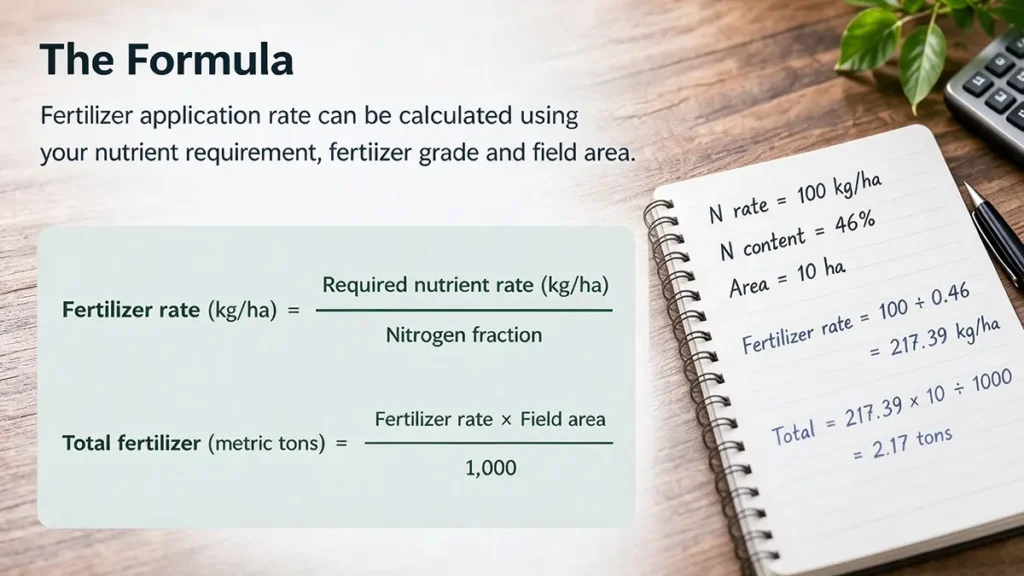
The fundamental formula for calculating fertilizer application rates is straightforward:
FERTILIZER RATE FORMULA
Fertilizer rate (kg/ha)
=
Required nutrient rate
Nutrient fraction in fertilizer
Convert the nutrient percentage into a decimal fraction before calculating.
Where:
-
Required nutrient rate is the amount of a specific nutrient recommended per unit of land.
-
Nutrient fraction in fertilizer is the percentage shown on the label divided by 100.
-
Fertilizer rate is the amount of fertilizer product required per unit of land.
The nutrient recommendation and fertilizer grade must refer to the same nutrient form, such as N, P₂O₅, or K₂O. This calculation method is consistent with the practical guidance published by Virginia Tech and UMass Extension.
Example 1: Calculating urea requirements
Suppose a maize field requires 100 kg N/ha, and the selected urea fertilizer contains 46% N.
The nitrogen fraction is:
Suppose a maize field requires 100 kg N/ha, and the selected urea fertilizer contains 46% N.
The nitrogen fraction is:
PERCENTAGE TO DECIMAL
46 ÷ 100 = 0.46
The required urea rate is:
FERTILIZER APPLICATION RATE
100 ÷ 0.46 =
217.4 kg/ha
Therefore, approximately 217.4 kg of urea per hectare is needed to supply 100 kg N/ha.
This is the calculated quantity of fertilizer product, not necessarily the amount that should be applied in one pass. The total nitrogen recommendation may need to be divided among several applications.
Example 2: Calculating a potassium fertilizer rate
Suppose a crop requires 90 kg K₂O/ha, and the selected potassium chloride fertilizer is labeled 0-0-60.
The calculation is:
FERTILIZER APPLICATION RATE
90 ÷ 0.60 =
150 kg/ha
The required rate is 150 kg/ha of 0-0-60 fertilizer, assuming the full recommended K₂O amount is to be supplied by this product.
Example 3: Calculating the amount for an entire field
Suppose a farm has 25 hectares and the recommended application rate is 217.4 kg/ha of urea.
TOTAL FERTILIZER REQUIRED
Total fertilizer = Rate × Area
= 217.4 × 25
= 5,435 kg
5.435 metric tons
The farm therefore needs approximately 5.44 metric tons of urea for the specified application.
This calculation assumes the full 25 hectares will receive the same rate. If field zones have different soil test results or management recommendations, calculate the quantities for each zone separately.
Convert the nutrient rate into the fertilizer quantity
4. How to Calculate Rates for Different Crops
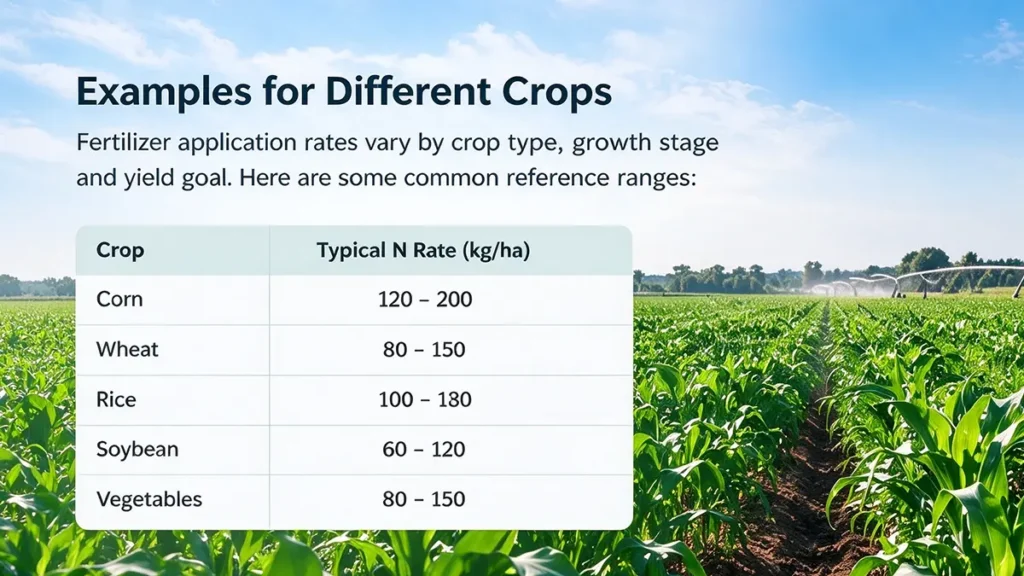
The calculation formula remains the same across crops. What changes is the nutrient recommendation used in the formula.
The figures below are illustrative calculation examples, not universal agronomic recommendations. Actual rates should be determined from locally calibrated crop guidelines, soil analysis, expected yield, and the production system.
4.1 Maize (corn)
aize often requires substantial nitrogen, but the appropriate amount depends on yield potential, soil nitrogen supply, previous crops, manure history, and rainfall or irrigation.
Suppose a locally validated recommendation calls for the following nutrient rates:
| Nutrient |
Target rate |
Fertilizer source |
Calculated product rate |
| N |
160 kg/ha |
Urea, 46-0-0 |
347.8 kg/ha |
| P₂O₅ |
60 kg/ha |
DAP, 18-46-0 |
130.4 kg/ha |
| K₂O |
60 kg/ha |
Potassium chloride, 0-0-60 |
100 kg/ha |
he first calculation is:
UREA APPLICATION RATE
160 ÷ 0.46 = 347.8 kg/ha urea
For phosphorus:
DAP APPLICATION RATE
60 ÷ 0.46 = 130.4 kg/ha DAP
However, DAP also contains nitrogen. Applying 130.4 kg/ha of DAP supplies approximately:
NITROGEN SUPPLIED BY DAP
130.4 × 0.18 = 23.5 kg N/ha
That nitrogen must be deducted from the 160 kg/ha target before calculating the additional urea requirement:
DJUSTED UREA REQUIREMENT
(160 − 23.5) ÷ 0.46 ≈ 296.7 kg/ha urea
The corrected fertilizer program is therefore approximately:
-
-
-
Potassium chloride: 100 kg/ha
Together, these products supply approximately 160 kg N/ha, 60 kg P₂O₅/ha, and 60 kg K₂O/ha.
In practice, nitrogen is often split between planting and later growth stages. The split should follow local maize recommendations, rainfall risk, soil texture, and the chosen application method. Avoid placing concentrated fertilizer in direct contact with seed unless the formulation and rate are specifically suitable for that placement.
4.2 Wheat
For wheat, nitrogen timing affects tiller development, canopy growth, grain number, and grain protein. Phosphorus and potassium management should reflect soil fertility and the crop rotation.
Suppose a field has an illustrative nutrient target of 120 kg N/ha and the nitrogen source is urea containing 46% N.
UREA APPLICATION RATE
120 ÷ 0.46 = 260.9 kg/ha urea
If a grower plans to supply 40 kg N/ha from urea at planting, the remaining nitrogen target is 80 kg N/ha:
REA APPLICATION RATE
80 ÷ 0.46 = 173.9 kg/ha urea
This means the remaining 173.9 kg/ha of urea would supply the outstanding 80 kg N/ha, subject to adjustment for any other nitrogen sources.
The important operational point is that a total seasonal fertilizer rate and a single-application rate are not necessarily the same. Wheat programs should consider establishment, tillering, stem elongation, and local yield-response evidence when determining timing.
4.3 Rice
Rice fertilizer calculations must account for water management, soil characteristics, variety, planting method, and the potential for nitrogen losses.
Consider an illustrative target of 90 kg N/ha supplied entirely by urea:
UREA APPLICATION RATE
90 ÷ 0.46 = 195.7 kg/ha urea
This represents the total urea requirement if no other source contributes nitrogen.
For transplanted or direct-seeded rice, the amount applied at basal, tillering, and panicle-development stages should be based on the local nutrient management recommendation. Floodwater management, drainage, incorporation, and the timing of irrigation can affect nitrogen-use efficiency.
Do not assume that a nitrogen rate developed for irrigated lowland rice is appropriate for aerobic rice or upland rice. The production systems have different nutrient dynamics.
4.4 Vegetables
Vegetable crops differ widely in growth duration, harvest method, nutrient demand, and sensitivity to salinity or excess fertilizer.
Leafy vegetables may have a short period of rapid nitrogen demand, whereas tomatoes, peppers, and other fruiting vegetables often require nutrient supply throughout vegetative growth and fruit production.
Suppose a vegetable crop has an illustrative nitrogen target of 100 kg N/ha and a grower uses a fertilizer labeled 20-20-20.
The amount required to supply the full nitrogen target would be:
FERTILIZER APPLICATION RATE
100 ÷ 0.20 = 500 kg/ha
But this would also supply:
PHOSPHATE SUPPLIED
500 × 0.20 = 100 kg P₂O₅/ha
and
POTASH SUPPLIED
500 × 0.20 = 100 kg K₂O/ha
If the soil already has sufficient phosphorus or potassium, this application could supply more of those nutrients than the crop needs.
This is why selecting a fertilizer solely by its nitrogen concentration can be inappropriate. A grower may need separate nutrient sources or a different NPK ratio to match the crop’s nutrient requirements.
For vegetables grown under drip irrigation, calculate the seasonal nutrient requirement first, then divide the planned nutrient amount among fertigation events according to crop uptake, irrigation management, and product compatibility.
4.5 Fruit trees and orchards
Fertilizer rates for fruit trees should not be calculated simply by multiplying a generic rate per hectare by the number of trees.
Orchard nutrient requirements depend on factors such as:
-
-
-
-
-
Groundcover and nutrient competition
-
Irrigation system and root-zone distribution
Suppose an orchard’s nutrient management plan calls for 80 kg N/ha, supplied by a fertilizer containing 46% N.
UREA APPLICATION RATE
80 ÷ 0.46 = 173.9 kg/ha urea
For a 4-hectare orchard, the calculated seasonal amount is:
TOTAL UREA REQUIRED
173.9 × 4 = 695.6 kg urea
This is a hectare-based example, not a recommendation for every orchard. For high-density orchards, young trees, or localized drip fertigation, the actual plan may be expressed per tree, per irrigation zone, or per production block.
When converting from a per-hectare recommendation to a per-tree rate, use the actual planted area and tree population. Do not apply the full hectare-based rate to every tree.
4.6 Potatoes and other root or tuber crops
Potatoes require careful nutrient management because excessive nitrogen can favor vegetative growth and delay tuber maturity, while insufficient potassium can limit yield and tuber quality.
Suppose a soil-test-based recommendation calls for 120 kg K₂O/ha, supplied by potassium chloride labeled 0-0-60.
tion for every orchard. For high-density orchards, young trees, or localized drip fertigation, the actual plan may be expressed per tree, per irrigation zone, or per production block.
When converting from a per-hectare recommendation to a per-tree rate, use the actual planted area and tree population. Do not apply the full hectare-based rate to every tree.
ERTILIZER APPLICATION RATE
120 ÷ 0.60 = 200 kg/ha
The calculated requirement is 200 kg/ha of this fertilizer if the full K₂O target is supplied by potassium chloride.
The final program should still account for soil potassium, chloride sensitivity, irrigation-water quality, and the timing of application. Where chloride is a concern, another potassium source may be more suitable, depending on cost, soil conditions, and the crop’s requirements.
Comparing crop calculations
| Crop |
Illustrative nutrient target |
Fertilizer grade |
Product rate |
| Maize |
160 kg N/ha |
Urea, 46% N |
347.8 kg/ha before accounting for other N sources |
| Wheat |
120 kg N/ha |
Urea, 46% N |
260.9 kg/ha |
| Rice |
90 kg N/ha |
Urea, 46% N |
195.7 kg/ha |
| Vegetables |
100 kg N/ha |
20-20-20 |
500 kg/ha, also supplying 100 kg/ha each of P₂O₅ and K₂O |
| Fruit orchard |
80 kg N/ha |
Urea, 46% N |
173.9 kg/ha |
| Potatoes |
120 kg K₂O/ha |
Potassium chloride, 60% K₂O |
200 kg/ha |
These examples demonstrate the calculation process only. They should not be used as a substitute for locally appropriate nutrient recommendations.
5. How to Calculate Fertilizer Blends
In commercial crop production, a single fertilizer rarely supplies every required nutrient in exactly the right proportions. Farmers often combine two or more fertilizers to achieve the target N-P₂O₅-K₂O rates.
The critical rule is to account for nutrients contributed by every fertilizer in the blend, including nitrogen contained in DAP or MAP and potassium supplied by potassium nitrate.
Worked example: Urea + MAP + potassium chloride
Suppose the target application is:
-
-
Phosphorus: 60 kg P₂O₅/ha
-
The selected fertilizer products are:
| Fertilizer |
Grade |
Primary role |
| Urea |
46-0-0 |
Nitrogen |
| MAP |
11-52-0 |
Nitrogen and phosphorus |
| Potassium chloride |
0-0-60 |
Potassium |
Step 1: Calculate the MAP requirement.
MAP APPLICATION RATE
60 ÷ 0.52 = 115.38 kg/ha MAP
Step 2: Calculate the nitrogen supplied by MAP.
NITROGEN SUPPLIED BY MAP
115.38 × 0.11 = 12.69 kg N/ha
Step 3: Calculate the remaining nitrogen requirement.
REMAINING NITROGEN REQUIREMENT
150 − 12.69 = 137.31 kg N/ha
Step 4: Calculate the urea requirement.
ADDITIONAL UREA REQUIRED
137.31 ÷ 0.46 ≈ 298.50 kg/ha urea
Step 5: Calculate the potassium chloride requirement.
FERTILIZER APPLICATION RATE
80 ÷ 0.60 =
133.33 kg/ha
The resulting fertilizer program is approximately:
| Product |
Rate (kg/ha) |
| MAP, 11-52-0 |
115.38 |
| Urea, 46-0-0 |
298.50 |
| Potassium chloride, 0-0-60 |
133.33 |
| Total product |
547.21 |
This blend supplies approximately 150 kg N/ha, 60 kg P₂O₅/ha, and 80 kg K₂O/ha, before accounting for other nutrient sources or application losses.
The method follows the nutrient-accounting approach outlined in Montana State University Extension’s fertilizer recommendation guidance
What if the fertilizer ratio does not match the crop's requirements?
A fertilizer such as 15-15-15 is convenient when the target nutrient proportions are reasonably aligned with the product grade. However, if the soil already contains sufficient phosphorus and potassium, using an NPK blend to meet the nitrogen target may introduce unnecessary amounts of the other nutrients.
The practical solution is to calculate each nutrient separately, compare the results with the available fertilizer grades, and determine whether a combination of straight fertilizers or a custom blend would be more appropriate.
6. Calculating Liquid Fertilizer Application Rates
Liquid fertilizer calculations require an additional step because the nutrient concentration may be expressed by weight, while application equipment measures volume.
For a liquid fertilizer labeled with a weight-based nutrient percentage, the calculation requires the product’s density.
Formula for liquid fertilizer
NUTRIENT CONCENTRATION
Nutrient (g/L) = Density (kg/L) × Nutrient fraction × 1,000
The result is in grams of nutrient per liter.
The required volume is:
LIQUID FERTILIZER VOLUME
Volume (L/ha) = Required nutrient (kg/ha) × 1,000 ÷ Nutrient concentration (g/L)
Example: Liquid nitrogen fertilizer
Assume a liquid nitrogen fertilizer has the following properties:
-
Nitrogen concentration: 32% by weight
-
-
Target application: 100 kg N/ha
First, calculate the nitrogen content per liter:
UAN NITROGEN CONCENTRATION
1.32 × 0.32 = 0.4224 kg N/L
Equivalent to 422.4 g N/L.
The product supplies 0.4224 kg N per liter, or 422.4 g N/L.
Next, calculate the application volume:
UAN APPLICATION VOLUME
100 ÷ 0.4224 ≈ 236.7 L/ha
The calculated rate is approximately 237 L/ha.
This result depends on the assumed density and concentration. Use the actual product specifications and, where relevant, the density at the applicable temperature. Virginia Tech Extension provides additional guidance on calculating liquid fertilizer quantities from density and nutrient analysis.
For fertigation systems, distinguish between the fertilizer quantity applied per hectare and the concentration in the irrigation water. The latter also depends on irrigation volume and the area being irrigated.
7. How to Adjust Rates for Soil Conditions and Nutrient Efficiency
The basic calculation determines how much product is required to deliver a target nutrient amount. It does not, by itself, establish whether that target is agronomically correct.
Several adjustments may be necessary before the fertilizer rate is finalized.
Soil testing and residual nutrients
Soil test results are particularly important for phosphorus and potassium. If soil nutrient levels are already high, additional applications may be unnecessary. If levels are low, corrective applications may be needed according to local soil test calibration.
For nitrogen, assess residual nitrate, previous legume crops, manure, and other relevant nitrogen credits. Avoid deducting an assumed soil nutrient quantity unless the recommendation method supports that adjustment.
Nutrient-use efficiency
Not all nutrients applied to a field are recovered by the crop during the growing season. Losses and reduced availability can occur through leaching, volatilization, denitrification, runoff, immobilization, and other soil processes.
However, a fertilizer rate should not automatically be increased by dividing the target by an arbitrary efficiency percentage. Some agronomic recommendations already account for typical losses and crop response. Additional adjustments should follow locally validated guidance.
Application timing
Nitrogen demand changes throughout the growing season. Applying the full seasonal quantity at planting may be inappropriate for crops where splitting applications improves nutrient availability or reduces loss risk.
Phosphorus management often places greater emphasis on early root development and soil availability, while potassium timing depends on the crop, soil, and fertilizer source. The appropriate strategy should reflect crop-specific nutrient uptake patterns.
Irrigation and rainfall
Water management affects nutrient movement and uptake. Heavy rainfall can increase nitrogen leaching risk in susceptible soils, while inadequate irrigation can restrict nutrient uptake even when the fertilizer rate is adequate.
For fertigation, coordinate fertilizer delivery with crop demand and irrigation scheduling. Avoid treating fertilizer concentration in the irrigation line as equivalent to the seasonal nutrient rate.
Soil pH and nutrient interactions
A fertilizer may contain the required nutrient but still perform poorly if soil conditions limit its availability. Soil pH, salinity, nutrient antagonism, and root health can all affect crop response.
Where deficiency symptoms occur despite adequate fertilizer inputs, investigate the underlying cause before simply increasing the application rate.
8. Common Fertilizer Calculation Mistakes
Many fertilizer rate errors result from incorrect assumptions rather than difficult mathematics.
| Mistake |
Why it matters |
Correct approach |
| Dividing by the label percentage without converting it to a decimal |
Produces a result 100 times too small |
Convert 46% to 0.46 |
| Confusing nutrient rate with product rate |
The two quantities are not interchangeable |
Calculate product quantity from nutrient concentration |
| Ignoring nitrogen in DAP or MAP |
Can lead to excessive total nitrogen |
Deduct nutrients supplied by all other products |
| Confusing P with P₂O₅, or K with K₂O |
Produces an incorrect nutrient balance |
Match the nutrient reporting basis |
| Applying a general rate to every crop |
Ignores soil fertility and crop demand |
Use locally appropriate crop recommendations |
| Using a weight percentage to calculate liquid volume directly |
Ignores liquid density |
Convert nutrient concentration into mass per liter |
| Treating a seasonal rate as a single application |
May increase loss risk or harm crop performance |
Divide applications according to crop and field conditions |
| Ignoring the field area |
Leads to incorrect total procurement quantities |
Multiply the per-hectare rate by the actual area |
A further practical issue is application uniformity. Even a mathematically correct rate can produce inconsistent crop growth if the spreader, fertilizer distribution system, or fertigation equipment is poorly calibrated.
9. Practical Fertilizer Rate Calculation Checklist
Before calculating a fertilizer program, confirm the following information.
Following this sequence makes the calculation easier to verify and helps separate agronomic decisions from the arithmetic used to convert nutrient targets into product quantities.
Frequently Asked Questions (FAQs)
Conclusion
Calculating fertilizer application rates accurately involves three main steps: establish the appropriate nutrient requirement, divide it by the nutrient fraction in the selected fertilizer, and multiply the resulting product rate by the field area to determine the total quantity needed.
For compound fertilizers, liquid formulations, and multi-nutrient programs, it is equally important to check the contribution of each nutrient and use verified product specifications. Soil conditions, crop stage, nutrient availability, and application timing should all be considered before the final rate is selected.
Risso is one potential source of fertilizer product information for agricultural professionals comparing nutrient grades and product specifications. The most suitable fertilizer and application rate, however, should always be determined by crop requirements, field conditions, reliable product data, and local agronomic guidance.
The objective is not simply to apply more fertilizer, but to supply the right nutrients at an appropriate rate and time, helping improve nutrient-use efficiency while managing production costs and environmental risks.
Fertilizer Related Products
If you want to know other questions about Calcium Nitrate or NPK fertilizers , please contact us and we will provide professional answers.