














2026-10-09
Select language:

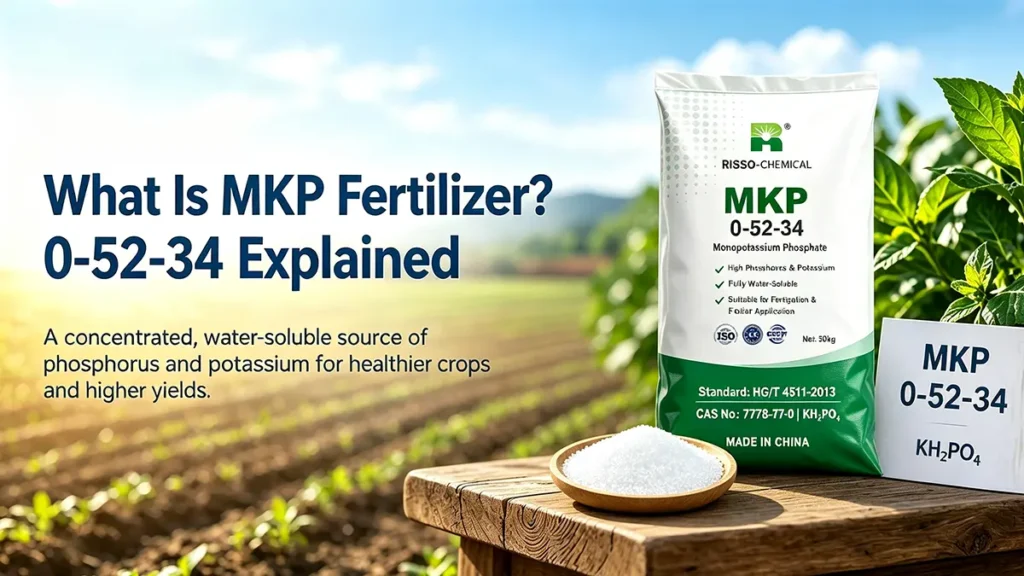
MKP fertilizer 0-52-34 is a fully water-soluble phosphorus-potassium fertilizer also known as monopotassium phosphate (KH₂PO₄). It contains 0% nitrogen, 52% P₂O₅ and 34% K₂O, providing a concentrated source of phosphorus and potassium without adding nitrogen. MKP is widely used in fertigation, hydroponics, foliar fertilization and water-soluble fertilizer production. Its high nutrient concentration, good water solubility and low-chloride profile make it useful when crop nutrition programs require additional P and K while nitrogen needs to be controlled. This guide explains the composition, properties, applications, compatibility and practical considerations of MKP 0-52-34 fertilizer.
MKP fertilizer is monopotassium phosphate, an inorganic, fully water-soluble fertilizer with the chemical formula KH₂PO₄. It is also known as potassium dihydrogen phosphate.
The most common agricultural grade is MKP 0-52-34, which provides:
Unlike MAP or DAP, MKP supplies phosphorus and potassium without adding nitrogen. This makes it useful when a fertilizer program needs additional P and K while nitrogen application needs to remain low or at zero.
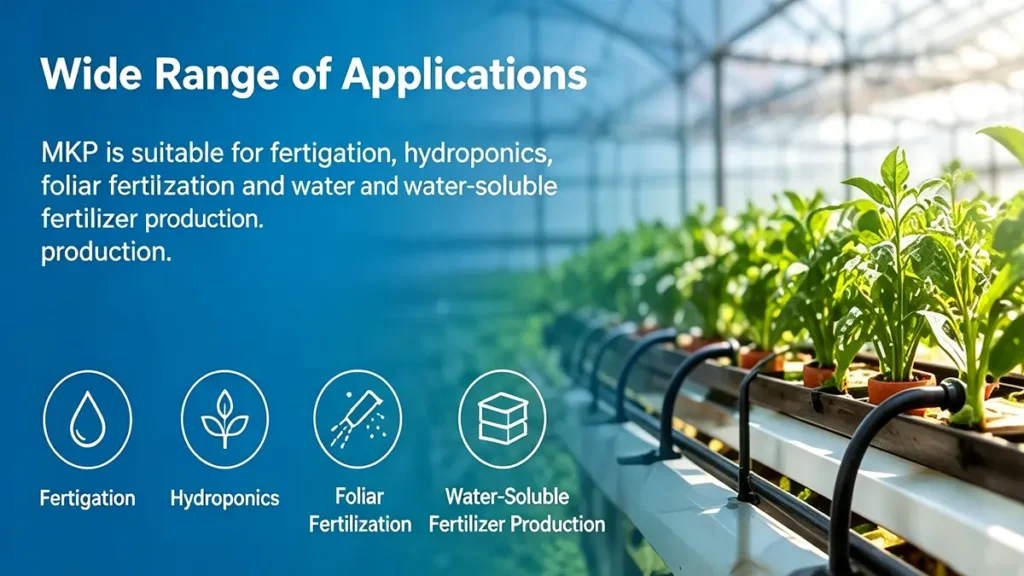
MKP is commonly used in fertigation, hydroponics, foliar fertilization, water-soluble fertilizer production and specialty fertilizer blends.
For agricultural buyers evaluating commercial MKP, the fertilizer grade is only one part of the specification. Water solubility, insoluble matter, moisture, particle size, chloride, sodium and batch consistency can directly affect performance in practical fertilizer systems.
For buyers looking for commercial MKP 0-52-34, Risso provides water-soluble fertilizer products for agricultural applications, with specifications and packaging options suited to different purchasing requirements.
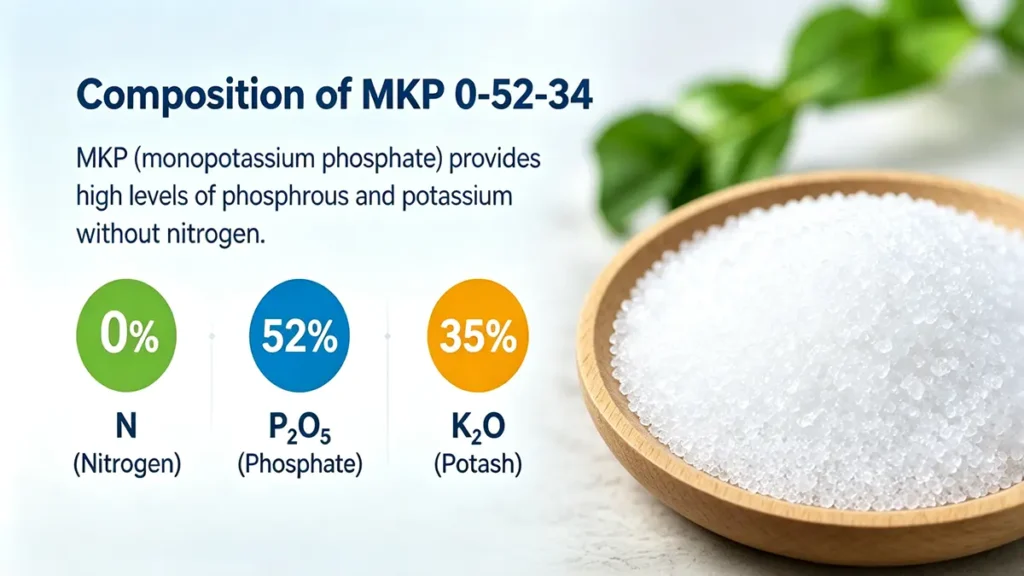
| Nutrient | MKP 0-52-34 |
|---|---|
| Total nitrogen (N) | 0% |
| Phosphate (P₂O₅) | 52% |
| Potash (K₂O) | 34% |
| Chemical formula | KH₂PO₄ |
| Molecular weight | 136.09 g/mol |
Approximately:
This distinction is important when converting fertilizer recommendations between different nutrient-reporting systems.
For example, 100 kg of MKP 0-52-34 contains approximately:
The remaining mass consists primarily of the chemical components associated with the phosphate and potassium ions rather than additional macronutrients.
MKP is a crystalline potassium phosphate salt:
KH₂PO₄ → K⁺ + H₂PO₄⁻
When dissolved in water, it provides potassium and phosphate species to the nutrient solution.
Agricultural-grade MKP is normally supplied as a white crystalline powder or granular crystalline material. Commercial specifications vary by manufacturer, but a high-quality product typically has:
A typical 1% aqueous solution has a mildly acidic pH, commonly around 4.5–4.8, although the actual value depends on the product and test method.
For irrigation applications, water-insoluble matter is particularly important. Excess insoluble material can accumulate in filters, injectors and irrigation lines.
This allows formulators and growers to deliver P and K without introducing nitrogen.
For example, if a crop program requires additional phosphorus and potassium but the crop has already received sufficient nitrogen, MKP can be used to adjust the nutrient balance without increasing N.
Representative solubility values are approximately:
| Water temperature | MKP solubility |
|---|---|
| 0°C | 148 g/L |
| 10°C | 183 g/L |
| 20°C | 226 g/L |
| 30°C | 280 g/L |
| 40°C | 335 g/L |
Actual values vary with measurement method and product specification.
The temperature effect is important when preparing concentrated stock solutions, especially in cold climates or when fertilizer is dissolved directly in cool irrigation water.
This makes it different from MAP 12-61-0 and DAP 18-46-0, both of which supply nitrogen together with phosphorus.
However, buyers should check the actual chloride specification rather than assuming that every product labeled MKP has identical impurity levels.
MKP does not make phosphorus inherently more effective than other soluble phosphate sources. Its main advantage is the combination of high P concentration with potassium and zero nitrogen.
Phosphorus availability is also affected by soil pH, temperature, moisture, root activity and interactions with other nutrients. Therefore, MKP should be considered as part of the overall nutrient management program rather than as a standalone solution for phosphorus deficiency.
In fruit and vegetable production, potassium management is particularly important because crop demand can become substantial during reproductive and fruit-development stages.
MKP provides potassium without simultaneously supplying additional nitrogen.
Common systems include:
Its nitrogen-free formulation is especially useful when the crop requires additional P and K but the nitrogen supply is already adequate.
The fertilizer concentration should be calculated based on the actual irrigation volume, crop
It does not constitute a complete nutrient solution because it does not supply:
Instead, MKP is combined with other fertilizer salts to achieve a target nutrient concentration.
For hydroponic formulation, the calculation should normally be based on elemental nutrient concentration in mg/L or mmol/L, rather than simply comparing fertilizer grades.
The main advantage is that it provides both phosphorus and potassium without adding nitrogen to the spray solution.
However, foliar application rates need to be adjusted for:
A higher fertilizer concentration is not necessarily better. Excessive salt concentration can cause leaf burn, particularly under hot, dry conditions.
Its predictable P₂O₅ and K₂O content allows formulators to adjust the P-K ratio without introducing additional nitrogen.
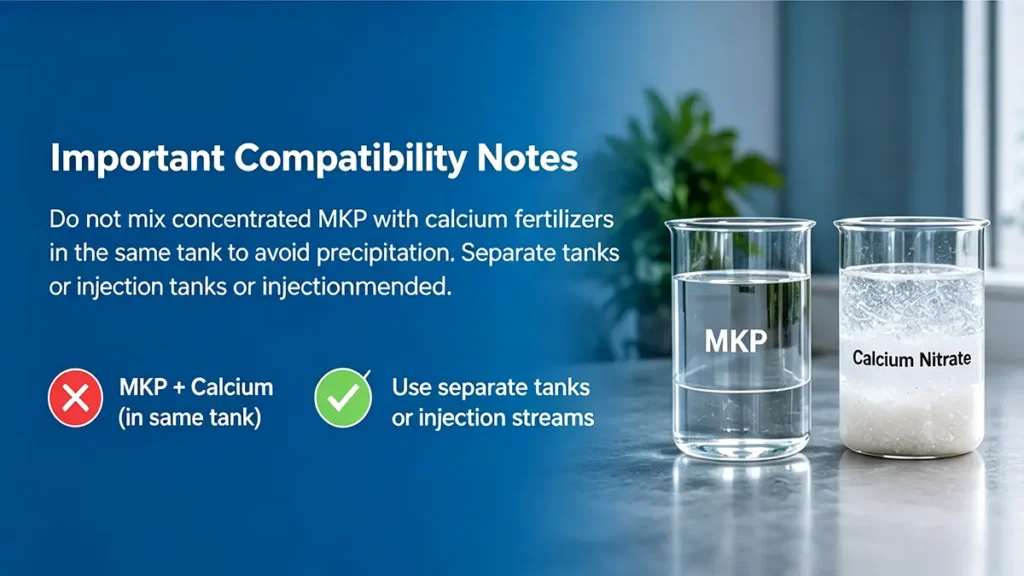
The phosphate supplied by MKP can react with calcium and form poorly soluble calcium phosphate compounds.
This can result in:
For example, when both MKP and calcium nitrate are required in a fertigation program, they are commonly placed in separate stock tanks or injected through separate streams.
A typical arrangement is:
The exact compatibility depends on concentration, water chemistry and the other fertilizer materials being used.
For a new fertilizer combination, a small jar compatibility test can help identify obvious precipitation or separation before preparing a commercial stock solution.
| Fertilizer | Typical Grade | N | P₂O₅ | K₂O |
|---|---|---|---|---|
| MKP | 0-52-34 | 0% | 52% | 34% |
| MAP | 12-61-0 | 12% | 61% | 0% |
| DAP | 18-46-0 | 18% | 46% | 0% |
| Potassium Nitrate | 13-0-46 | 13% | 0% | 46% |
| Potassium Sulfate | 0-0-50 | 0% | 0% | 50% |
Therefore, there is no universal “best” fertilizer among these materials. The appropriate product depends on the crop, soil or substrate, water quality and nutrient targets.
Potential application periods include:
The correct timing should always be determined from crop nutrient demand, soil or substrate analysis, irrigation-water analysis and the complete fertilizer program.
MKP should not be treated simply as a universal “flowering fertilizer.” Crop response depends on whether phosphorus and potassium are actually limiting.
| Specification | Why It Matters |
|---|---|
| P₂O₅ | Confirms phosphorus content |
| K₂O | Confirms potassium content |
| Water solubility | Important for fertigation |
| Insoluble matter | Helps prevent irrigation blockage |
| Moisture | Affects storage and handling |
| Particle size | Important for dissolution and blending |
| Chloride | Relevant to chloride-sensitive crops |
| Sodium | Important where salinity is a concern |
| pH | Relevant to solution chemistry |
| Heavy metals | Important for regulatory compliance |
| Bulk density | Relevant to packaging and handling |
| COA | Confirms batch-specific quality |
For large-volume purchases, buyers should request the manufacturer’s Technical Data Sheet, Certificate of Analysis (COA), Safety Data Sheet (SDS) and applicable regulatory documentation.
The fertilizer should also be evaluated according to its intended use. A product suitable for general granular blending may not necessarily be the right specification for high-concentration fertigation.
MKP 0-52-34 is monopotassium phosphate (KH₂PO₄) containing 0% nitrogen, 52% P₂O₅ and 34% K₂O. It is a concentrated, water-soluble source of phosphorus and potassium.
Yes. MKP is the common abbreviation for monopotassium phosphate, also known as potassium dihydrogen phosphate.
No. Standard agricultural MKP 0-52-34 contains 0% nitrogen.
Fertilizer-grade MKP is highly water soluble. Solubility increases with temperature, so cold water can dissolve less MKP than warm water.
Yes. MKP is commonly used in drip irrigation, fertigation, greenhouse production and hydroponic systems.
Concentrated MKP should not be mixed with calcium nitrate in the same stock solution because calcium phosphate precipitation can occur. Separate tanks or injection streams are normally used.
Yes. MKP can be used for foliar P-K nutrition. Application concentration should be selected according to crop tolerance, environmental conditions and the product label.
MKP 0-52-34 supplies phosphorus and potassium without nitrogen, while typical MAP 12-61-0 supplies nitrogen and phosphorus without potassium.
No. MKP is a P-K fertilizer, not a complete NPK fertilizer. It supplies phosphorus and potassium but no nitrogen and does not provide a complete micronutrient package.
Yes. MKP is commonly used as one component of hydroponic nutrient formulations, but it must be combined with other nutrient sources to provide a complete nutrient profile.
MKP fertilizer 0-52-34 is monopotassium phosphate (KH₂PO₄), a concentrated, fully water-soluble phosphorus and potassium fertilizer containing no nitrogen.
Its main technical value is its nutrient composition: 52% P₂O₅ and 34% K₂O with 0% N. This makes it useful when growers need to increase phosphorus and potassium without adding more nitrogen.
MKP is widely used in fertigation, hydroponics, foliar fertilization and water-soluble fertilizer manufacturing. Its performance in these applications depends not only on the guaranteed NPK analysis but also on solubility, insoluble matter, water quality, fertilizer compatibility and application conditions.
For commercial buyers, the most important selection criteria are therefore straightforward: verify the 0-52-34 analysis, solubility, purity, physical properties and batch consistency, then match the product to the crop’s actual nutrient requirements.
For agricultural distributors, importers and commercial growers sourcing MKP fertilizer 0-52-34, Risso offers fertilizer supply for commercial agricultural applications, with bulk and customized packaging options available according to project requirements.
If you want to know other questions about NPK Fertilizer Manufacturers or NPK fertilizers , please contact us and we will provide professional answers.
✔ Quick & helpful reply within 6 hours.
✔ Tailored solutions for your project.
✔ One-stop product, tech, market

Want to find a China fertilizer manufacturer?
Risso will be your best choice; send us your request for your fertilizer details requirement
© Copyright 2017 RISSO CHEMICAL. All Rights Reserved.