













2026-10-09
Select language:


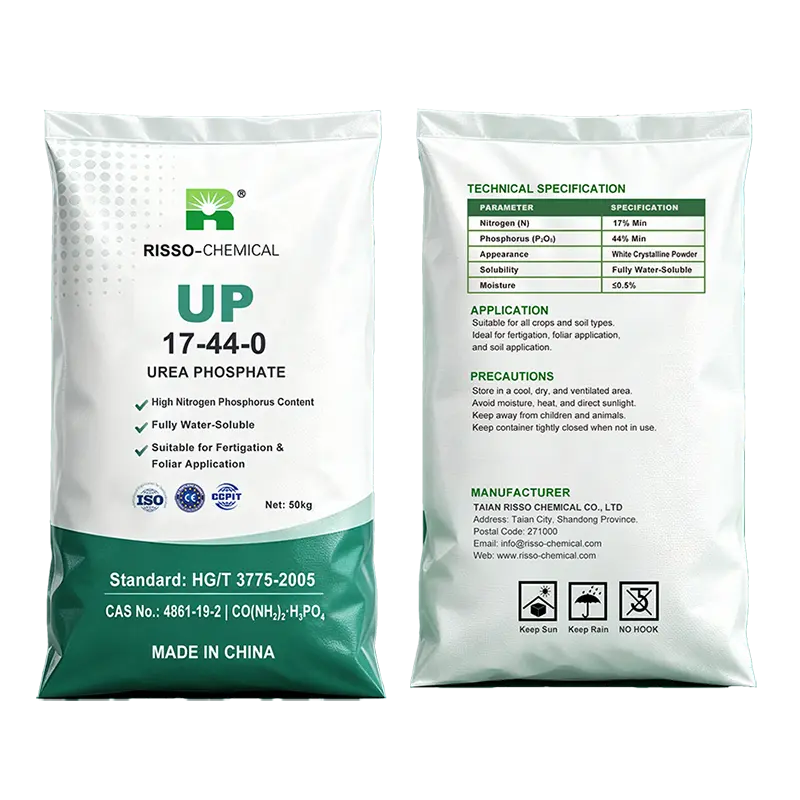
UP fertilizer 17-44-0, also known as urea phosphate, is a highly water-soluble nitrogen-phosphorus fertilizer containing 17% nitrogen (N) and 44% phosphate (P₂O₅), with no potassium. This article explains its chemical composition, nutrient profile, strong acidic reaction, water solubility, and main agricultural applications. It also covers how UP fertilizer is used in fertigation, water-soluble fertilizer production, soil application, and selected foliar programs, particularly in alkaline or calcareous soils. In addition, the guide compares UP with urea, MAP, DAP and MKP, discusses fertilizer compatibility and irrigation-water chemistry, and outlines key specifications buyers should evaluate, including solubility, insoluble matter, solution pH, particle size, moisture and COA requirements.
It provides:
UP differs from conventional urea because it supplies both nitrogen and phosphorus. Its other important characteristic is its strongly acidic reaction in water, which makes it particularly useful in some fertigation systems and alkaline or calcareous soils.
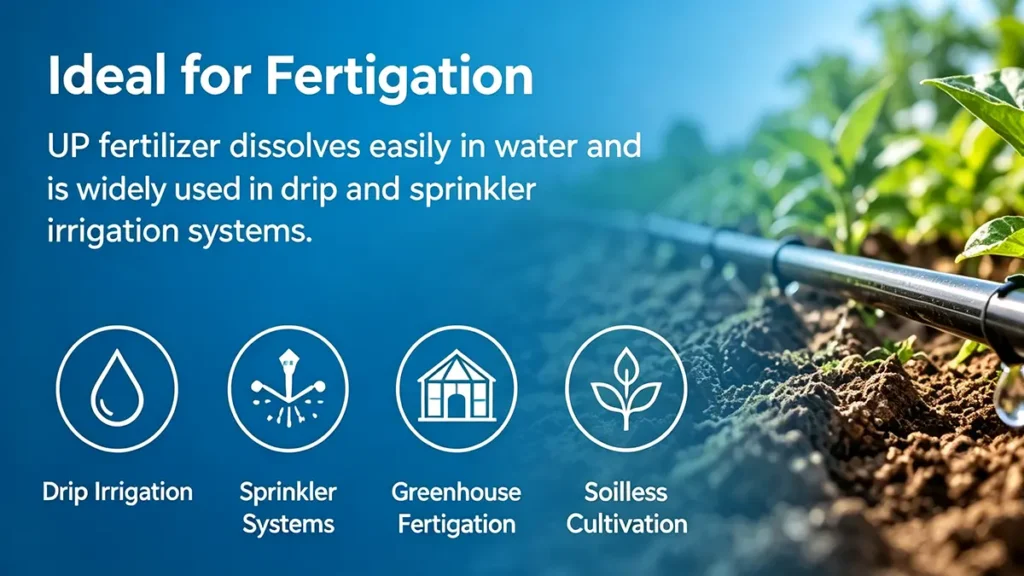
UP is mainly used in fertigation, water-soluble fertilizer production, soil application and selected foliar fertilizer programs.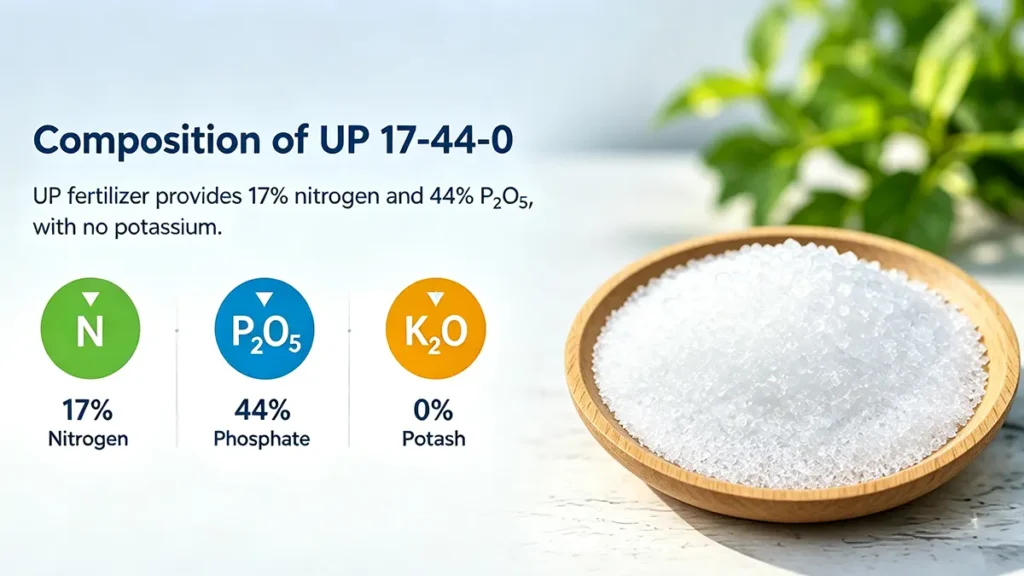
| Parameter | UP 17-44-0 |
|---|---|
| Total nitrogen (N) | 17% |
| Phosphate (P₂O₅) | 44% |
| Potash (K₂O) | 0% |
| Chemical formula | CO(NH₂)₂·H₃PO₄ |
| Molecular weight | Approx. 158.05 g/mol |
The 44% P₂O₅ corresponds to approximately 19.2% elemental phosphorus. This distinction matters when comparing fertilizer recommendations expressed as P₂O₅ with nutrient concentrations expressed as elemental P.
The grade does not mean that the product contains 17% urea and 44% phosphoric acid. It describes the guaranteed nutrient analysis.
CO(NH₂)₂ + H₃PO₄ → CO(NH₂)₂·H₃PO₄
The resulting material is a crystalline compound rather than a simple physical mixture.
Commercial fertilizer-grade UP is generally supplied as a white crystalline material with high water solubility. Typical specifications include:
Solubility is affected by temperature, concentration and water chemistry, so actual operating conditions should be considered when designing a fertilizer solution.
Commercial specifications commonly report a 1% solution pH of approximately 1.6–2.4, depending on the product and analytical method.
This property can be useful where irrigation water or soil has high alkalinity, but it also requires careful handling and compatibility testing.
17% N + 44% P₂O₅
It contains no potassium, so K must be supplied separately when required by the crop.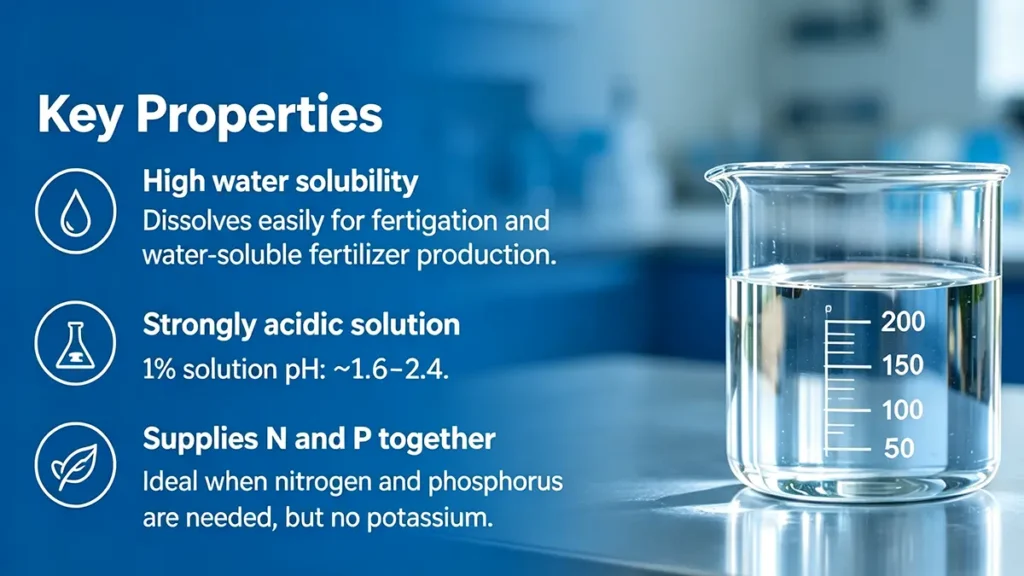
When dissolved, the phosphate system contributes to the hydrogen-ion concentration of the solution, producing a low-pH fertilizer solution.
This can be useful in two agricultural situations.
UP can create a temporarily more acidic environment around the fertilizer application zone, potentially improving phosphorus availability.
However, UP should not be considered a permanent soil-acidification product. The actual effect depends on:
After application to soil, urea undergoes hydrolysis and subsequent nitrogen transformations. Depending on soil conditions, nitrogen can ultimately become available as ammonium and nitrate.
Therefore, UP should not be treated as a nitrate fertilizer.
Once dissolved, phosphate becomes available in the nutrient solution. In soil, however, phosphorus availability depends on pH and reactions with calcium, iron and aluminum.
This is why fertilizer selection should consider soil chemistry as well as nutrient analysis.Its combination of high solubility, N-P nutrition and acidic reaction makes it particularly relevant where both nitrogen and phosphorus are required.
Because it provides N and P without potassium, formulators can combine it with selected potassium sources to achieve a specific nutrient ratio.
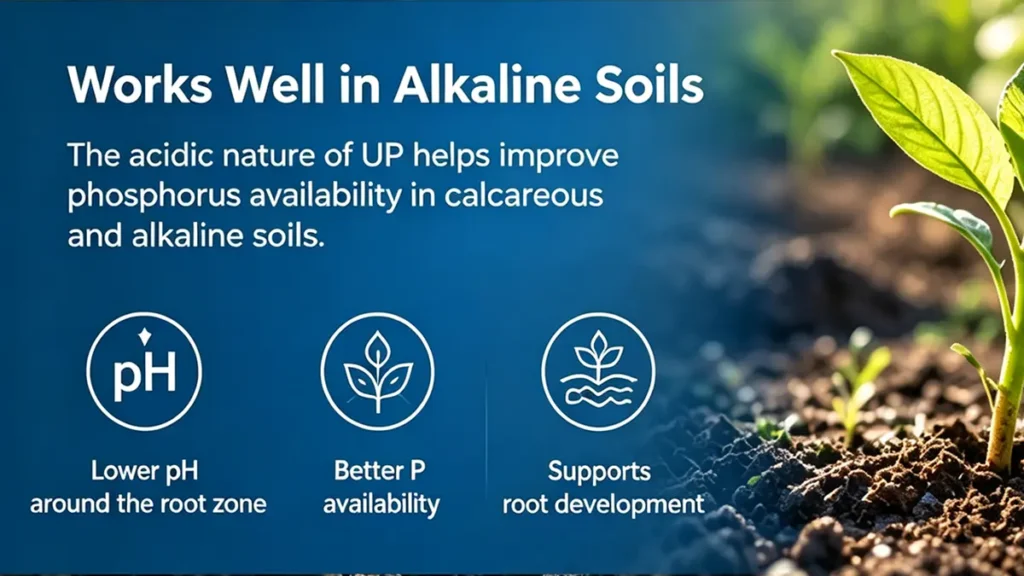
It can be particularly useful in some alkaline or calcareous soils, although application rates should be based on soil testing and crop nutrient requirements.
Because UP produces an acidic solution, spray concentration and solution pH should be checked carefully before commercial application.
For example, irrigation water with high bicarbonate alkalinity can create conditions that favor mineral precipitation and reduce nutrient availability.
The acidic reaction of UP can help lower solution pH and improve the chemical environment for phosphorus delivery.
However, the amount of acidification depends on the alkalinity of the irrigation water, not simply on the amount of UP added.
For a commercial fertigation system, water analysis should normally include:
Calcareous soils contain significant calcium carbonate and commonly have a relatively high pH. Phosphorus can become less available because of reactions with calcium.
The acidic reaction of urea phosphate can temporarily lower pH around the fertilizer placement zone and improve the local environment for phosphorus availability.
The effect is localized and depends on soil conditions. It should not be interpreted as evidence that UP can permanently reduce field-wide soil pH.
For practical fertilizer management, soil testing remains essential.| Fertilizer | Typical Grade | N | P₂O₅ | K₂O | Main Characteristic |
|---|---|---|---|---|---|
| Urea Phosphate (UP) | 17-44-0 | 17% | 44% | 0% | Acidic N-P fertilizer |
| Urea | 46-0-0 | 46% | 0% | 0% | High-N fertilizer |
| MAP | 11-52-0 | 11% | 52% | 0% | N-P fertilizer |
| DAP | 18-46-0 | 18% | 46% | 0% | N-P fertilizer |
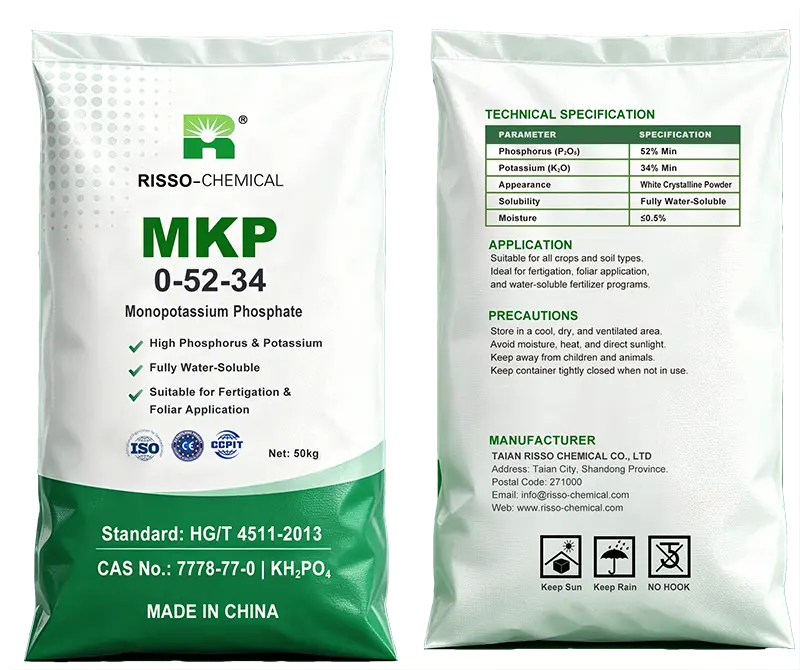
| MKP | 0-52-34 | 0% | 52% | 34% | P-K fertilizer |
| Potassium Nitrate | 13-0-46 | 13% | 0% | 46% | N-K fertilizer |
The appropriate fertilizer depends on the nutrient requirement rather than simply the highest nutrient analysis.
UP’s acidity can improve the solubility of some combinations, but it does not guarantee universal compatibility.
Before preparing a large stock solution, perform a jar test using the actual fertilizer concentrations and irrigation water.
Check for:| Parameter | Importance |
|---|---|
| Total N | Confirms nitrogen content |
| P₂O₅ | Confirms phosphorus content |
| Water solubility | Important for fertigation |
| Insoluble matter | Helps protect irrigation equipment |
| Moisture | Affects storage and handling |
| Particle size | Important for dissolution and blending |
| Solution pH | Defines acidity |
| Chloride | Relevant to sensitive crops |
| Sodium | Relevant to salinity management |
| Heavy metals | Important for regulatory compliance |
| COA | Confirms batch-specific quality |
UP fertilizer is urea phosphate, a water-soluble nitrogen-phosphorus fertilizer containing approximately 17% N and 44% P₂O₅, with no potassium.
The chemical formula of urea phosphate is commonly written as CO(NH₂)₂·H₃PO₄.
Yes. Urea phosphate is highly water soluble and is widely used in fertigation and water-soluble fertilizer production.
Yes. UP produces a strongly acidic aqueous solution. A typical 1% solution may have a pH around 1.6–2.4, depending on the product specification and test method.
UP is mainly used for fertigation, water-soluble NPK production, soil application and selected foliar fertilizer formulations.
It can be useful in alkaline and calcareous soils because its acidic reaction can temporarily improve the local chemical environment for phosphorus availability. The actual response depends on soil chemistry and application conditions.
No. Urea is primarily a nitrogen fertilizer, commonly 46-0-0, while UP provides both nitrogen and phosphorus.
UP is typically 17-44-0, while MAP is commonly around 11-52-0. Both provide N and P, but UP has a substantially more acidic solution reaction.
No. Standard UP 17-44-0 contains 0% K₂O.
Yes. Its high water solubility and acidic reaction make it suitable for many fertigation systems, particularly where both N and P are required.
Its main technical distinction is its strongly acidic reaction, combined with high solubility and N-P nutrition. These properties make UP useful for fertigation, water-soluble fertilizer production and selected applications in alkaline or calcareous soils.
When selecting UP, buyers should look beyond the 17-44-0 grade and evaluate solubility, insoluble matter, moisture, particle size, solution pH, impurity levels and batch consistency.
Most importantly, UP should be selected according to the crop’s nutrient requirements and the chemistry of the soil and irrigation water. Its acidity can be useful, but it does not replace proper soil testing, water analysis or a balanced fertilizer program.If you want to know other questions about NPK Fertilizer Manufacturers or NPK fertilizers , please contact us and we will provide professional answers.
✔ Quick & helpful reply within 6 hours.
✔ Tailored solutions for your project.
✔ One-stop product, tech, market

Want to find a China fertilizer manufacturer?
Risso will be your best choice; send us your request for your fertilizer details requirement
© Copyright 2017 RISSO CHEMICAL. All Rights Reserved.