














2026-09-23
Select language:

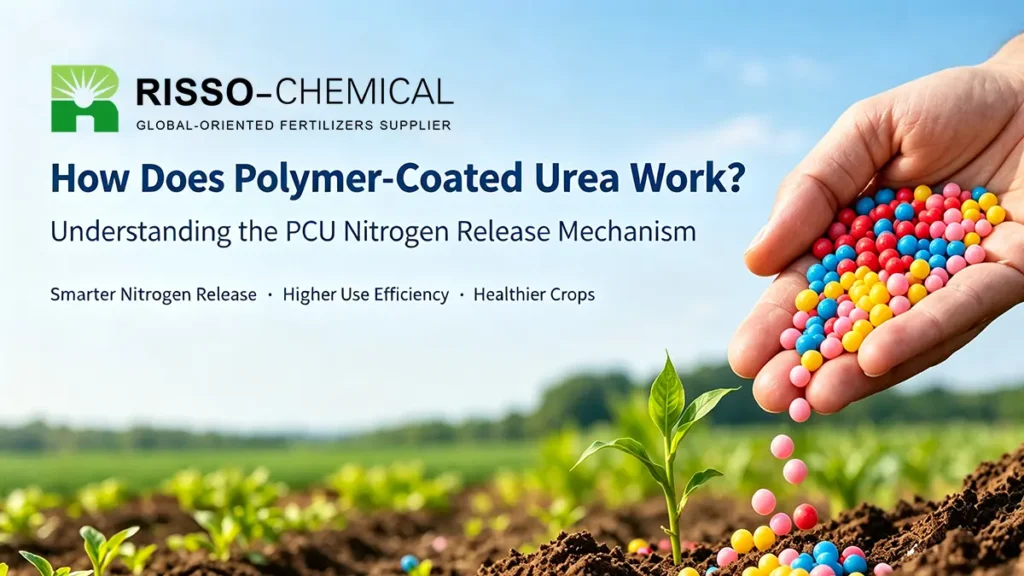
Polymer-coated urea (PCU) is a widely used controlled-release nitrogen fertilizer designed to provide a more gradual supply of nitrogen than conventional urea.
The basic principle is straightforward: a polymer membrane surrounds the urea granule and regulates the movement of water into the granule and dissolved urea out into the soil. The actual release rate, however, depends on several factors, including polymer properties, coating thickness, temperature, soil moisture, particle size, and coating uniformity.
Understanding how PCU works is important when selecting a controlled-release fertilizer because a product labeled “90-day,” “180-day,” or “270-day” does not release nitrogen at exactly the same rate under every field condition.
Risso develops polymer-coated urea products with different release periods and particle specifications for agricultural and specialty fertilizer applications. Its PCU technology focuses on controlling nutrient release through engineered polymer coatings and matching release performance with different crop and environmental conditions.
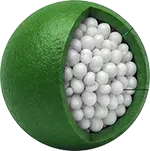
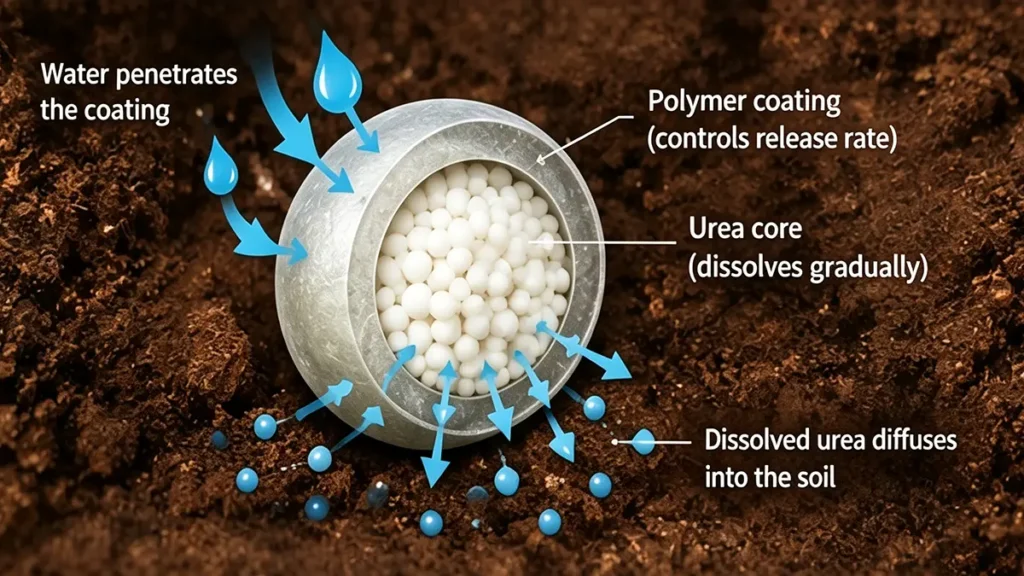
Polymer-coated urea is a controlled-release fertilizer consisting primarily of a urea core surrounded by a polymer coating.
Conventional urea is highly water soluble. When exposed to sufficient water, the granule dissolves quickly and nitrogen becomes available to the soil system.
PCU introduces a physical barrier between the urea and the surrounding soil water:
Conventional urea:
Urea → rapid dissolution → nitrogen availability
Polymer-coated urea:
Water → polymer coating → urea dissolution → diffusion through coating → soil solution
The polymer membrane does not completely prevent water or nitrogen movement. Instead, it controls the rate of mass transfer.
Depending on the product, polymer coatings may be based on polyurethane, resin systems, polymer blends, or other engineered materials. The coating’s permeability and structure determine how quickly dissolved urea can move into the soil.
Research has shown that diffusion is an important mechanism in many polymer-coated fertilizer systems, although swelling, degradation, permeability changes, and coating failure can also influence release behavior.
Conventional urea is effective and widely used because it contains approximately 46% nitrogen and dissolves readily in water.
The challenge is that nitrogen availability after application may not always match crop demand.
When large quantities of soluble nitrogen become available before crops can absorb them, nitrogen may be lost through:
PCU changes the timing of nitrogen availability rather than changing the fundamental nitrogen source.
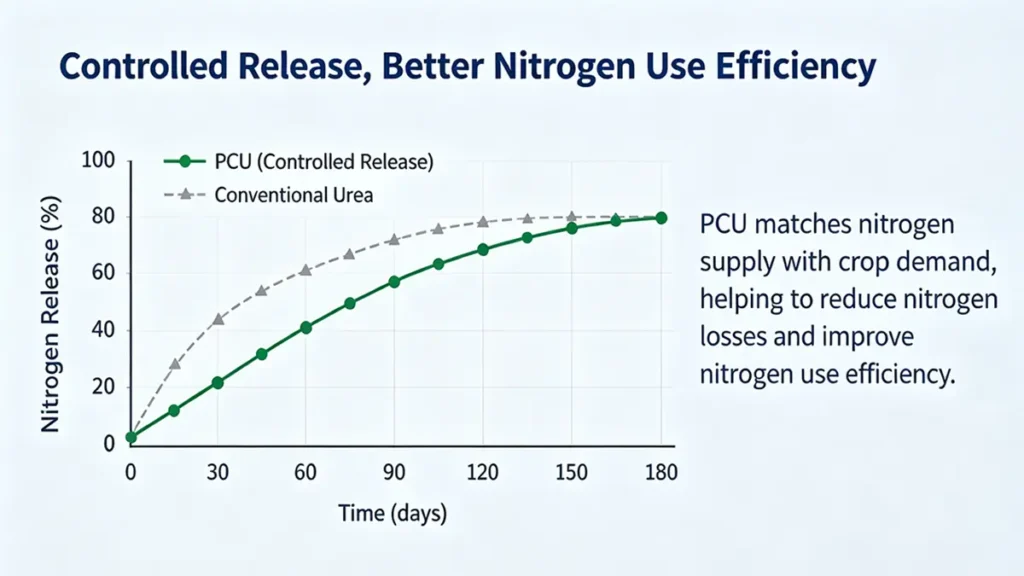
By releasing urea more gradually, PCU can help synchronize nitrogen availability with crop uptake.
A global meta-analysis found that controlled-release urea increased nitrogen use efficiency by approximately 24.1% on average compared with conventional urea in the analyzed cropping systems, although results varied with crop, nitrogen rate, and environmental conditions.
The basic PCU nitrogen release mechanism can be summarized as:
Water penetrates the polymer coating, dissolves the urea core, and dissolved urea gradually diffuses through the polymer membrane into the surrounding soil.
The process is controlled mainly by the physical and chemical properties of the coating.
A simplified model is:
Soil water → polymer membrane → dissolved urea → polymer membrane → soil solution
Once the urea solution forms inside the granule, differences in concentration and osmotic pressure contribute to nutrient movement through the coating.
Diffusion-based mathematical models have been successfully used to describe polymer-coated urea release, although actual commercial products may involve additional processes such as polymer swelling, changing permeability, or coating degradation.
The important point is that PCU is not simply “urea with a protective layer.” The polymer coating functions as an engineered nutrient-release membrane.
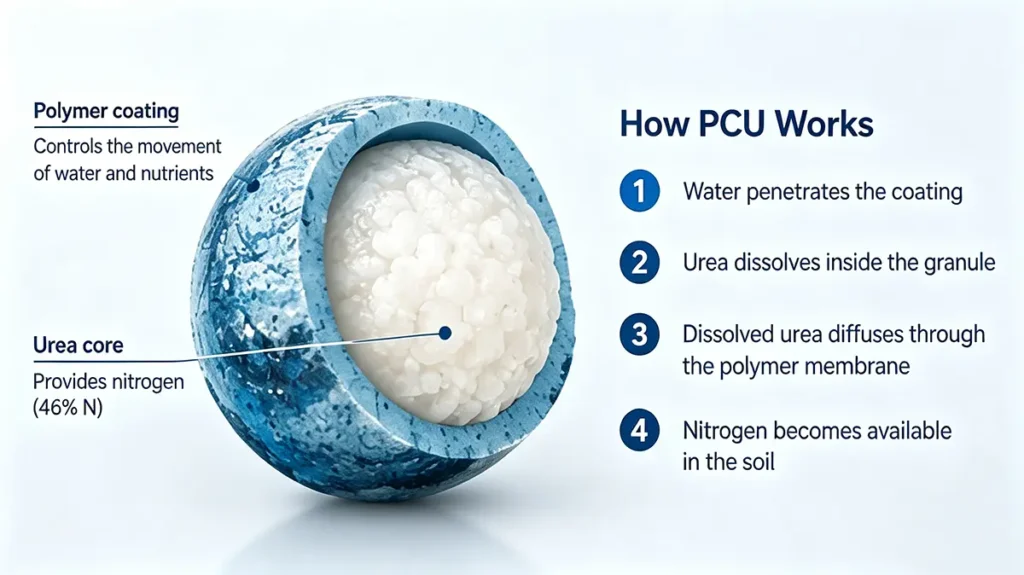
Because the membrane has limited permeability, water enters the granule more slowly than it would contact an uncoated urea particle.
The permeability, thickness, structure, and chemistry of the coating strongly influence this stage.
PCU therefore does not eliminate nitrogen transformation or loss. Its primary function is to control the rate at which nitrogen becomes available.
| Factor | Effect on Release |
|---|---|
| Temperature | Higher temperatures generally accelerate release |
| Soil moisture | Provides water required for the release process |
| Coating thickness | Generally increases diffusion resistance when increased |
| Polymer chemistry | Determines permeability and transport behavior |
| Coating uniformity | Affects consistency between granules |
| Granule size | Influences surface-area-to-volume relationships |
| Coating defects | May cause localized faster release |
| Soil conditions | Affect moisture availability and nitrogen fate |
This means two PCU products with the same nitrogen content and similar coating percentages can still have substantially different release profiles.
For commercial PCU, coating design is more important than coating weight alone.
In many PCU systems:
Higher temperature → faster nitrogen release
Lower temperature → slower nitrogen release
Temperature can affect water transport, polymer permeability, diffusion, and other processes within the coating.
For example, Risso’s published 180-day PCU specification uses 25°C soil temperature as a reference condition. Its stated release duration is approximately 220–240 days at 15°C, compared with approximately 130–150 days at 30°C. These values are specific to that product and testing methodology, not universal values for all PCU fertilizers.
This illustrates an important principle:
A PCU release period should always be considered together with its test temperature.
A “180-day PCU” does not necessarily mean exactly 180 calendar days in every climate.
Water is essential to the PCU release mechanism.
If soil conditions are extremely dry, water penetration into the coating and dissolution of the urea core can be limited. When adequate moisture becomes available, the release process can proceed more effectively.
Therefore:
Temperature influences release kinetics, while water availability determines whether the water-mediated release process can proceed.
Rainfall and irrigation patterns can consequently affect field release behavior.
This is one reason laboratory release data should be interpreted carefully. A release curve measured under constant laboratory conditions provides a standardized performance reference, but field conditions are more variable.
In general, a thicker polymer membrane increases the distance that dissolved urea must travel and can therefore extend the release period.
However, thickness alone does not determine PCU performance.
Other important characteristics include:
Modern research increasingly treats the coating as an engineered transport membrane rather than simply a protective shell. Recent reviews identify diffusion, swelling, permeability changes, degradation, and coating failure as important mechanisms that can affect controlled-release performance.
For this reason, a thicker coating is not automatically a better coating. The objective is to achieve the appropriate permeability and mechanical properties for the required release profile.
A controlled-release fertilizer may show:
The exact release curve depends on coating formulation, coating structure, temperature, moisture, and testing conditions.
For this reason, it is more meaningful to evaluate PCU using a cumulative nitrogen release curve than simply describing a product as “90-day” or “180-day.”
A mathematical study of polymer-coated urea demonstrated that diffusion models can describe release behavior, while also showing that more complex behavior can occur during the later stages of release.
Commercial products may include:
A longer release period is not necessarily better.
The appropriate release duration depends on:
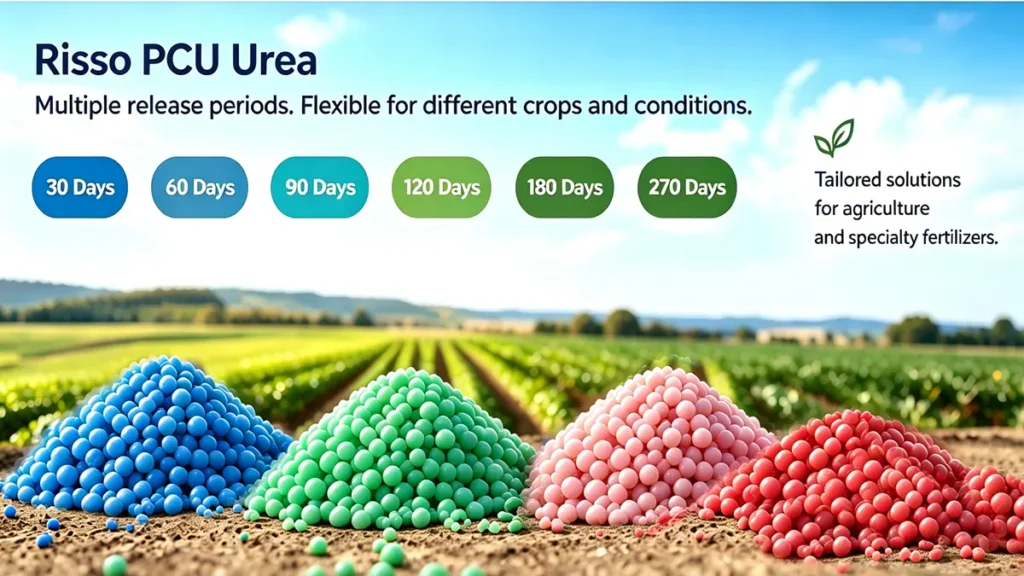
For example, shorter-release PCU may be appropriate for short-season crops, while longer-release products can be considered for long-season crops, turf, orchards, plantations, and forestry.
Risso offers PCU products with different release periods so that fertilizer programs can be matched more closely with crop and environmental requirements.
The basic concept is nitrogen synchronization:
Controlled nitrogen release → soil nitrogen availability → crop nitrogen uptake
When nitrogen becomes available closer to crop demand, the potential for unused nitrogen to be lost may be reduced.
Research supports this concept, but PCU should not be presented as a guarantee of higher NUE under every field condition.
A 2026 meta-analysis of enhanced-efficiency fertilizers found that controlled-release urea can improve NUE, while the magnitude of the improvement varies according to climate, soil, crop, nitrogen rate, and management.
Another recent meta-analysis of maize studies, covering 822 observations from 220 studies, reported average improvements in maize yield and NUE from controlled-release urea, while also identifying soil properties, nitrogen rate, and coating materials as important sources of variation.
The practical conclusion is simple:
PCU works best when its release profile is matched to crop nitrogen demand and local field conditions.
| Characteristic | Conventional Urea | Polymer-Coated Urea |
|---|---|---|
| Nitrogen source | Urea | Urea |
| Polymer coating | None | Yes |
| Water interaction | Rapid dissolution | Controlled water penetration |
| Nitrogen release | Relatively rapid | Gradual |
| Release control | Limited | Engineered |
| Release duration | Short | Extended |
| Application strategy | Often split applications | Can support fewer applications |
| Product cost | Generally lower | Generally higher |
The key difference is therefore not the nitrogen molecule itself.
PCU is essentially an engineered delivery system for urea nitrogen.
It changes the rate and timing of nutrient availability rather than changing urea into a different nitrogen fertilizer.
For example, Risso specifies controlled particle-size ranges for its PCU products and uses screening as part of its production process.
Uniform coating is therefore critical for consistent release between individual granules.
“Is this a 90-day PCU?”
buyers should ask:
“What is the cumulative nitrogen release curve under the specified test conditions?”
This provides much more useful information.
Water gradually penetrates the polymer coating and dissolves the urea core. The dissolved urea then moves through the polymer membrane, primarily through diffusion and related mass-transfer processes.
Generally, yes. Many polymer-coated urea systems release nitrogen faster at higher temperatures because temperature affects water transport, polymer permeability, and diffusion. The exact response depends on the coating formulation.
Yes. Water is essential because it must penetrate the coating and dissolve the urea core.
No. Thickness is important, but polymer chemistry, permeability, coating structure, and coating uniformity also affect release.
PCU can be designed for different release periods, including approximately 30 to 270 days. Actual field performance depends on the product and environmental conditions.
PCU provides more controlled nitrogen release and can improve nitrogen use efficiency or reduce nitrogen losses under appropriate conditions. However, it generally costs more, so its economic value depends on crop, climate, fertilizer management, and application costs.
No. PCU controls the rate of nitrogen release but does not eliminate ammonia volatilization, leaching, denitrification, or other nitrogen loss mechanisms.
Water penetration → urea dissolution → diffusion through the polymer coating → nitrogen availability in soil
The actual release profile depends on the interaction of:
polymer chemistry + coating thickness + coating uniformity + temperature + moisture + granule properties + soil conditions.
This is why the quality of a PCU product cannot be judged simply by its nitrogen content or by a “90-day” or “180-day” label.
For professional fertilizer buyers and manufacturers, the more useful questions are:
These factors determine whether a controlled-release fertilizer can perform as intended in the field.
Risso focuses on polymer-coated urea technology with multiple release durations and product specifications designed for different agricultural and specialty fertilizer applications. The objective is not simply to make urea release more slowly, but to provide a more controlled nitrogen supply that can be matched to crop demand and growing conditions.
Ultimately, the value of PCU lies in controlling the timing of nitrogen availability. When coating design, release characteristics, crop demand, and field conditions are properly matched, polymer-coated urea can provide a practical approach to more efficient nitrogen management.
If you want to know other questions about NPK Fertilizer Manufacturers or NPK fertilizers , please contact us and we will provide professional answers.
✔ Quick & helpful reply within 6 hours.
✔ Tailored solutions for your project.
✔ One-stop product, tech, market

Want to find a China fertilizer manufacturer?
Risso will be your best choice; send us your request for your fertilizer details requirement
© Copyright 2017 RISSO CHEMICAL. All Rights Reserved.