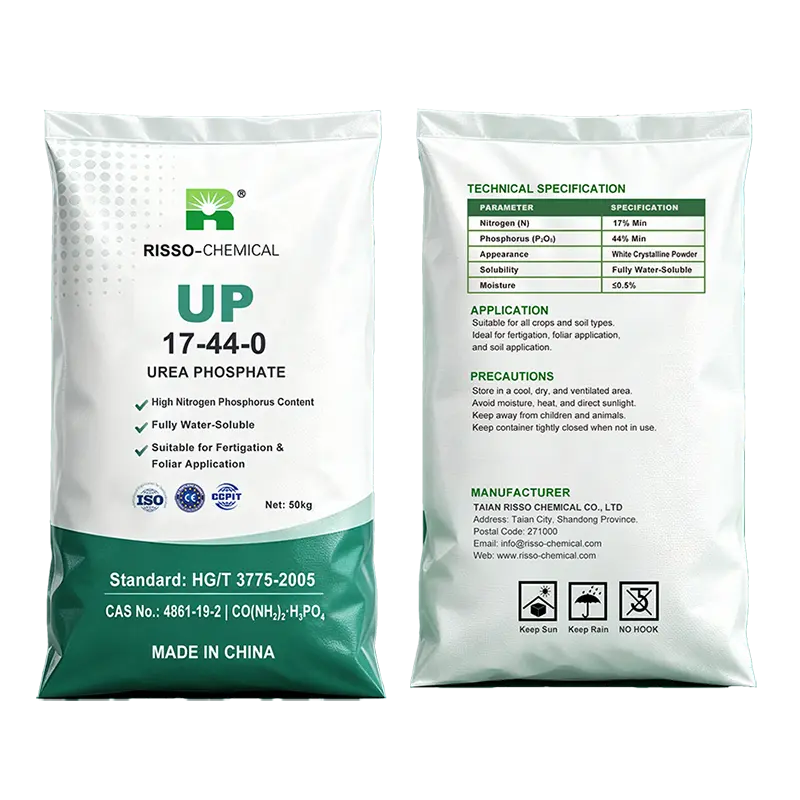
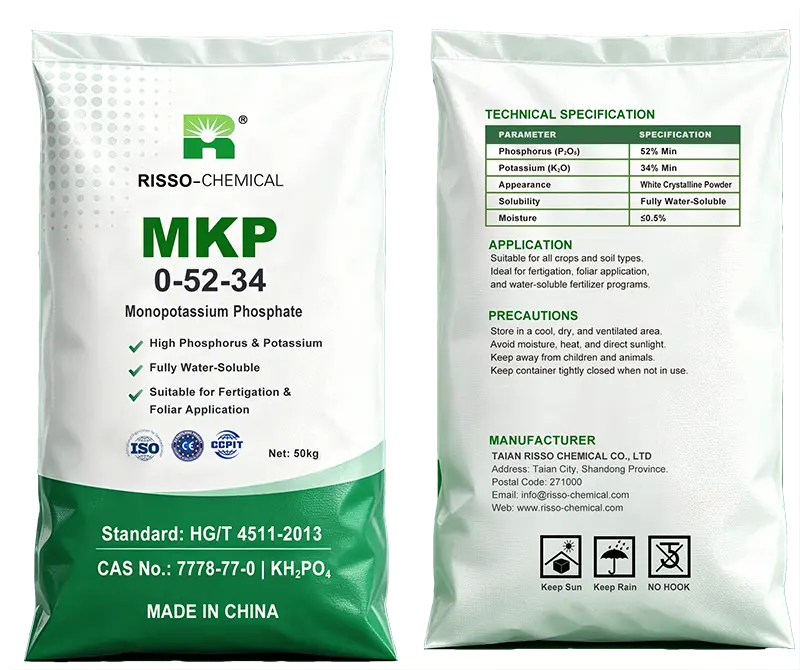
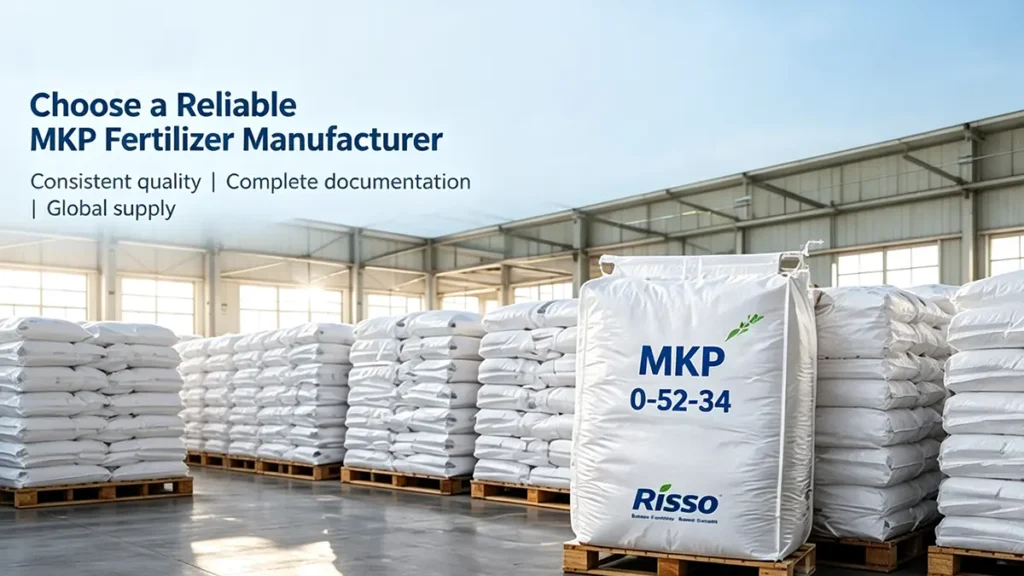
High-purity MKP fertilizer, or monopotassium phosphate (KH₂PO₄), is widely used in fertigation, foliar nutrition, hydroponics, greenhouse production and water-soluble fertilizer manufacturing. Its common fertilizer grade, 0-52-34, supplies phosphorus and potassium without nitrogen.
For commercial buyers, however, the 0-52-34 label is only the starting point. Two products with the same declared nutrient grade may differ in water solubility, insoluble matter, chloride content, moisture, physical properties and consistency between production lots.
These differences can affect fertilizer blending, stock-solution preparation, irrigation equipment and crop nutrition programs.
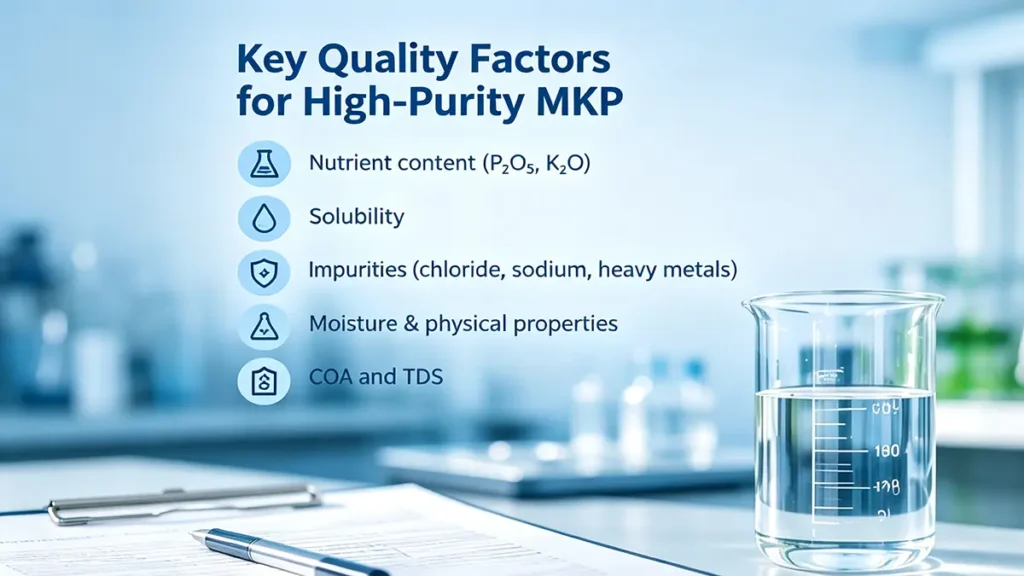
A practical approach to purchasing high-purity MKP is to evaluate the chemical composition, physical quality, application requirements, documentation and manufacturing consistency together.
1. What Is High-Purity MKP Fertilizer?
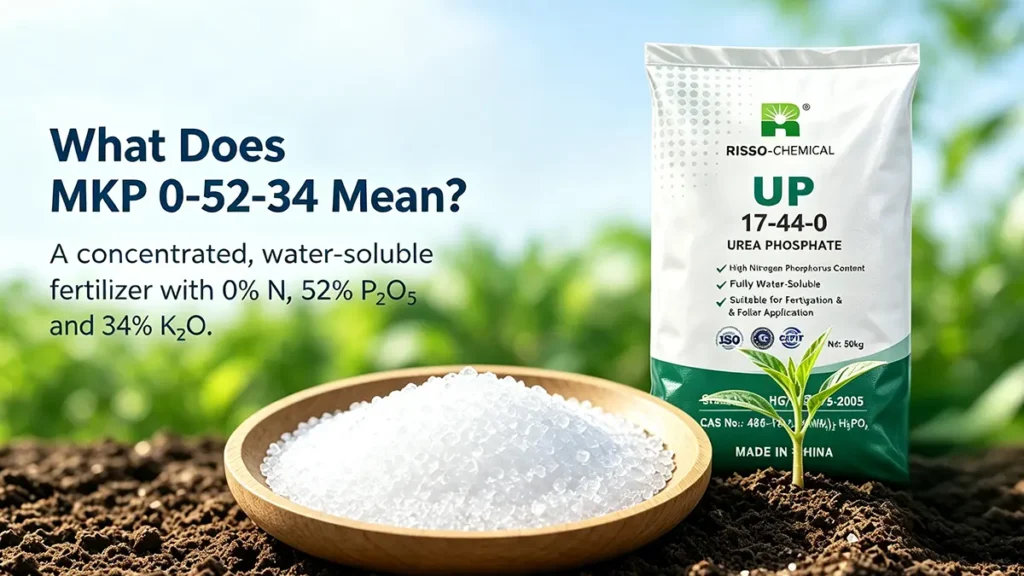
High-purity MKP fertilizer is a high-quality grade of monopotassium phosphate (KH₂PO₄) intended to provide a consistent source of phosphorus and potassium. MKP is commonly sold as 0-52-34, containing approximately 52% P₂O₅ and 34% K₂O, with no nitrogen.
The term high purity should refer to measurable chemical and physical characteristics—not simply a product label or a supplier’s marketing description.
For commercial buyers, a high-quality MKP product should meet its declared nutrient specification and have appropriate limits for impurities, moisture and water-insoluble matter. It should also perform consistently in its intended application.
The required quality level depends on the end use. An MKP used in general fertilizer blending may have different requirements from one intended for concentrated fertigation, hydroponics or specialized foliar formulations.
Why is high-purity MKP important?
MKP is frequently used in systems where fertilizer must dissolve efficiently and deliver a predictable nutrient concentration. Unwanted impurities or inconsistent physical properties can affect:
- Stock-solution preparation
- Irrigation filters and emitters
- Fertilizer blending
- Nutrient-solution management
- Product storage and handling
- Batch-to-batch consistency
A practical purchasing decision should therefore consider nutrient content, solubility, impurity limits, application requirements and supplier documentation together.
2. What Does MKP 0-52-34 Mean?
MKP fertilizer is commonly identified by the grade 0-52-34, which follows the conventional N–P₂O₅–K₂O labeling system.
| Nutrient |
Typical content |
| Total nitrogen (N) |
0% |
| Phosphate (P₂O₅) |
52% |
| Potash (K₂O) |
34% |
The elemental equivalents are approximately 22.7% phosphorus and 28.2–28.7% potassium.
The zero-nitrogen formulation is important when a crop requires phosphorus and potassium but the fertilizer program needs to limit additional nitrogen. MKP is therefore used in selected fertigation, foliar and hydroponic formulations.
Is 99% purity the same as 0-52-34?
No. These figures describe different characteristics:
-
99% KH₂PO₄ assay: Indicates the proportion of monopotassium phosphate in the tested material.
-
52% P₂O₅: Indicates the phosphate content expressed as P₂O₅.
-
34% K₂O: Indicates the potash content expressed as K₂O.
A product may meet the 0-52-34 fertilizer grade without having an assay of exactly 99%. Buyers should compare the actual specification and test method rather than relying on one number.
3. Why Does MKP Purity Matter?
Purity affects more than the nutrient percentage. In commercial fertilizer production, the quality of the raw material can influence how a product dissolves, blends and behaves in an application system.
3.1 Nutrient consistency
A consistent MKP grade helps formulators calculate the quantity of P₂O₅ and K₂O supplied by each batch.
For example, a fertilizer manufacturer producing a soluble NPK blend needs reliable nutrient analysis to maintain the target formulation. Variations in nutrient content can affect the final product and its labeling.
3.2 Dissolution and irrigation performance
Fertigation systems often use filters, injectors, drip lines and precise dosing equipment. Water-insoluble particles can increase filter loading or contribute to emitter blockage.
High water solubility and low insoluble matter are therefore important when MKP is intended for concentrated stock solutions or irrigation systems.
3.3 Impurity control
Unwanted chloride, sodium, iron or heavy metals may be relevant to particular crops, growing systems or regulatory requirements.
For example, sodium accumulation is an important consideration in recirculating hydroponic systems. The acceptable impurity level should be determined by the application and destination-market requirements.
3.4 Batch-to-batch reliability
A sample that meets the required specification does not automatically prove that every future shipment will have the same quality.
For long-term supply, buyers should examine batch records, production controls and the supplier’s ability to maintain consistent specifications.
4. Key Specifications to Check Before Buying
A high-purity MKP fertilizer should be evaluated through a complete technical specification rather than the product name alone.
MKP fertilizer specification checklist
| Parameter |
What to check |
Why it matters |
| KH₂PO₄ assay |
Declared minimum or typical value |
Indicates chemical purity |
| P₂O₅ |
Guaranteed content |
Confirms phosphorus supply |
| K₂O |
Guaranteed content |
Confirms potassium supply |
| Water solubility |
Test result and conditions |
Important for solution preparation |
| Water-insoluble matter |
Maximum limit |
Helps control residue and blockage risk |
| Moisture |
Maximum limit |
Affects storage and handling |
| Chloride |
Declared maximum |
Relevant to crop and water quality |
| Sodium |
Declared maximum, if relevant |
Important for salinity-sensitive systems |
| Iron and heavy metals |
Limits and test methods |
Relevant to end use and regulations |
| pH |
Test concentration and result |
Useful for solution chemistry |
| Particle size |
Distribution or mesh range |
Affects dissolving, blending and handling |
| Bulk density |
Measured range |
Important for packaging and dosing |
| COA |
Actual batch results |
Verifies shipped material |
Published MKP specifications from Haifa, for example, include P₂O₅, K₂O, pH, iron, chloride, loss on drying, insoluble matter and bulk density. These parameters provide a useful reference for evaluating a commercial product, although the buyer’s required limits may differ.
4.1 Check the assay and nutrient guarantees
The specification should clearly distinguish between:
- guaranteed minimum;
- typical value;
- maximum limit;
- and actual batch result.
For example, a supplier may declare 52% P₂O₅ as a typical value but guarantee a slightly lower minimum. These figures should not be treated as interchangeable.
The same principle applies to K₂O and KH₂PO₄ assay.
4.2 Check the physical form
MKP is commonly supplied as white crystals, crystalline powder or other specified particle forms.
The appropriate form depends on the application:
- Crystal grade: May be suitable for fertilizer blending, dissolving and general handling.
- Powder grade: May be selected for particular blending or processing requirements.
- Specified particle-size grade: May be necessary for automated dosing or a specialized formulation.
Particle size should be evaluated using the actual intended equipment. A finer powder is not automatically better if it creates dust, handling problems or poor flowability.
5. How to Evaluate MKP Solubility
Solubility is a key consideration for water-soluble MKP fertilizer, especially in fertigation and hydroponic applications.
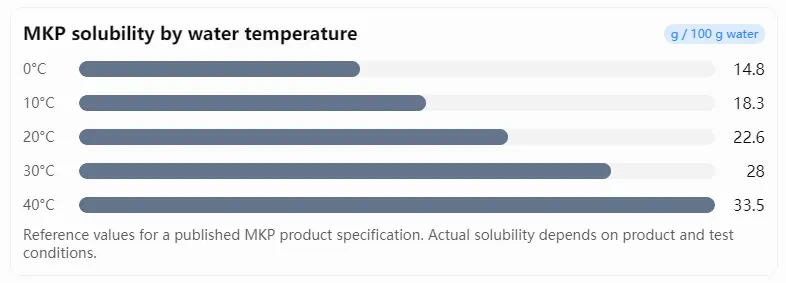
One published MKP specification reports the following solubility values:
At 20°C, the reported solubility is 22.6 g per 100 g of water, equivalent to approximately 226 g per kg of water under those test conditions.
Why does solubility matter in practice?
When preparing a concentrated fertilizer solution, buyers should consider:
- Water temperature.
- Required concentration.
- Mixing time and agitation.
- Water hardness and dissolved minerals.
- Compatibility with other fertilizers.
- Storage time before injection.
A product that dissolves well in a laboratory test may still require careful handling in a commercial stock tank.
Solubility is not the same as dissolution speed
These terms should be distinguished:
Particle size, agitation, water temperature and crystal structure can affect dissolution speed. Buyers should request test conditions or conduct an application-specific trial when rapid preparation is important.
Check pH and EC data
Published MKP data show that a 1% solution may have a pH of approximately 4.5, while EC increases as fertilizer concentration rises. The exact values depend on the product and measurement conditions.
For hydroponics and fertigation, pH and EC should be evaluated in the complete nutrient solution—not from MKP alone
6. Impurities That Affect Fertilizer Quality
High-purity MKP should be assessed for impurities that are relevant to the intended application.
Chloride
Chloride may be important for crops or growing systems where chloride accumulation needs to be controlled.
A low-chloride specification should be supported by a defined numerical limit and test method. The phrase “chloride-free” should only be used when it accurately reflects the relevant specification and analytical detection limits.
Sodium
Sodium can accumulate in recirculating hydroponic systems and may contribute to salinity concerns.
For these applications, buyers should request a sodium specification and consider the quality of the irrigation water and other fertilizer ingredients.
Iron and heavy metals
Iron and heavy metals may affect the suitability of MKP for specialized nutrient solutions or regulated markets.
The relevant limits depend on the application and destination country. Buyers should identify the required limits before placing an order.
Water-insoluble matter
Insoluble matter is especially important in drip irrigation, fertigation and foliar spraying.
A low insoluble-matter specification helps reduce the risk of residue, but it does not eliminate the need to check water quality, fertilizer compatibility and filtration.
Moisture
Excess moisture may contribute to caking and affect handling. It can also influence the result of analyses reported on a wet or dry basis.
When comparing suppliers, check whether the nutrient and assay values are reported on an as-received basis or dry basis.
7. Understanding MKP COA, TDS and SDS
Commercial fertilizer buyers should request the correct technical documents before confirming a bulk order.
7.1 COA — Certificate of Analysis
A batch-specific document showing actual test results for the supplied material. It should identify the batch number, test date or production reference, analytical results and applicable specification limits.
7.2 TDS — Technical Data Sheet
Describes product properties, nutrient content, physical characteristics, typical specifications, packaging and intended applications.
7.3 SDS — Safety Data Sheet
Provides information on handling, storage, hazards, personal protection, transport and emergency procedures, as applicable.
What should buyers verify?
Before purchasing MKP fertilizer, compare the COA and TDS for:
- Product name and fertilizer grade.
- Chemical formula.
- Nutrient guarantees.
- Assay and purity basis.
- Insoluble matter.
- Moisture.
- Chloride, sodium and other relevant impurities.
- Test methods.
- Batch number and traceability.
- Packaging and product identification.
A COA should correspond to the actual production batch whenever possible. A generic laboratory report or an old sample certificate is not a substitute for batch-specific quality verification.
8. How to Test an MKP Fertilizer Sample
A sample evaluation can help determine whether an MKP product is suitable for a particular commercial application.
Step 1: Inspect the material
Check the appearance, crystal or powder condition, visible contamination, caking and packaging integrity.
Appearance alone cannot establish chemical purity, but it can reveal obvious physical problems.
Step 2: Check the technical documents
Compare the supplier’s COA and TDS with your required specifications.
Pay attention to the units, test methods, dry-basis reporting and the distinction between typical and guaranteed values.
Step 3: Conduct a dissolution test
Prepare a solution using the actual water and concentration expected in production.
Observe:
- Dissolution time.
- Solution clarity.
- Residue after filtration.
- Sediment formation.
- Temperature during mixing.
The test should be performed under controlled and documented conditions.
Step 4: Test compatibility
If MKP will be mixed with other fertilizers, test the complete formulation or stock-tank recipe.
Phosphate fertilizers can react with calcium or magnesium under concentrated conditions. Published MKP guidance recommends avoiding direct mixing with calcium- or magnesium-containing fertilizers in concentrated solutions.
Step 5: Use independent laboratory testing when necessary
For large-volume purchases or sensitive applications, consider third-party testing of key parameters such as:
- KH₂PO₄ assay.
- P₂O₅ and K₂O.
- Moisture.
- Water-insoluble matter.
- Chloride and sodium.
- Heavy metals.
- Other customer-specific requirements.
The testing scope should match the risks and regulatory requirements of the final application.
9. Choosing MKP for Different Applications
The required purity and physical specification should be matched to the actual use.
| Application |
Important quality considerations |
| Fertigation |
Solubility, insoluble matter, water quality and compatibility |
| Hydroponics |
Impurity control, nutrient consistency, sodium and chloride |
| Foliar fertilizer |
Solubility, purity, physical consistency and crop-specific safety |
| Water-soluble NPK production |
Nutrient accuracy, dissolution, particle size and blending behavior |
| Liquid fertilizer production |
Solubility, solution stability and compatibility |
| Commercial fertilizer distribution |
Consistent specifications, packaging, COA and traceability |
MKP for fertigation
For fertigation, a suitable product should dissolve under the expected water temperature and concentration. Low insoluble matter and reliable batch quality are important for systems using filters and small irrigation emitters.
MKP for hydroponics
Hydroponic formulations require more than a high P₂O₅ and K₂O content. Buyers should also consider impurities that may accumulate in recirculating systems and the compatibility of MKP with the other nutrient salts.
MKP for foliar application
For foliar products, the specification should be evaluated alongside the intended spray concentration, crop sensitivity, water quality and label requirements. High purity does not guarantee that any concentration will be safe for every crop.
MKP for fertilizer manufacturing
For fertilizer blenders and formulators, particle size, moisture, bulk density and dissolution behavior can affect production efficiency. The product should be selected according to the manufacturing process and final formulation.
10. How to Evaluate an MKP Fertilizer Manufacturer
Selecting a supplier involves more than comparing the quoted price per metric ton.
Manufacturing and quality control
Ask whether the manufacturer can provide:
- A clear product specification.
- Batch-specific COAs.
- Documented quality-control procedures.
- Consistent production standards.
- Traceability from production to shipment.
- Sample testing and technical support.
Supply and packaging
For commercial procurement, also confirm:
- Available packaging sizes.
- Bulk or jumbo-bag options.
- Minimum order quantity.
- Production lead time.
- Export documentation.
- Loading and shipping arrangements.
- Ability to maintain quality across repeat orders.
Technical communication
A reliable supplier should be able to explain the basis of its specifications, provide the relevant documentation and respond to questions about solubility, mixing and application requirements.
For buyers evaluating Risso Fertilizer as a potential MKP supplier, the appropriate starting point is its official product information and technical documentation. Product specifications, packaging and commercial terms should be confirmed directly for the required grade and destination market.
11. Common Mistakes When Buying MKP
Mistake 1: Choosing by the 0-52-34 label alone
The fertilizer grade confirms the declared nutrient composition, but it does not fully describe insoluble matter, moisture, impurity limits or physical properties.
Mistake 2: Treating “99% purity” as a complete quality assessment
Assay is important, but it does not replace testing for solubility, insoluble matter, chloride, moisture and other relevant parameters.
Mistake 3: Comparing specifications without checking the test basis
A dry-basis result and an as-received result may not be directly comparable.
Mistake 4: Ignoring water quality
MKP performance in a stock solution depends on the actual irrigation water, concentration and other dissolved salts.
Mistake 5: Mixing MKP with calcium without a compatibility test
Phosphate and calcium may form precipitates under concentrated conditions. Use the supplier’s compatibility guidance and test the actual formulation.
Mistake 6: Selecting a product without considering the end use
A product suitable for general fertilizer blending may not meet the requirements of a specialized hydroponic or fertigation application.
Mistake 7: Relying on one sample to represent all future shipments
Long-term procurement should include batch documentation and an agreed quality specification.
Frequently Asked Questions (FAQs)
Conclusion
Choosing a high-purity MKP fertilizer requires a technical evaluation rather than a comparison of product names or advertised purity percentages.
A suitable commercial product should provide the required
0-52-34 nutrient grade, reliable water solubility, controlled impurities and consistent physical properties. Buyers should also verify the COA, TDS, SDS, test methods and batch traceability.
The most important factors depend on the application:
- Fertigation: Solubility, insoluble matter and compatibility.
- Hydroponics: Nutrient consistency and impurity control.
- Foliar nutrition: Product purity, dissolution and crop-specific application requirements.
- Fertilizer manufacturing: Nutrient accuracy, particle size, moisture and blending performance.
For fertilizer distributors, formulators and agricultural buyers, the right MKP supplier is one that can meet the agreed technical specification consistently and provide reliable documentation for every commercial shipment.
Before placing a bulk order, request the current TDS, a batch-specific COA and a representative sample. Evaluate the product under the conditions in which it will actually be used, and confirm that the specification meets both the end-use requirements and the regulations of the destination market.
Fertilizer Related Products
If you want to know other questions about NPK Fertilizer Manufacturers or NPK fertilizers , please contact us and we will provide professional answers.