















2026-10-21
Select language:

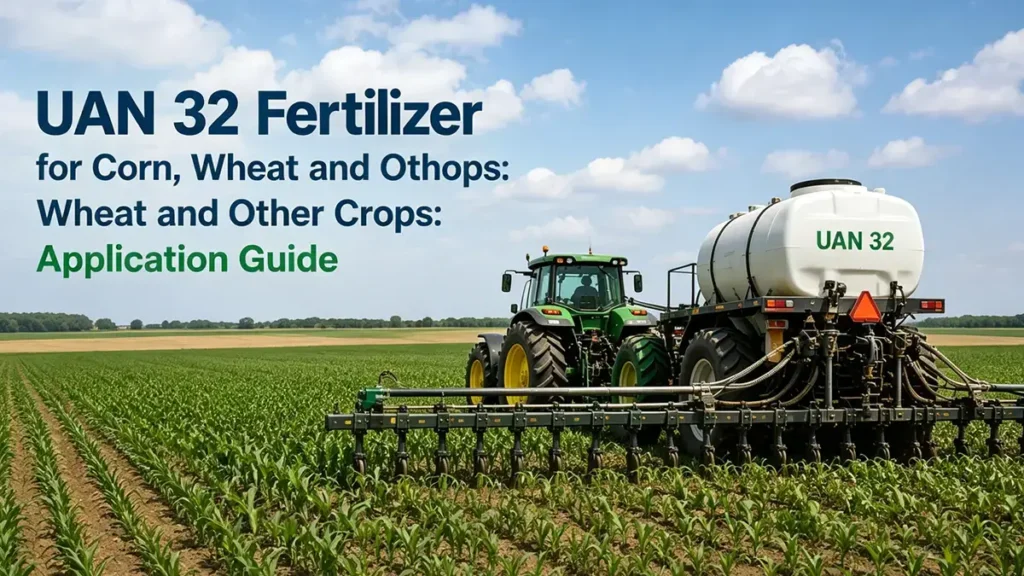
Its flexibility makes UAN 32 suitable for a wide range of crops, including corn, wheat, barley, canola, sugar beet, potatoes, vegetables, and other field crops. It can be applied before planting, during crop growth, as a sidedress application, or through suitable fertigation systems. Commercial fertilizer manufacturers also list UAN 32 among the liquid nitrogen fertilizers used for cereals, maize, oilseed crops, root crops, grassland, and vegetables.
However, there is no single UAN 32 fertilizer application rate that works for every crop or field.
The appropriate nitrogen program depends on crop demand, soil nitrogen supply, yield target, weather, irrigation, previous fertilizer applications, and the timing and placement of the fertilizer.
For that reason, the most useful way to evaluate UAN 32 is not simply to ask how much fertilizer to apply, but to determine when, where, and how much nitrogen the crop needs.
Risso supplies UAN 32 liquid nitrogen fertilizer for agricultural markets worldwide, with product specifications and technical documentation available to support fertilizer distributors, importers, growers, and commercial farming operations.
It is commonly identified as:
UAN 32 — 32-0-0 liquid fertilizer
The nitrogen is supplied in three forms:This combination gives UAN 32 a different nitrogen-release profile from fertilizers containing only one nitrogen form.
Because it is a liquid fertilizer, UAN 32 can be accurately metered and applied using a range of agricultural equipment. Common application methods include:The choice of method is particularly important because UAN contains urea nitrogen and can therefore be subject to ammonia volatilization when left on the soil surface under unfavorable conditions. Soil injection, incorporation, or suitable surface-band placement can reduce this risk.
The goal is not simply to maximize the amount of nitrogen applied, but to improve nitrogen use efficiency (NUE) by matching nitrogen availability with crop demand.
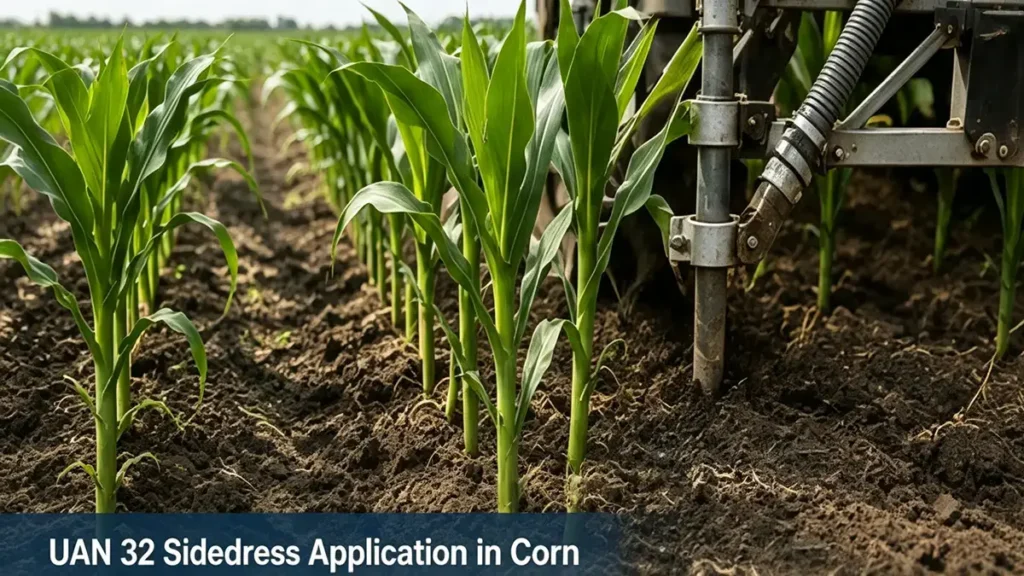
Corn’s nitrogen demand increases substantially as the crop develops. California’s fertilization guidelines, for example, note relatively low nitrogen uptake before approximately the six-leaf stage, followed by much higher uptake from V6 through later reproductive development.
This makes UAN 32 sidedress application an important nitrogen management strategy for many corn production systems.
When UAN is surface applied, appropriate incorporation, rainfall, irrigation, or other management may be needed to move nitrogen into the soil and reduce volatilization losses.
UAN 28 and UAN 32 are commonly used for corn sidedress applications, including injection and surface-band approaches.
Suitable approaches include:
Direct contact between concentrated UAN and corn foliage should be avoided because it can cause leaf injury. Extension guidance specifically recommends careful placement of UAN around growing corn to reduce foliar burn.
Wheat nitrogen management has two major objectives:
The appropriate strategy depends on soil nitrogen, previous applications, expected yield, irrigation, and local growing conditions.
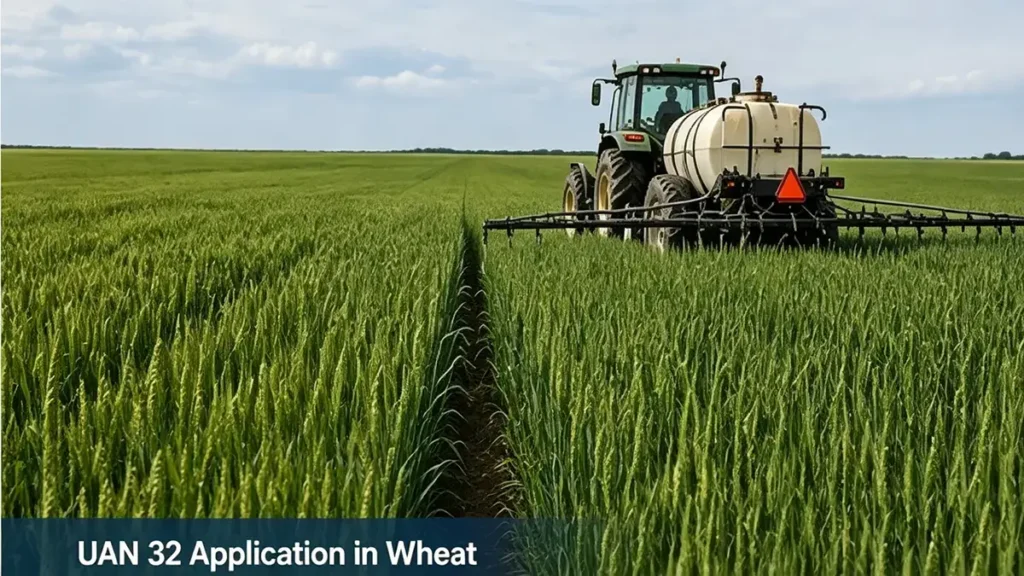
California wheat guidance, for example, recommends determining early-season nitrogen by accounting for total crop requirements and nitrogen already supplied before or later in the season. It also notes that surface-applied UAN should receive irrigation or otherwise be moved into the soil to reduce ammonia volatilization.
The exact timing and split should therefore be based on local wheat production conditions rather than a universal schedule.
For feed barley and malting barley, the nitrogen strategy may differ because excessive nitrogen can affect crop development and grain quality.
UAN 32 can be incorporated into a barley fertilizer program through:The application rate should be calculated from the crop’s actual nitrogen requirement rather than using the same rate recommended for wheat or corn.
Commercial UAN 32 fertilizer programs commonly include barley among the cereal crops receiving pre-sowing or top-dressing applications.
For oilseed crops, nitrogen should also be considered alongside other nutrients, particularly sulfur where soil and crop conditions indicate a requirement.
A balanced nutrient program is more important than simply increasing the UAN 32 rate.
Crops such as potatoes, sugar beet, vegetables, and grassland are among the agricultural systems where UAN fertilizers are commercially used.
For vegetables and other high-value crops, split applications can be useful because nutrient demand changes rapidly during crop development.Typical calculation process:
| Crop | Common UAN 32 Application Strategy |
|---|---|
| Corn | Pre-plant, sidedress, and selected in-season applications |
| Winter Wheat | Early spring topdressing and later applications where appropriate |
| Spring Wheat | Pre-plant and in-season nitrogen management |
| Barley | Pre-plant or early-season nitrogen, depending on production system |
| Canola | Pre-plant and split nitrogen applications |
| Potatoes | Pre-plant, side-dress, or fertigation depending on the system |
| Vegetables | Split applications, often through fertigation or side dressing |
| Grassland | Seasonal applications based on growth and nutrient demand |
Subsurface placement can reduce direct exposure to the atmosphere and improve nitrogen placement. California corn guidelines specifically discuss subsurface banding and appropriate placement relative to the crop row.
This method can provide more controlled placement than broadcast application.
For corn, extension recommendations commonly discuss surface-banded UAN using drop hoses, Y-drop systems, or similar equipment while emphasizing the need to avoid direct contact with leaves.
Because UAN contains urea nitrogen, surface application can result in ammonia volatilization if the fertilizer remains exposed under conditions favorable to nitrogen loss.
Rainfall, irrigation, incorporation, or appropriate fertilizer management can help move nitrogen into the soil.
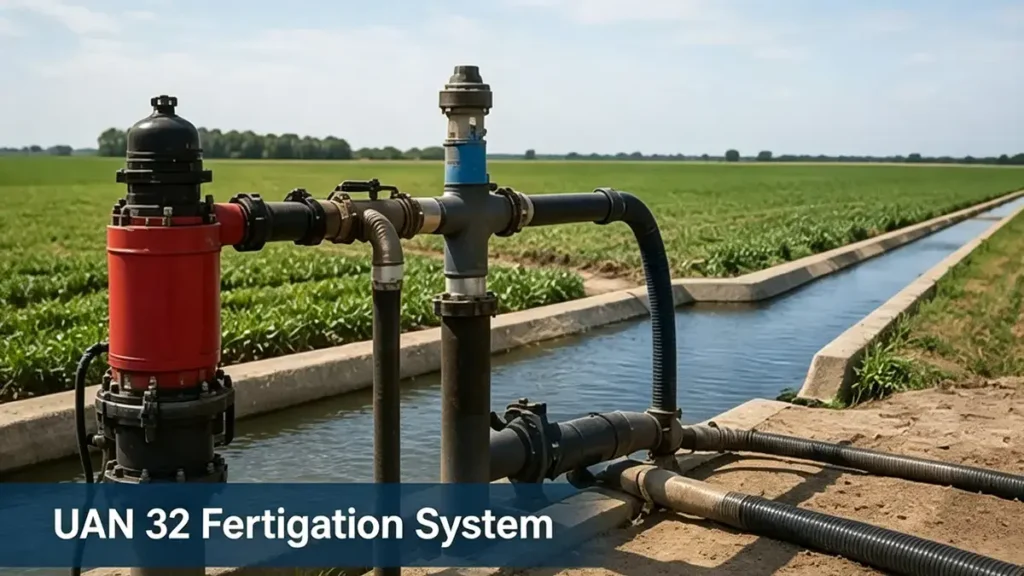
Fertigation can support:
However, injection rate, irrigation flow, fertilizer compatibility, and system design must be evaluated before application.
Do not start with a fixed UAN 32 volume and assume it is appropriate for every field.
This is particularly relevant for crops with strong mid-season nitrogen uptake, such as corn.
For irrigated crops, fertigation may provide greater flexibility.
For wheat, topdressing strategies need to consider crop stage, soil moisture, and expected rainfall or irrigation.
Poorly drained soils and sandy soils can have higher risks of certain nitrogen losses, while warm conditions and surface-applied urea-containing fertilizers can increase volatilization risk.
A crop-specific nitrogen budget is more reliable than a universal UAN 32 rate.
300 L/ha of UAN 32
is not the same thing as:
300 kg N/ha
The actual nitrogen supplied depends on the fertilizer density and nitrogen concentration.
This is particularly important for growing corn and other crops where foliage may be exposed during application.
How much UAN 32 should I apply per hectare?
The calculation should start with the crop’s nitrogen requirement.
For example, if a field requires:
120 kg N/ha
and the selected UAN 32 product contains:
32% N
the required fertilizer mass is calculated from the nitrogen concentration.
The fertilizer volume then depends on the product’s density.
This is why a professional UAN 32 fertilizer application rate should be calculated from actual product specifications rather than estimated from a generic L/ha number.
For a detailed calculation method, see:
How to Calculate UAN 32 Fertilizer Application Rates
This creates a natural internal link between the crop-specific article and your previous technical calculation article.
For corn, UAN 32 is particularly useful for sidedress and carefully managed in-season nitrogen applications.
For wheat, application timing should follow crop development and local nitrogen-management recommendations.
For barley and canola, fertilizer rates should reflect yield goals, soil fertility, crop characteristics, and end-use requirements.
For vegetables and irrigated crops, fertigation can provide additional flexibility for split nitrogen applications.
The most effective UAN 32 program therefore follows a simple principle:
Determine the crop’s nitrogen requirement → calculate the correct UAN 32 rate → choose the appropriate application timing → place the fertilizer correctly → manage nitrogen losses.
Risso provides UAN 32 fertilizer for international agricultural markets, supported by product specifications and technical documentation for growers, distributors, importers, and commercial fertilizer buyers.
Good nitrogen management is not about applying the maximum amount of fertilizer. It is about delivering the right amount of nitrogen, at the right time, in the right place.
Yes. UAN 32 is widely used as a liquid nitrogen fertilizer for corn, particularly for sidedress and in-season nitrogen applications. Injection and properly managed band applications can improve placement and reduce direct contact with foliage.
Yes. UAN 32 can be used for wheat as a pre-plant or topdress nitrogen fertilizer. Application timing should be matched to crop development, soil nitrogen availability, and local agronomic recommendations.
UAN fertilizers are used across many crop systems, including corn, wheat, barley, canola, sugar beet, potatoes, vegetables, grassland, and other commercial crops.
Timing depends on the production system, but sidedress applications during early to mid-vegetative growth are widely used to align nitrogen supply with increasing crop demand.
Yes, UAN 32 can be used in suitable fertigation systems. The irrigation system, injection equipment, fertilizer concentration, and application rate should be properly evaluated before use.
Neither product is universally better. Both can supply nitrogen effectively when correctly managed. The practical choice depends on crop requirements, equipment, application method, storage, logistics, and the risk of nitrogen losses. Cornell's nutrient-management guidance notes that plants respond to the nutrient supplied rather than simply whether the nitrogen came from a liquid or dry source; management of volatilization, leaching, and denitrification is an important part of the comparison.
If you want to know other questions about NPK Fertilizer Manufacturers or NPK fertilizers , please contact us and we will provide professional answers.
✔ Quick & helpful reply within 6 hours.
✔ Tailored solutions for your project.
✔ One-stop product, tech, market

Want to find a China fertilizer manufacturer?
Risso will be your best choice; send us your request for your fertilizer details requirement
© Copyright 2017 RISSO CHEMICAL. All Rights Reserved.