















2026-10-08
Select language:

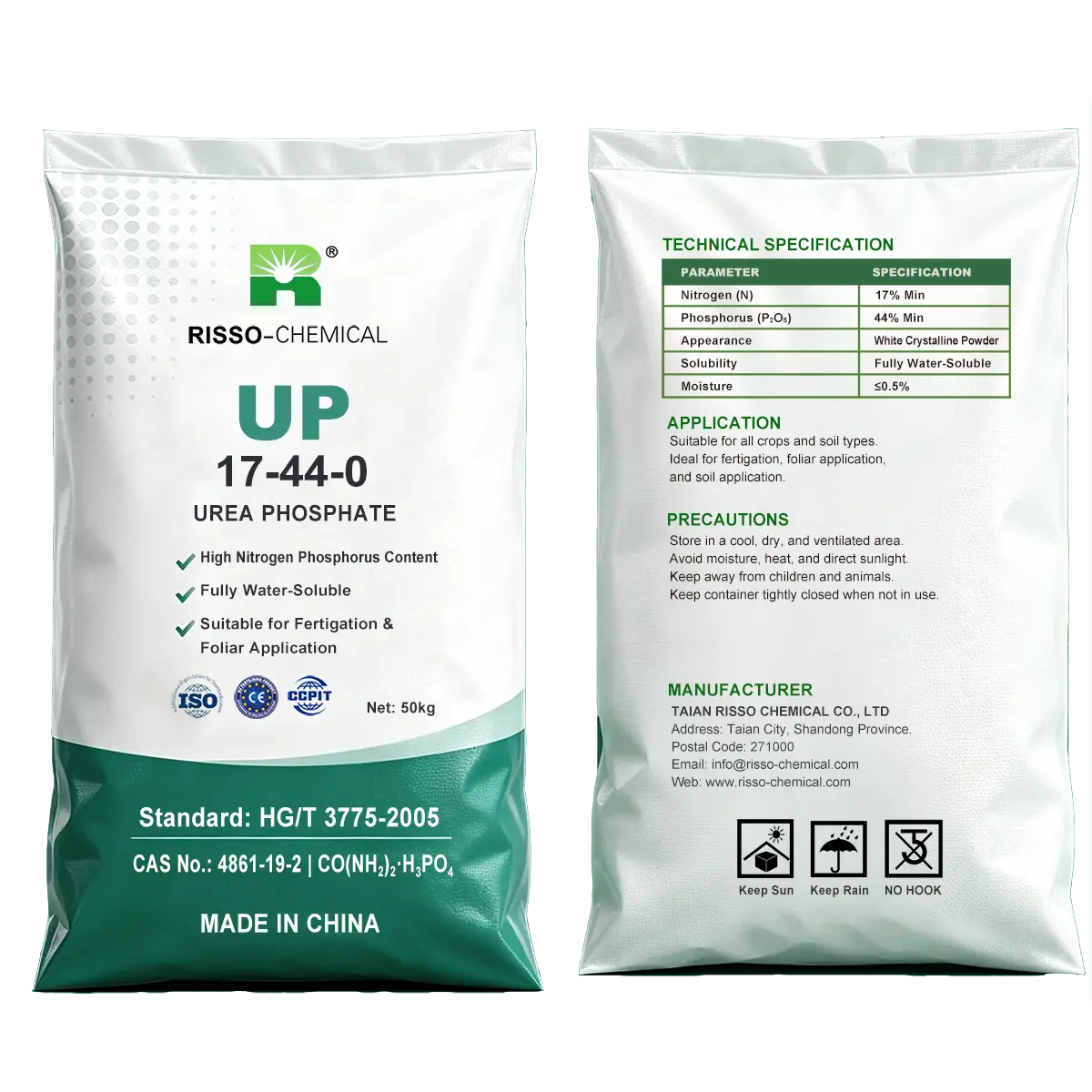
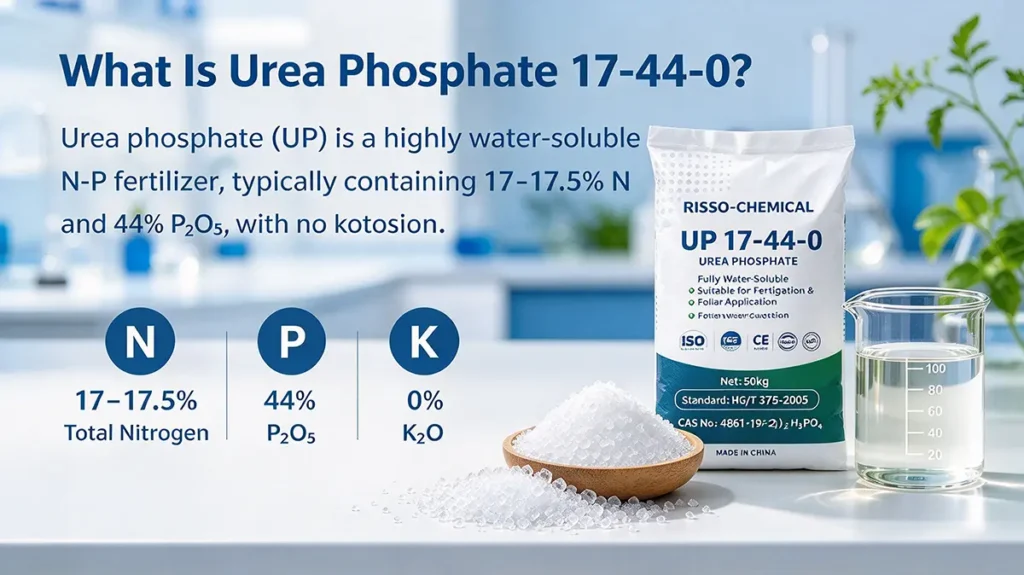
Urea phosphate (UP) is a highly water-soluble nitrogen-phosphorus fertilizer widely used in fertigation, drip irrigation and nutrient management for alkaline or calcareous soils. The most common commercial grade is UP 17-44-0, typically containing about 17–17.5% nitrogen (N) and 44% phosphorus expressed as P₂O₅, with no potassium.
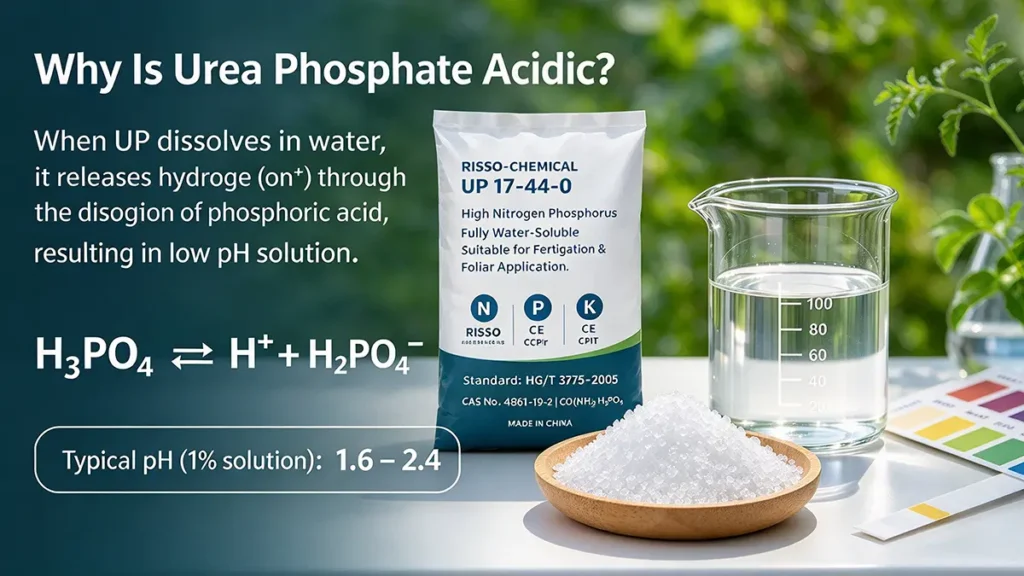
One of the defining characteristics of urea phosphate is its strongly acidic reaction in water. Depending on the concentration and test method, commercial specifications commonly report a solution pH in the range of approximately 1.6–2.4.
But why is urea phosphate acidic?
The answer is more specific than simply saying that UP “contains phosphoric acid.” Urea phosphate is a crystalline compound formed from urea and phosphoric acid. When it dissolves in water, it dissociates and establishes an acid-base equilibrium involving phosphoric acid, phosphate ions, urea and hydrogen ions. This chemistry gives UP its low solution pH and explains many of its practical applications in fertigation.
For fertilizer manufacturers and agricultural users such as Risso, understanding this chemistry is important when evaluating UP 17-44-0 for alkaline irrigation water, calcareous soils and drip-fertigation systems.
CO(NH₂)₂·H₃PO₄
As a fertilizer, it is generally classified as 17-44-0, meaning approximately:
Some commercial products specify approximately 17.5% N and 44% P₂O₅.
Typical characteristics include:
| Property | Typical characteristic |
|---|---|
| Fertilizer grade | 17-44-0 |
| Total nitrogen | 17–17.5% |
| Phosphate | 44% P₂O₅ |
| Potassium | 0% K₂O |
| Physical form | White crystalline solid |
| Water solubility | Very high |
| Solution reaction | Strongly acidic |
| Main applications | Fertigation, drip irrigation, soil application |
This distinction is important when comparing UP with other nitrogen-phosphorus fertilizers such as MAP 12-61-0 and DAP 18-46-0.
Urea phosphate is not simply a physical mixture of urea and free phosphoric acid. It is a crystalline compound formed through the interaction of urea and phosphoric acid.
When UP dissolves in water, the crystal structure breaks down and the dissolved components establish a series of chemical equilibria. Phosphoric acid can dissociate according to:
H₃PO₄ ⇌ H⁺ + H₂PO₄⁻
The release of hydrogen ions (H⁺) produces the strongly acidic reaction characteristic of a UP solution.
Phosphoric acid has three dissociation stages, but the first is the most relevant to the acidity of a typical UP fertilizer solution:
H₃PO₄ ⇌ H⁺ + H₂PO₄⁻
The first dissociation has a pKa of approximately 2.15, while the second and third dissociation steps are much weaker.
Therefore, the low pH of UP is primarily associated with the equilibrium between phosphoric acid and dihydrogen phosphate in solution.
However, the actual behavior of UP is more complex than a simple phosphoric acid solution because urea, phosphate species and hydrogen ions interact according to concentration-dependent equilibria.
Thermodynamic research on urea phosphate solutions has shown that the degree of dissociation changes with concentration. One study reported a decrease in estimated UP dissociation from approximately 74% at 0.02 mol/kg to 42% at 1 mol/kg.
This is one reason why there is no single “pH of UP fertilizer” that applies to every application.
UP has high water solubility, which is one of the reasons it is widely used in fertigation and other applications requiring concentrated water-soluble fertilizers.
A simplified representation is:
H₃PO₄ ⇌ H⁺ + H₂PO₄⁻
The final pH depends on several factors, including:
Therefore, a fertilizer specification should always identify the concentration and testing conditions associated with its pH value.
Commercial specifications can differ because pH is concentration-dependent.
For example, one commercial UP specification reports approximately:
Other technical specifications report values around pH 1.7–1.8 at a 1% solution.
These differences do not necessarily indicate different fertilizer chemistry. They often reflect different:
A solution with pH 2 does not necessarily have the same acidifying effect in every irrigation-water source.
For example, irrigation water containing substantial bicarbonate (HCO₃⁻) has a higher buffering capacity and can resist pH reduction.
Therefore, when calculating the acidifying effect of UP, it is more useful to evaluate water alkalinity than to look at initial water pH alone.
In practical fertigation, the important parameters are:
UP dose + irrigation-water alkalinity + final solution concentration + water chemistry.
Irrigation water may contain:
These components can influence nutrient availability and contribute to mineral precipitation inside irrigation equipment.
When UP dissolves, hydrogen ions can react with bicarbonate and carbonate:
H⁺ + CO₃²⁻ → HCO₃⁻
and:
H⁺ + HCO₃⁻ → H₂CO₃
Carbonic acid can then establish an equilibrium with dissolved carbon dioxide:
H₂CO₃ ⇌ CO₂ + H₂O
This sequence reduces the concentration of carbonate species that can react with calcium.
That is one of the key chemical reasons acidic fertilizers can be useful in fertigation systems using alkaline water.
This distinction explains why two water sources can have similar pH values but require very different amounts of acid to achieve the same final pH.
For example, water with substantial bicarbonate can consume hydrogen ions supplied by UP:
This can be particularly relevant to drip irrigation systems where carbonate precipitation is a concern.
Under suitable water conditions, UP can reduce the potential for calcium carbonate (CaCO₃) precipitation.
The basic precipitation reaction is:
Ca²⁺ + CO₃²⁻ → CaCO₃ ↓
If acidification converts carbonate into bicarbonate and carbonic acid, the concentration of free carbonate available to react with calcium can decrease.
Research published in Agricultural Water Management has examined the effect of urea phosphate and other phosphate fertilizers on emitter clogging. Under the tested brackish-water conditions, UP showed favorable performance and reduced calcium-carbonate-related clogging compared with some alternative fertilizers.
However, this should not be interpreted as meaning that UP automatically prevents all drip-irrigation clogging.
Irrigation-system deposits can also involve:
Water chemistry therefore remains the starting point for evaluating emitter-clogging risk.
A professional fertigation program should consider water analysis, filtration, flushing and fertilizer compatibility together.

Phosphorus availability is strongly influenced by soil pH.
In highly alkaline soils, phosphate can react with calcium and form relatively low-solubility calcium phosphate compounds. This can reduce the efficiency of applied phosphorus.
When an acidic fertilizer such as UP dissolves near the fertilizer placement zone, it can temporarily reduce pH around that localized area.
This creates a more favorable chemical environment for phosphorus.
The effect is particularly relevant in:
Research on UP application in calcareous soils has demonstrated localized soil-pH reductions and improved phosphorus availability under experimental conditions.
However, this should be understood as a localized chemical effect, not as permanent whole-field soil acidification.
This is an important distinction when evaluating UP fertilizer.
A UP solution can have a pH close to 2, but the long-term effect on soil pH depends on the soil’s buffering capacity.
Soils containing significant amounts of calcium carbonate can neutralize substantial quantities of acidity.
Therefore:
Strongly acidic fertilizer solution does not automatically mean strong long-term soil acidification.
The final soil response depends on:
UP is therefore better described as an acidic water-soluble NP fertilizer than as a conventional soil-acidification product.
| Fertilizer | Typical 1% solution pH | Common analysis |
|---|---|---|
| Urea phosphate (UP) | ~1.8 | 17-44-0 |
| MAP | ~4.3–4.5 | 12-61-0 |
| MKP | ~4.5 | 0-52-34 |
| DAP | Higher / alkaline reaction | 18-46-0 |
UP 17-44-0 is based on the urea-phosphate system.
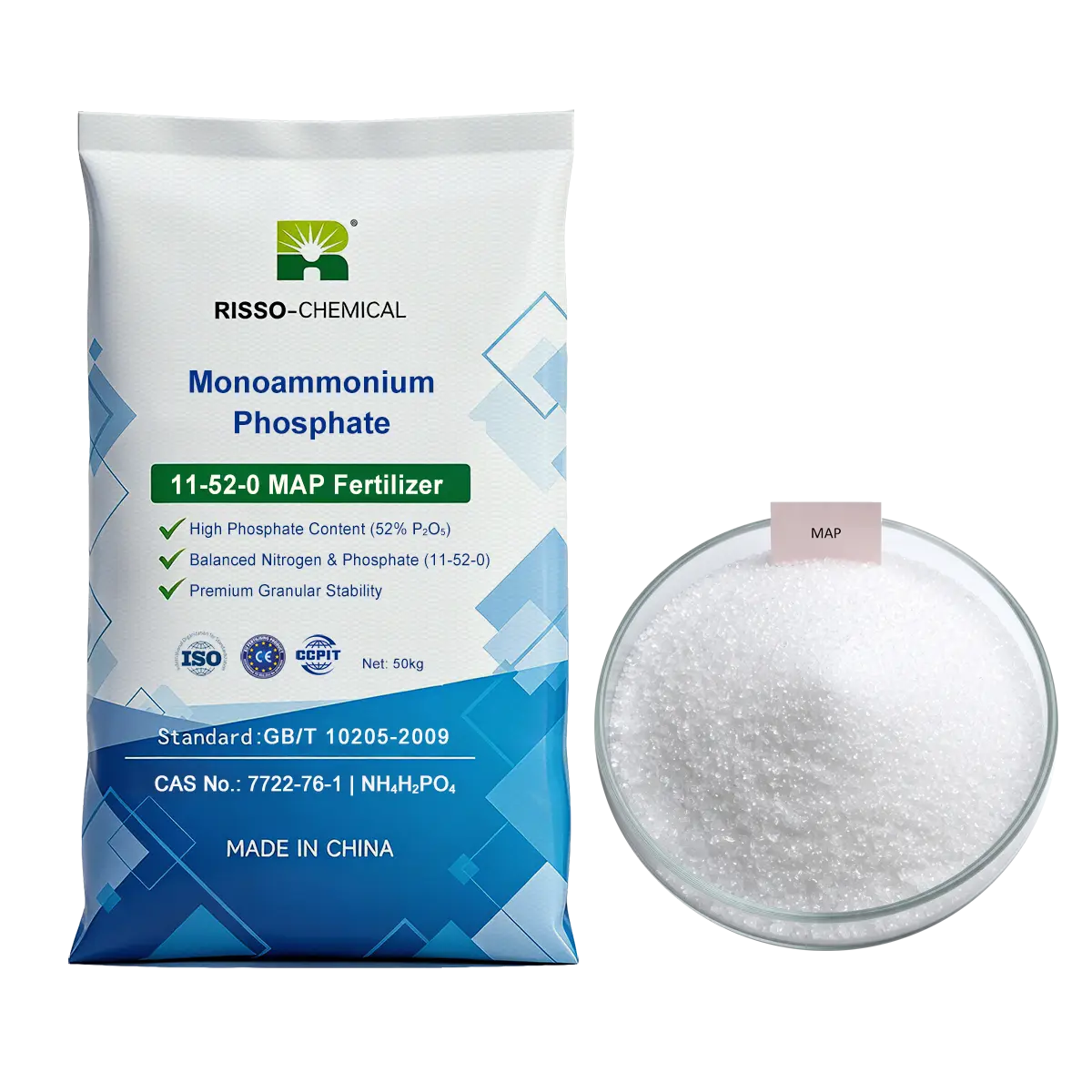
MAP 12-61-0 contains ammonium and dihydrogen phosphate.
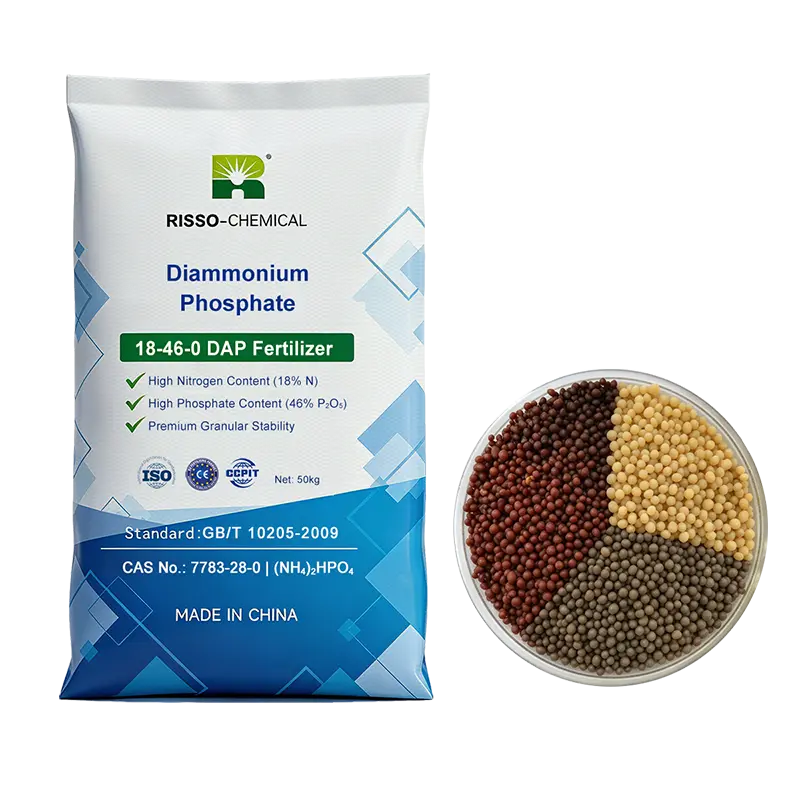
DAP 18-46-0 contains a higher proportion of ammonium and produces a much less acidic solution.
Therefore, two fertilizers that both provide nitrogen and phosphorus can behave very differently in:
This is an important consideration when selecting an NP fertilizer for a specific water or soil condition.

In particular, phosphate and calcium require careful management.
A concentrated mixture containing UP and a calcium fertilizer can create conditions favorable for precipitation, depending on:
For this reason, UP should generally not be assumed to be compatible with concentrated calcium-containing stock solutions.
The same consideration applies to some magnesium-containing fertilizers.
Where necessary, separate stock tanks or separate injection points can be used.
However, the reverse assumption is also unsafe.
A fertilizer mixture should be evaluated under the actual irrigation-water conditions and application concentration.
For commercial fertigation, a small-scale jar compatibility test is a practical first step before full-scale application.
Water pH alone is not enough to determine how much acidification will occur.
The fertilizer specification is only the starting point.
What ultimately reaches the root zone is a diluted solution containing UP, irrigation water and potentially other fertilizers.
Monitoring the final solution can help confirm:This is especially important for concentrated fertilizer solutions.
Its value comes from combining its nutrient supply and acidic reaction with an appropriate fertigation strategy.
Urea phosphate is a crystalline compound formed from urea and phosphoric acid. When it dissolves in water, phosphate species establish acid-base equilibria that generate hydrogen ions, resulting in a strongly acidic solution.
Typical reported values are approximately pH 1.6–2.4, depending on fertilizer concentration and test conditions. A value around 1.8 is commonly reported for a 1% solution.
No. Urea phosphate is a solid crystalline urea-phosphate compound. It supplies both nitrogen and phosphorus and produces an acidic solution when dissolved in water.
UP can be particularly useful in alkaline and calcareous soils because its acidic reaction can temporarily lower pH around the fertilizer placement zone and improve the chemical environment for phosphorus availability.
Yes. Its high water solubility and acidic reaction make UP 17-44-0 suitable for many fertigation systems, particularly where high-pH irrigation water or alkaline soil conditions are present.
It can reduce certain forms of chemical precipitation, particularly calcium-carbonate-related deposits, under suitable water conditions. However, it does not prevent every type of emitter clogging.
Care is required. Concentrated phosphate-calcium mixtures can form precipitates. UP and calcium-containing fertilizers are often better handled through separate stock solutions unless compatibility has been confirmed.
Not necessarily. UP produces a strongly acidic solution, but its long-term effect on soil pH depends on soil buffering capacity, carbonate content, application rate and frequency.
Generally, yes. A 1% UP solution is commonly reported around pH 1.8, whereas MAP solutions are typically around pH 4.3–4.5. DAP has a considerably less acidic, often alkaline, solution reaction.
UP is a crystalline compound formed from urea and phosphoric acid. When dissolved, it establishes equilibria involving phosphoric acid, dihydrogen phosphate, other phosphate species and urea. The resulting hydrogen-ion activity gives UP its characteristic low solution pH.
This acidity has practical consequences.
In alkaline irrigation water, UP can react with bicarbonate and carbonate and alter the carbonate equilibrium. Under suitable conditions, this can reduce the potential for calcium carbonate precipitation in drip-irrigation systems.
In alkaline and calcareous soils, localized acidification around the fertilizer can improve the chemical environment for phosphorus availability.
At the same time, UP should not be considered a universal soil acidifier or irrigation-system cleaner. Its actual performance depends on water alkalinity, calcium and magnesium concentration, soil buffering capacity, fertilizer concentration, application rate and compatibility with other fertilizers.
For fertilizer producers and professional agricultural users, this is the key point: the value of UP is not simply that it has a low pH. Its value comes from combining a highly soluble source of nitrogen and phosphorus with an acidic chemical reaction that can be useful under specific soil and water conditions.
For buyers evaluating UP 17-44-0 fertilizer, factors such as nutrient analysis, solubility, product consistency, application method and technical support are more important than pH alone. Risso supplies water-soluble fertilizer solutions for professional agricultural applications, including UP 17-44-0, with product selection based on practical crop, soil and fertigation requirements.
Ultimately, the right question is not simply “Why is urea phosphate acidic?” but rather:
How can the acidic reaction of UP 17-44-0 be used effectively under a specific soil, irrigation-water and fertigation condition?
That is the practical basis for selecting urea phosphate as an N-P fertilizer.
If you want to know other questions about Urea phosphate Manufacturers or NPK fertilizers , please contact us and we will provide professional answers.
✔ Quick & helpful reply within 6 hours.
✔ Tailored solutions for your project.
✔ One-stop product, tech, market

Want to find a China fertilizer manufacturer?
Risso will be your best choice; send us your request for your fertilizer details requirement
© Copyright 2017 RISSO CHEMICAL. All Rights Reserved.