Calcium nitrate fertilizer is widely used in vegetable production, greenhouse cultivation, fruit growing, and fertigation systems. It supplies two essential nutrients: nitrate nitrogen, which supports plant growth, and calcium, which contributes to cell wall development, tissue strength, and fruit quality.
However, effective calcium nitrate application depends on more than fertilizer selection. Application rates, crop growth stages, irrigation management, and compatibility with other fertilizers all influence nutrient uptake and fertilizer efficiency.
For growers and agricultural buyers evaluating reliable fertilizer solutions,
Risso provides a range of fertilizer products designed to support different crop nutrition requirements and agricultural applications. Selecting the appropriate product and application method should always be based on crop needs, local growing conditions, and verified product specifications.
This guide explains how to apply calcium nitrate fertilizer, when to use it, how to calculate application rates, and which practices help improve nutrient-use efficiency.
1. What Is Calcium Nitrate Fertilizer?
Calcium nitrate is a
water-soluble fertilizer that supplies plants with nitrogen and calcium. It is commonly used in field crops, vegetables, fruit production, greenhouse cultivation, and hydroponic systems.
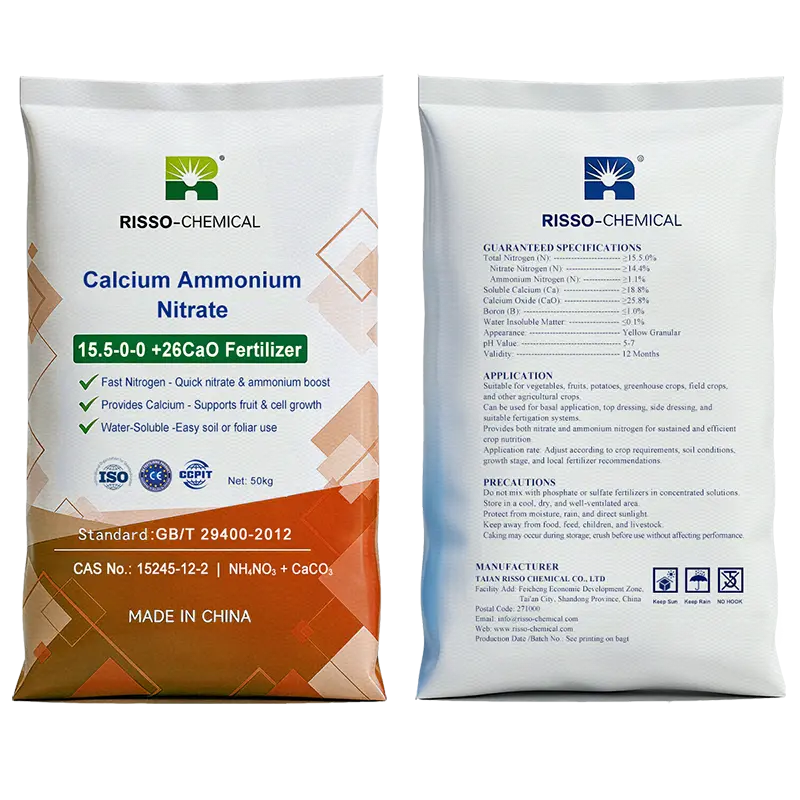
A widely used agricultural grade contains approximately 15.5% total nitrogen and 19% calcium, although the actual composition varies by product. Always verify whether the calcium content is expressed as elemental Ca or calcium oxide (CaO).
Its main functions include:
- – Nitrogen supply: Supports chlorophyll production, protein synthesis, and vegetative growth.
- – Calcium nutrition: Contributes to cell wall formation, membrane stability, and normal development of young tissues.
- – Flexible application: Its water solubility makes it suitable for soil application and properly managed fertigation systems.
Calcium nitrate is particularly useful when crops require both nitrogen and calcium. However, it should be incorporated into a balanced nutrient management program rather than used as a universal solution for every calcium-related disorder.
2. When Should You Apply Calcium Nitrate Fertilizer?
The optimal timing depends on crop type, growth stage, soil conditions, and nutrient requirements.
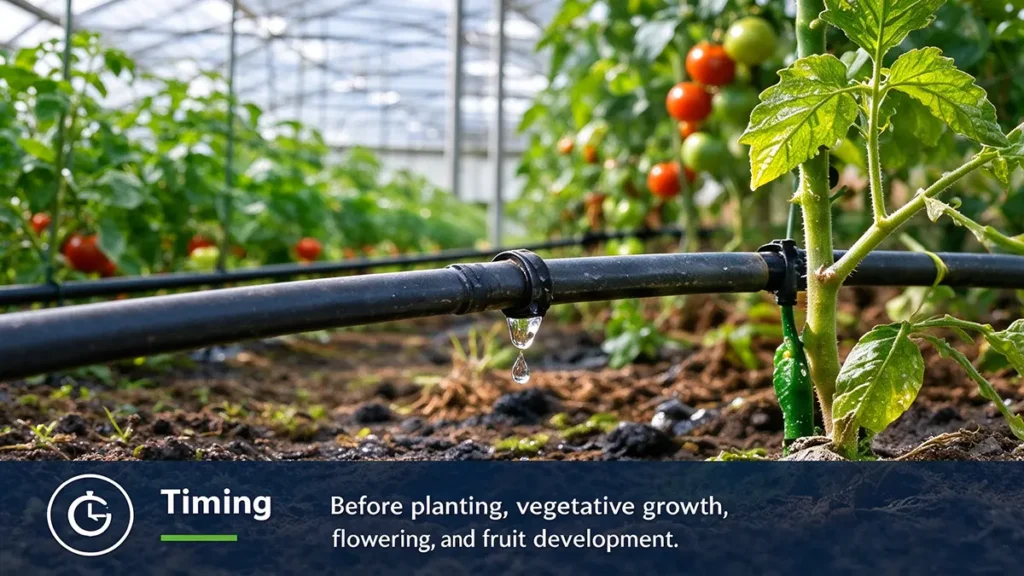
Before planting
Pre-plant application may be appropriate when soil tests indicate a need for additional nitrogen or calcium. However, because calcium nitrate is highly soluble, excessive rainfall or irrigation can move nitrate nitrogen below the active root zone.
In sandy soils and regions with heavy rainfall, splitting applications may improve nutrient-use efficiency.
During vegetative growth
During active vegetative growth, plants require nitrogen to develop leaves, stems, and roots. Calcium also supports the formation of new tissues.
Calcium nitrate can be applied through side-dressing or fertigation when additional nitrogen and calcium are required. Application rates should be adjusted to avoid excessive nitrogen-driven vegetative growth.
During flowering and early fruit development
This period is particularly important for tomatoes, peppers, and other fruiting vegetables.
Blossom-end rot in tomatoes and peppers is associated with inadequate calcium in developing fruit, but it can occur even when the soil contains sufficient calcium. Irregular irrigation, root stress, and excessive vegetative growth can limit calcium delivery to fruit.
Maintaining consistent soil moisture and a balanced nutrient supply is therefore essential. Increasing calcium nitrate application alone may not resolve the problem.
During fruit development and harvesting
For crops with an extended production cycle, nutrient requirements continue throughout fruit development and harvesting. Split applications through fertigation can help match nutrient supply to crop demand while reducing the risk of excessive fertilizer application.
3. How to Apply Calcium Nitrate Fertilizer
Calcium nitrate can be applied through soil application, fertigation, or selected foliar programs. The appropriate method depends on the crop and production system.
3.1 Soil application
Soil application is suitable for field crops, vegetables, and other crops where fertilizer can be placed near the active root zone.
Common methods include:
- – Broadcasting: Distributing fertilizer uniformly over a defined soil area.
- – Side-dressing: Applying fertilizer near crop rows after planting to support continued nutrient uptake.
Avoid direct contact between concentrated fertilizer and seeds, stems, or exposed roots. Irrigate appropriately after application where necessary to dissolve the fertilizer and move nutrients into the root zone.
The rate should be based on soil testing, crop nutrient requirements, and the nutrient contribution from other fertilizers.
3.2 Fertigation
Fertigation delivers dissolved calcium nitrate through an irrigation system. It is widely used in greenhouse vegetables, drip-irrigated crops, and intensive commercial production.
Key advantages include more precise nutrient delivery, flexible application timing, and the ability to divide fertilizer applications throughout the growing season.
Recommended procedure:
- Check irrigation water quality and the compatibility of the intended fertilizers.
- Dissolve calcium nitrate in water according to the product’s solubility guidance.
- Calibrate the injector to deliver the required nutrient concentration.
- Apply the solution uniformly through the irrigation system.
- Flush irrigation lines with clean water as required by the system design.
Important compatibility note: Do not mix concentrated calcium nitrate solutions with phosphate- or sulfate-containing fertilizers unless the specific combination has been confirmed compatible. Calcium phosphate or calcium sulfate precipitation can block filters, pipes, and drip emitters. Separate stock tanks are commonly used to prevent these reactions.
3.3 Foliar application
Foliar application delivers diluted fertilizer directly to plant surfaces. It may be suitable for specific crop programs, particularly certain fruit-quality management practices.
However, calcium moves primarily through the xylem with water uptake and is poorly redistributed from mature leaves to developing fruit. Foliar application therefore cannot be assumed to replace root-zone calcium supply.
Follow crop-specific product instructions, test compatibility before tank mixing, and avoid spraying under conditions that increase leaf injury risk.
4. Calcium Nitrate Fertilizer Application Rates
There is no single application rate suitable for all crops. The correct amount depends on soil fertility, crop demand, growth stage, product analysis, irrigation water, and the complete fertilizer program.
A practical calculation method is:
For example, suppose a crop requires an additional 20 kg of nitrogen per hectare, and the calcium nitrate product contains 15.5% nitrogen.
Approximately 129 kg of this calcium nitrate fertilizer per hectare would supply 20 kg of nitrogen.
If the product also contains 19% elemental calcium, this application would supply approximately 24.5 kg of calcium per hectare.
These figures illustrate nutrient calculations; they are not a universal crop recommendation. The calculated amount must be checked against the crop’s calcium requirement and total nitrogen budget.
| Factor |
Effect on application rate |
| Soil test results |
Determine existing nutrient availability and additional requirements. |
| Crop and growth stage |
Influence nutrient demand throughout the season. |
| Soil texture |
Sandy soils generally require more careful nitrate management because of leaching risk. |
| Irrigation water |
May contribute calcium and affect fertilizer compatibility. |
| Product analysis |
Determines how much fertilizer is needed to supply a target nutrient amount. |
| Other fertilizers |
Must be accounted for to avoid excessive nitrogen or nutrient imbalance. |
For fertigation, smaller, appropriately scheduled applications may be more effective than applying the entire seasonal requirement at once, particularly where nitrate leaching is a concern.
5. Application Guidelines for Different Crops
Calcium nitrate application should be tailored to crop-specific nutrient requirements and growing conditions.
Tomatoes and peppers
Calcium nitrate is commonly used in tomato and pepper production, especially in drip-irrigated systems.
Applications may be scheduled during active growth and early fruit development when the crop requires additional nitrogen and calcium. Consistent irrigation is essential because fluctuations in water availability can interfere with calcium transport to developing fruit.
To manage blossom-end rot, combine appropriate calcium supply with balanced nitrogen and potassium nutrition and stable soil moisture.
Cucumbers and greenhouse vegetables
In greenhouse production, fertigation allows growers to adjust nutrient delivery as plants develop.
Calcium nitrate may be incorporated into the nutrient solution when additional calcium and nitrate nitrogen are required. Monitor nutrient concentration, drainage, root-zone salinity, and irrigation uniformity.
In hydroponic and substrate systems, maintain a balanced nutrient solution rather than increasing calcium nitrate without considering the other nutrients.
Leafy vegetables
Leafy vegetables require sufficient nitrogen for leaf development, while calcium supports tissue structure.
Calcium nitrate can be applied through fertigation or soil application where appropriate. Rates should reflect the crop’s growth cycle, soil fertility, and local recommendations. Excessive nitrogen should be avoided.
Fruit trees and orchard crops
Calcium management in fruit trees depends on species, cultivar, fruit development, and the specific quality issue being addressed.
Calcium nitrate may be used to supply nutrients through the root zone, while selected crops may benefit from crop-specific foliar calcium programs.
For orchard crops, soil and leaf analysis, irrigation management, and local extension recommendations should guide application timing and rates.
6. Best Practices and Common Mistakes
Effective calcium nitrate management depends on maintaining nutrient balance, ensuring reliable water supply, and preventing fertilizer losses.
Best practices
- Maintain consistent soil moisture. Water stress and excessive irrigation can both interfere with effective nutrient management.
- Split applications when appropriate. Smaller applications can help match nutrient supply to crop demand.
- Check fertilizer compatibility. Keep incompatible concentrated calcium, phosphate, and sulfate solutions separate.
- Monitor nutrient status. Use soil tests, plant tissue analysis, and irrigation-water analysis where appropriate.
- Manage nitrogen carefully. Remember that increasing calcium nitrate also increases nitrogen input.
- Follow product specifications. Confirm nutrient analysis, solubility, application instructions, and crop suitability before use.
Common mistakes to avoid
| Mistake | Potential consequence | Recommended approach |
| Applying the same rate to every crop | Over- or under-application | Use crop-specific recommendations. |
| Increasing fertilizer without checking irrigation | Persistent calcium-related disorders | Correct water management and assess root-zone conditions. |
| Mixing incompatible fertilizers | Precipitation and blocked emitters | Verify compatibility and use separate stock tanks where needed. |
| Applying excessive nitrogen | Excessive vegetative growth and nutrient losses | Account for all nitrogen sources. |
| Relying only on foliar sprays | Insufficient calcium delivery to some developing tissues | Prioritize appropriate root-zone nutrition where necessary. |
For growers and agricultural buyers comparing fertilizer products, Risso emphasizes the importance of matching fertilizer specifications and application methods to the actual nutrient requirements of each crop. Product analysis, solubility, and compatibility should be evaluated before incorporating any fertilizer into a commercial nutrient management program.
Frequently Asked Questions (FAQs)
Conclusion
Calcium nitrate fertilizer is a useful source of nitrogen and calcium for vegetables, greenhouse crops, fruit production, and fertigation systems. Its effectiveness depends on choosing the appropriate application method, timing applications to crop demand, and maintaining balanced nutrition and consistent irrigation.
Soil application is suitable for many field crops, while fertigation offers greater control over nutrient delivery in intensive production systems. Foliar application should be reserved for appropriate crop-specific programs.
The most reliable strategy is to base application rates on nutrient analysis and crop requirements, avoid incompatible fertilizer mixtures, and monitor soil moisture and plant response throughout the growing season.
For agricultural buyers seeking fertilizer solutions for different production systems, Risso offers a starting point for evaluating product specifications and application suitability. The final product choice and application program should always reflect verified technical data, crop requirements, and local agronomic recommendations.
Fertilizer Related Products
If you want to know other questions about Calcium Nitrate or NPK fertilizers , please contact us and we will provide professional answers.