Calcium nitrate fertilizer is widely used in greenhouse production, fertigation, hydroponics, and field agriculture where crops need readily available nitrogen and calcium. However, not all calcium nitrate products are suitable for the same applications. Differences in nutrient composition, water solubility, insoluble residue, packaging, and quality control can affect fertilizer performance, irrigation system reliability, and total procurement costs.
For fertilizer importers, distributors, greenhouse operators, and agricultural input manufacturers, choosing a calcium nitrate fertilizer supplier should involve more than comparing prices per metric ton. Buyers need to establish whether a product meets the required nutrient guarantees, whether its physical and chemical properties match the intended application, and whether the supplier can provide reliable batch-level quality records and the documentation required for the destination market.
For procurement teams comparing offers from Risso Fertilizer and other potential suppliers, the following guide explains how to evaluate calcium nitrate fertilizer quality, compare technical specifications, verify documentation, and reduce purchasing risks.
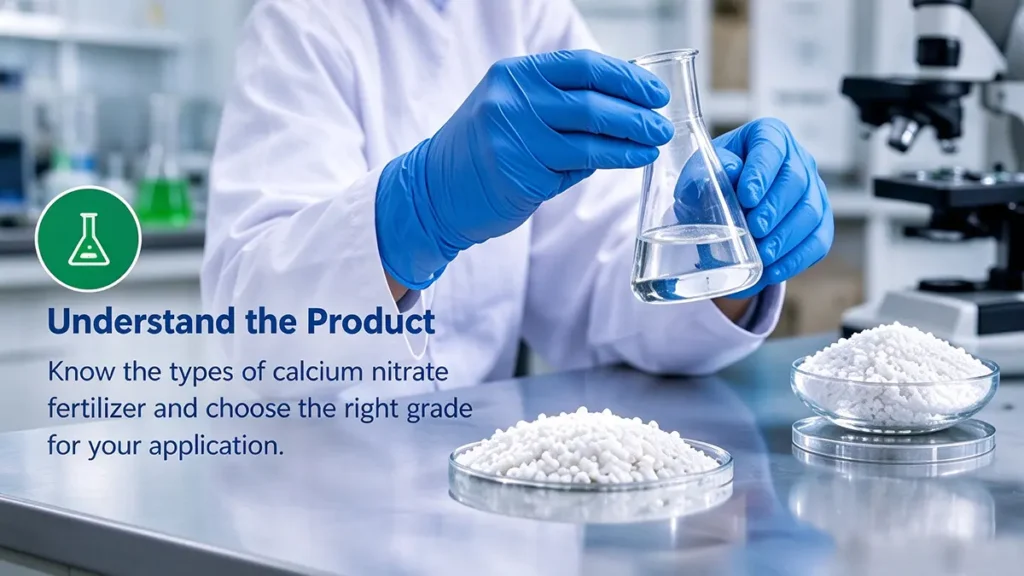
1. Understand the Different Types of Calcium Nitrate Fertilizer
Before evaluating a calcium nitrate fertilizer supplier, buyers should define the product grade and intended application. A fertilizer designed for open-field application may not meet the requirements of a precision fertigation system.
Calcium nitrate is a source of nitrogen and calcium. Commercial fertilizer grades commonly contain both nitrate nitrogen and a smaller proportion of ammoniacal nitrogen, although the exact composition depends on the formulation.
Agricultural-grade calcium nitrate
Agricultural products are used in field crops, orchards, vegetable production, and other farming systems. Depending on the product, they may be suitable for soil application, fertigation, or both.
When purchasing this grade, buyers should check the nutrient guarantees, granule quality, moisture content, and suitability for the planned application method.
A product intended for soil application should not automatically be considered suitable for drip irrigation. Its insoluble content and dissolution characteristics need to be verified.
Greenhouse and fertigation-grade calcium nitrate
Greenhouse-grade calcium nitrate is typically selected for crops requiring precise nutrient management, including tomatoes, cucumbers, peppers, lettuce, and strawberries.
These products need reliable solubility and low insoluble residue to reduce the risk of sediment accumulation and irrigation emitter blockage. The actual specification should be matched to the grower’s nutrient solution system and water quality.
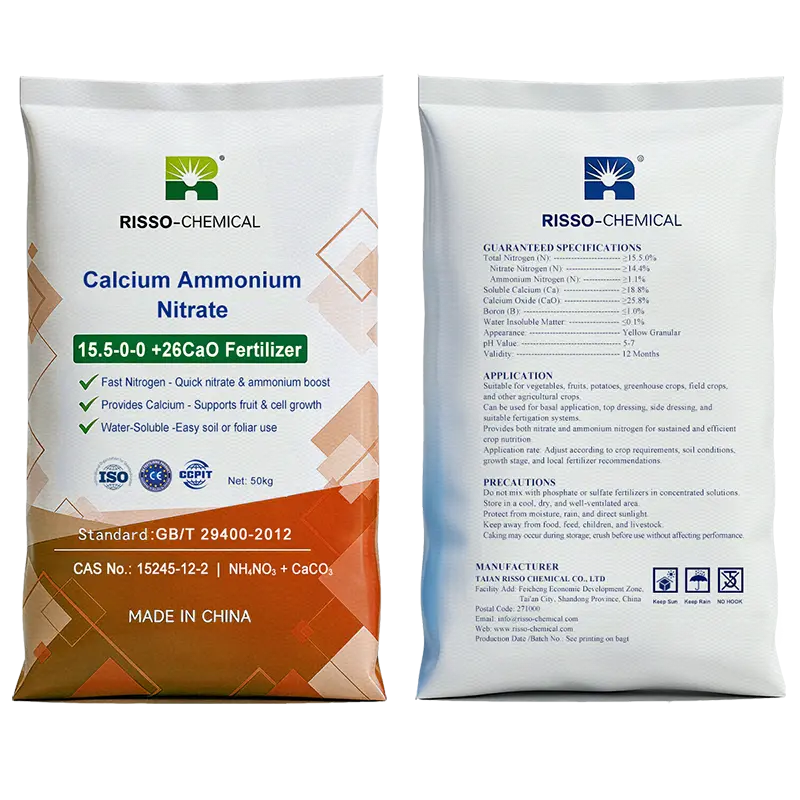
For example, Risso publishes a greenhouse-grade calcium nitrate specification of 15.5-0-0 + 26.5% CaO, equivalent to approximately 19% elemental calcium. Its published specification also includes nitrate nitrogen, ammoniacal nitrogen, insoluble matter, and solution pH. These figures are a useful reference for comparing similar products, not a universal specification for every calcium nitrate grade.
Liquid calcium nitrate
Liquid calcium nitrate may be appropriate for certain fertigation systems and industrial agricultural operations. Buyers should confirm the guaranteed nitrogen and calcium concentrations, solution density, crystallization behavior under expected storage temperatures, and shelf-life conditions.
Liquid and solid products should be compared on the basis of actual nutrient content and delivered usable nutrients, rather than price per ton alone.
The first question to ask a supplier is therefore not simply, “What is your calcium nitrate price?” It is, “Which grade are you supplying, and does its specification match my application?”
2. Check Nutrient Content and Technical Specifications
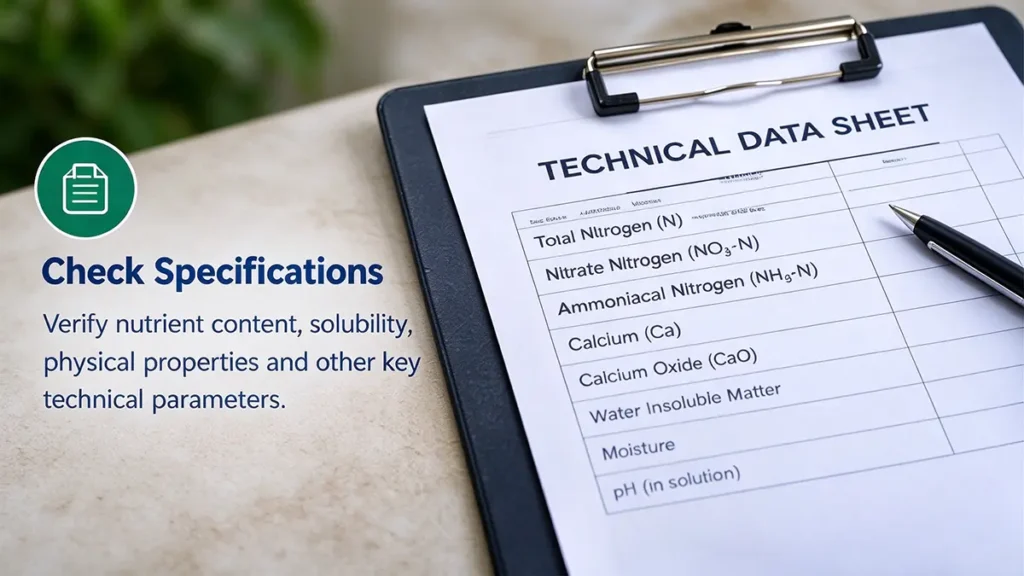
A reliable calcium nitrate fertilizer supplier should provide a technical data sheet (TDS) with defined nutrient guarantees and measurable quality parameters. The buyer should review the specification before requesting a final quotation.
The following table provides a practical checklist for solid calcium nitrate fertilizer.
| Parameter | What buyers should verify | Why it matters |
| Total nitrogen (N) | Guaranteed percentage by weight | Determines nitrogen supply and fertilizer dosage |
| Nitrate nitrogen (NO₃-N) | Percentage of total product | Identifies the readily available nitrate fraction |
| Ammoniacal nitrogen (NH₄-N) | Percentage of total product | Affects nitrogen form and nutrient solution formulation |
| Calcium (Ca) | Elemental calcium percentage | Allows accurate comparison of calcium supply |
| Calcium oxide (CaO) | Percentage, if declared | Must be distinguished from elemental calcium |
| Water-insoluble matter | Maximum percentage and test method | Indicates potential residue in fertigation systems |
| Solution pH | pH and specified concentration | Helps characterize the product in solution |
| Moisture | Guaranteed or maximum content, where specified | Helps assess handling, storage, and physical stability |
| Appearance and particle size | Form, granule size, and acceptance criteria | Affects handling, dissolution, and application equipment |
| Chloride, sodium, and trace contaminants | Limits appropriate to the intended use | Important where crop sensitivity or local requirements apply |
Pay attention to elemental calcium versus calcium oxide
This is one of the most important points when comparing supplier quotations.
Calcium may be expressed as elemental calcium (Ca) or calcium oxide equivalent (CaO). These are not interchangeable percentages.
The approximate conversion is:
Calcium (Ca) = calcium oxide (CaO) × 0.715
For example, a product containing 26.5% CaO supplies approximately 18.9% elemental calcium, conventionally rounded to 19% in the cited greenhouse-grade specification.
If one supplier quotes 19% Ca and another quotes 26.5% CaO, their figures may describe essentially the same calcium concentration. Comparing the numbers without checking their chemical basis can lead to incorrect purchasing decisions.
Verify nitrogen distribution
Two products can have similar total nitrogen content but different proportions of nitrate nitrogen and ammoniacal nitrogen.
This difference matters when formulating a nutrient solution or following a crop-specific nitrogen management program. Ask the supplier to identify each nitrogen fraction separately rather than relying solely on the total N figure.
Establish acceptance limits before placing an order
Do not rely on terms such as “high quality,” “premium grade,” or “fully soluble” without numerical specifications.
The purchase specification should state which parameters are guaranteed, the applicable test method where relevant, and the acceptable limits for each parameter. The certificate of analysis supplied for the shipment should then be checked against these agreed values.
3. Evaluate Solubility and Physical Quality
For fertigation-grade calcium nitrate, solubility is a critical operating parameter. A high nutrient content does not guarantee that a fertilizer will dissolve cleanly enough for use in a particular irrigation system.
Water solubility and insoluble residue
Ask the supplier for information on:
- Solubility under defined test conditions, including temperature where relevant.
- Maximum water-insoluble matter.
- The test method used to measure insoluble residue.
- Whether the product produces a clear solution under the intended operating conditions.
Avoid treating “100% water soluble” as a complete technical specification. Buyers should establish the test conditions and allowable residue, particularly when the fertilizer will be used in drip irrigation or hydroponic nutrient solutions.
University of Florida agricultural guidance emphasizes that fertigation products should be selected with attention to solubility, precipitation potential, compatibility, and the risk of irrigation system blockage.
Appearance and granule consistency
Inspect the product’s appearance and physical condition. For solid fertilizer, useful checks include:
- Consistent color and particle appearance.
- Limited dust and excessive fines.
- Free-flowing granules without significant hard caking.
- No visible foreign matter, damaged packaging, or signs of moisture exposure.
A white appearance alone does not prove chemical purity. Visual inspection should complement, not replace, laboratory analysis.
Compatibility with other fertilizers
Calcium nitrate requires particular care when preparing concentrated fertilizer solutions.
Mixing calcium nitrate with phosphate-containing fertilizers can produce insoluble calcium phosphate. Mixing it with sulfate-containing fertilizers can produce calcium sulfate under suitable conditions. These precipitates can settle in tanks or clog irrigation lines and emitters.
For this reason, calcium nitrate is commonly kept in a separate concentrated stock solution from phosphate and sulfate fertilizers. Before combining products, follow the fertilizer manufacturer’s compatibility instructions and assess the quality of the irrigation water.
A product’s suitability for fertigation depends not only on the fertilizer itself, but also on the water source, mixing concentration, temperature, and operating system.
4. Assess the Supplier's Manufacturing and Quality Control
A supplier’s technical claims are more credible when they are supported by a consistent quality management process. Buyers should distinguish between a manufacturer with direct control over production and a trading company that sources fertilizer from other factories.
Both may be suitable business partners, but they should be evaluated according to their actual roles and responsibilities.
Confirm the supplier's production capability
Ask whether the supplier manufactures the product directly or purchases it from another producer. If it is a manufacturer, request relevant information about the production process, quality control laboratory, production capacity, and normal lead time.
If it is a trading company, confirm the identity of the actual manufacturer where disclosure is possible, and establish who is responsible for product conformity, claims, and replacement in the event of a quality problem.
Review the quality control process
A well-defined quality control system should address raw materials, production batches, finished-product testing, packaging inspection, and product traceability.
Questions worth asking include:
- Is every production batch tested against the agreed specification?
- Can the supplier provide a batch-specific certificate of analysis?
- Are the analytical methods identified and appropriate for the parameters tested?
- Can the manufacturer trace a shipment back to its production lot?
- What is the procedure for handling out-of-specification products?
A supplier should be able to explain its process clearly rather than provide only general statements about quality.
Verify certifications carefully
An ISO 9001 certificate can provide evidence of a quality management system within its stated scope. However, it is not a product-specific guarantee that every shipment meets the required nutrient content or solubility limits.
Check the certificate holder, issuing certification body, validity period, and scope of certification. Where necessary, request third-party verification.
For buyers comparing suppliers such as Risso Fertilizer, these checks help establish whether the supplier’s quality controls, technical support, and commercial arrangements match the requirements of the intended market.
5. Verify Certificates and Export Documentation
For international fertilizer procurement, product quality and documentation should be reviewed together. A technically suitable product may still encounter clearance delays or market access problems if required documents are incomplete, inconsistent, or unsuitable for the destination country.
The exact requirements depend on the importing country, product classification, commercial arrangement, and intended use.
Essential product documents
| Document | What to check |
| Technical Data Sheet (TDS) | Nutrient guarantees, physical properties, application suitability, and specification limits |
| Certificate of Analysis (COA) | Actual test results for the relevant batch or lot |
| Safety Data Sheet (SDS) | Product identification, hazards, handling, storage, and applicable transport information |
| Product label or specification sheet | Guaranteed analysis, manufacturer details, batch identification, and required labeling information |
| Quality management certificates | Authenticity, validity, certification scope, and issuing body |
| Third-party inspection or test report | Sampling details, tested parameters, methods, and inspection scope, if required |
A TDS and a COA serve different purposes. The TDS describes the product’s typical characteristics and guaranteed specification. The COA reports analytical results for a particular batch or lot. One does not automatically replace the other.
For higher-volume purchases, buyers may consider independent pre-shipment sampling and testing, especially when working with a new supplier or introducing a new product into an established supply chain.
Essential shipping and customs documents
Depending on the transaction and destination, an export shipment may require:
- Commercial invoice.
- Packing list.
- Bill of lading or other applicable transport document.
- Certificate of origin, where required or requested.
- Inspection certificate, where contractually or legally required.
- Import permit, fertilizer registration, or product conformity documents, where applicable.
Do not assume that every shipment needs every document on this list. Confirm the specific requirements with the importer, customs broker, freight forwarder, and relevant local authority before shipment.
Confirm destination-market fertilizer regulations
Regulatory compliance must be assessed for the actual market, not assumed from the supplier’s country of origin.
For example, fertilizer products placed on the EU market under the EU fertilising products framework may need to meet the applicable requirements of Regulation (EU) 2019/1009, including relevant conformity assessment, technical documentation, labeling, and CE marking obligations. National fertilizer rules and other applicable product routes should also be considered where relevant.
For other destinations, confirm whether fertilizer registration, local-language labeling, product testing, or specific import approvals apply.
The SDS should also match the exact formulation being shipped. Product hazard and transport classifications must be confirmed from the applicable documentation and transport rules; they should not be inferred from the product name alone.
6. Check Packaging, Storage, and Transportation Arrangements
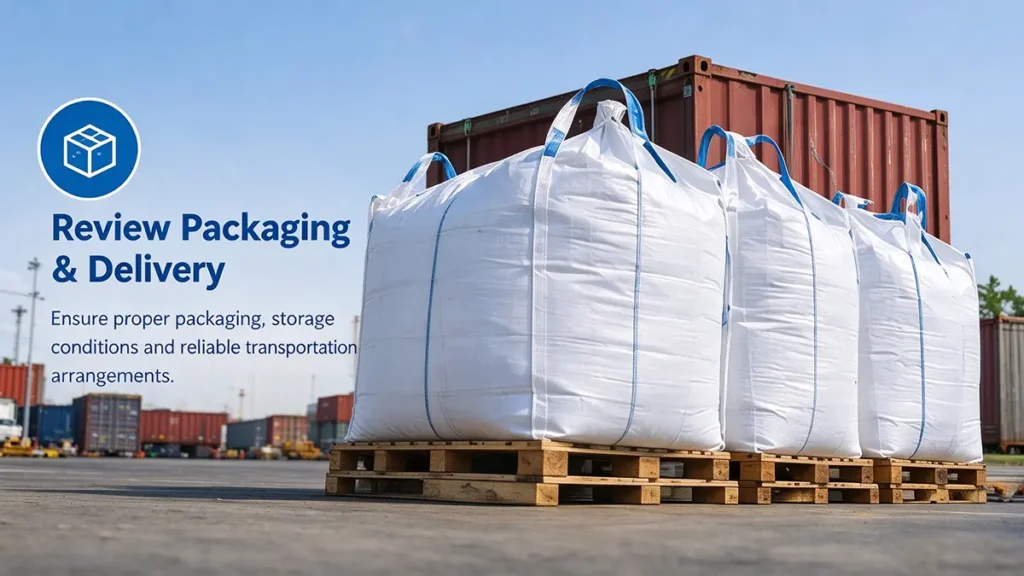
Packaging is part of product quality, particularly for calcium nitrate fertilizer shipped over long distances or stored in humid conditions. Poor moisture protection can contribute to caking and handling difficulties.
Select the right packaging format
Common packaging options include 25 kg bags, 50 lb bags, and 1,000 kg bulk bags, although availability varies by supplier. Haifa’s published greenhouse-grade product specifications, for example, list 25 kg and 50 lb bags, as well as 1,000 kg bags with an inner polyethylene liner.
When requesting a quotation, confirm the following details:
- Net weight per bag and total shipment quantity.
- Bag material and moisture-barrier liner.
- Whether bags are palletized or loaded individually.
- Pallet material, dimensions, and applicable shipping requirements.
- Labeling, batch-number identification, and packaging customization.
- Packaging condition and responsibility for damage during transit.
For bulk purchases, buyers should calculate the practical advantages of each format. Larger bags can reduce handling and packaging costs, while smaller bags may be easier for distributors and agricultural retailers to handle.
Confirm storage and transport conditions
Ask the supplier for written storage recommendations and confirm that the proposed packaging is appropriate for the expected transit and storage environment.
Before loading, inspect the shipping containers or transport vehicles for cleanliness, dryness, damage, and potential contamination. Packaging should be intact and clearly identifiable by product and batch.
Also request the current SDS for the exact grade and formulation. Its storage, handling, and transport information should be reviewed before dispatch, with the carrier and freight forwarder confirming any applicable transport restrictions.
For long-distance shipments, the agreement should specify how wet, damaged, contaminated, or seriously caked material will be handled if it is discovered at destination.
7. Compare Total Procurement Costs, Not Just the Quoted Price
Calcium nitrate fertilizer quotations are meaningful only when the products and commercial terms are comparable.
A lower price per metric ton may not represent better value if the product has a lower nutrient concentration, a higher insoluble content than the buyer can accept, unsuitable packaging, or a longer lead time.
Compare quotations on the same basis
| Cost factor | Questions to ask |
| Nutrient value | Are total N and elemental Ca stated on the same basis? |
| Product quality | Do both products meet the same specification and test requirements? |
| Packaging | Are bag weights, liners, and pallet arrangements equivalent? |
| Freight | Are the quotations based on the same delivery terms and destination? |
| Inspection | Are sampling, laboratory testing, and inspection included? |
| Documentation | Are required certificates and compliance documents available? |
| Payment terms | Are the payment schedule and associated costs comparable? |
| Delivery | Are production lead time, shipping schedule, and delivery commitments realistic? |
Use landed cost where appropriate
For imported fertilizer, a useful starting point is:
Landed cost per metric ton = Total cost delivered to the agreed destination ÷ Net metric tons delivered
Depending on the selected Incoterm and the buyer’s accounting approach, total cost may include the purchase price, freight, insurance, customs duties, inspection, port handling, inland transport, and other applicable charges.
Exclude costs already included in the quoted price to avoid double counting. Keep recoverable taxes separate where appropriate.
For example, when comparing two suppliers offering similar calcium nitrate grades, a quotation with a higher product price may still be preferable if it includes better moisture protection, more reliable shipment scheduling, and the documentation needed to clear the goods without avoidable delays.
The correct decision should reflect technical suitability, compliance, delivery reliability, and the total cost of receiving usable fertilizer.
8. Prepare a Clear Calcium Nitrate Fertilizer RFQ
A detailed request for quotation (RFQ) helps suppliers provide comparable offers and reduces misunderstandings before a purchase order is issued.
Instead of asking only for the current calcium nitrate price, buyers should define the required product, acceptance criteria, quantity, packaging, and commercial terms.
A professional RFQ should cover the following information.
| RFQ item | Information to specify |
| Product | Calcium nitrate fertilizer, including intended grade and application |
| Nutrient analysis | Required total N, nitrate-N, ammoniacal-N, and elemental Ca or CaO |
| Technical limits | Insoluble matter, pH, moisture, and relevant impurity limits |
| Physical form | Granular, prilled, crystalline, or liquid |
| Application | Field agriculture, fertigation, greenhouse, or hydroponics |
| Quantity | Trial order, initial shipment, and estimated annual requirement |
| Packaging | Bag weight, liner, palletization, and label requirements |
| Quality documents | TDS, batch COA, SDS, and any specified inspection report |
| Regulatory requirements | Registration, conformity, or labeling documents applicable to the destination |
| Commercial terms | Incoterm, destination port, payment terms, and quotation validity |
| Delivery | Production lead time, estimated shipment date, and available supply capacity |
The technical limits should be mutually agreed upon rather than copied blindly from another supplier’s data sheet. Some parameters are critical for fertigation, while others depend on crop sensitivity, local regulations, or the buyer’s quality requirements.
For a first purchase, consider requesting a representative sample for independent testing. Where a sample is not sufficient to establish commercial-batch consistency, negotiate pre-shipment inspection and clear acceptance procedures.
If a buyer is evaluating Risso Fertilizer or another potential supply partner, submitting the same RFQ to each supplier makes it easier to compare the actual product specifications, documentation, and commercial conditions.
9. Common Mistakes When Selecting a Calcium Nitrate Supplier
Several procurement mistakes can be avoided by agreeing on the specification and verification process before confirming an order.
Choosing solely by price. A lower quotation may reflect a different grade, nutrient guarantee, packaging format, or delivery basis. Compare technically equivalent products before evaluating price.
Confusing CaO with elemental calcium. The two figures represent different reporting bases. Normalize the values before calculating nutrient cost.
Assuming all calcium nitrate is suitable for fertigation. Field-grade products may not meet the insoluble-residue requirements of sensitive irrigation systems. Confirm application suitability against measurable parameters.
Accepting a generic COA. A sample certificate or standard specification does not establish the quality of the actual shipment. Request batch-specific test results linked to identifiable lots.
Treating ISO certification as proof of every product claim. Verify the scope of the certificate and the actual product quality evidence separately.
Ignoring import requirements until the shipment arrives. Product registration, labeling, transport, and customs requirements should be confirmed before production or dispatch.
Failing to define the procedure for quality disputes. The contract should identify the applicable specification, sampling method, independent laboratory arrangements where needed, claim deadlines, and agreed remedies for nonconforming goods.
These controls are especially important for long-term supply agreements, in which consistency between shipments may matter as much as the quality of the initial order.
Frequently Asked Questions (FAQs)
Conclusion
Choosing a Calcium nitrate fertilizer supplier requires a combination of technical evaluation, quality verification, regulatory preparation, and commercial risk management.
The most reliable procurement process begins with a clearly defined product specification. Buyers should verify nutrient content, distinguish elemental calcium from CaO, establish acceptable limits for insoluble matter, and confirm that the product is suitable for the intended agricultural application. They should then evaluate the supplier’s quality control process, verify batch-level documentation, and confirm packaging, delivery terms, and destination-market requirements before placing an order.
For recurring purchases, consistency between shipments is particularly important. A supplier that can provide clear specifications, traceable quality records, dependable delivery arrangements, and responsive technical support offers a stronger basis for a long-term supply relationship than a supplier selected on price alone.
The key principle is simple: select calcium nitrate fertilizer based on verified product quality and total delivered value, not just the quoted price per metric ton. This approach helps importers, distributors, and agricultural producers reduce procurement risks while maintaining more consistent fertilizer quality and supply.
Fertilizer Related Products
If you want to know other questions about Calcium Nitrate or NPK fertilizers , please contact us and we will provide professional answers.