











2026-10-09
Select language:

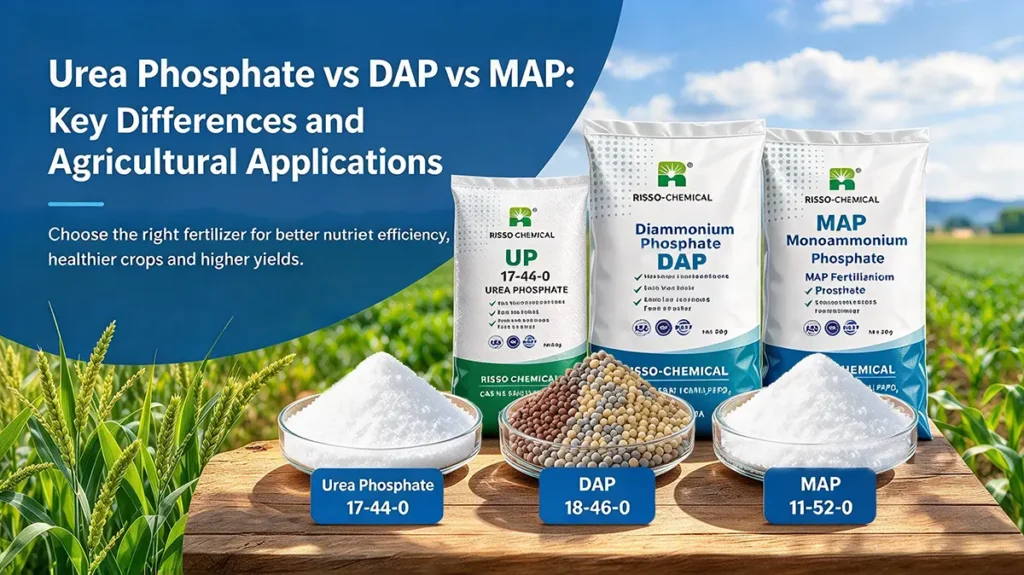
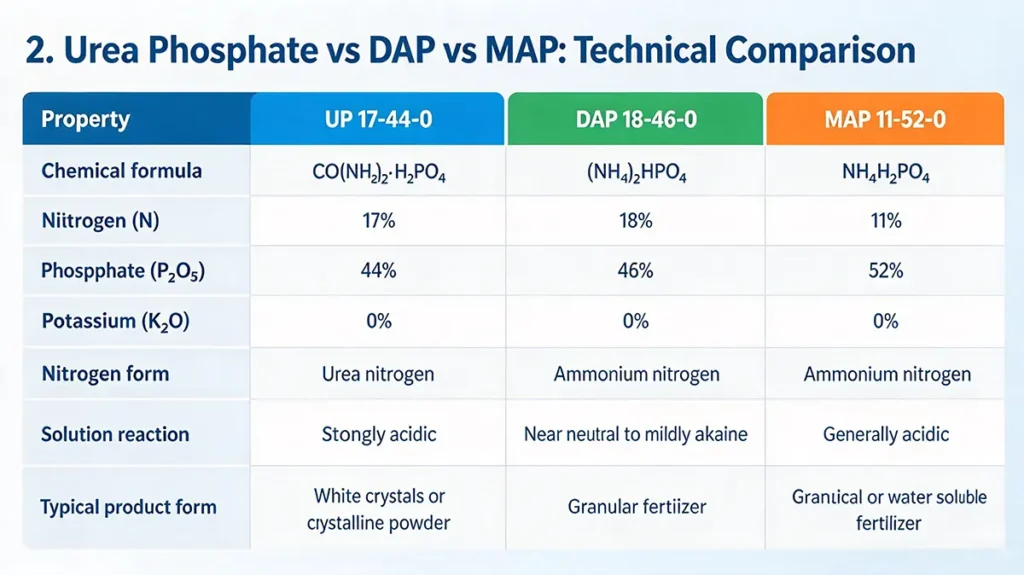
Urea phosphate (UP), diammonium phosphate (DAP), and monoammonium phosphate (MAP) are nitrogen–phosphorus fertilizers used in conventional soil fertilization, specialty fertilizer production, and, where the product specifications permit, fertigation. Although all three supply nitrogen and phosphorus, they differ in nitrogen form, nutrient concentration, solution chemistry, and suitability for different application systems.
The distinction becomes particularly important when selecting a fertilizer for drip irrigation, high-pH growing conditions, starter fertilizer programs, or large-scale field crops. A product that works well as a basal fertilizer may not be the most appropriate choice for preparing a concentrated stock solution for an irrigation system.
This article compares the typical commercial grades of UP 17-44-0, DAP 18-46-0, and MAP 11-52-0. It examines their nutrient composition, chemical behavior, agricultural applications, and practical limitations to help growers, fertilizer distributors, and agricultural input buyers make better-informed decisions.
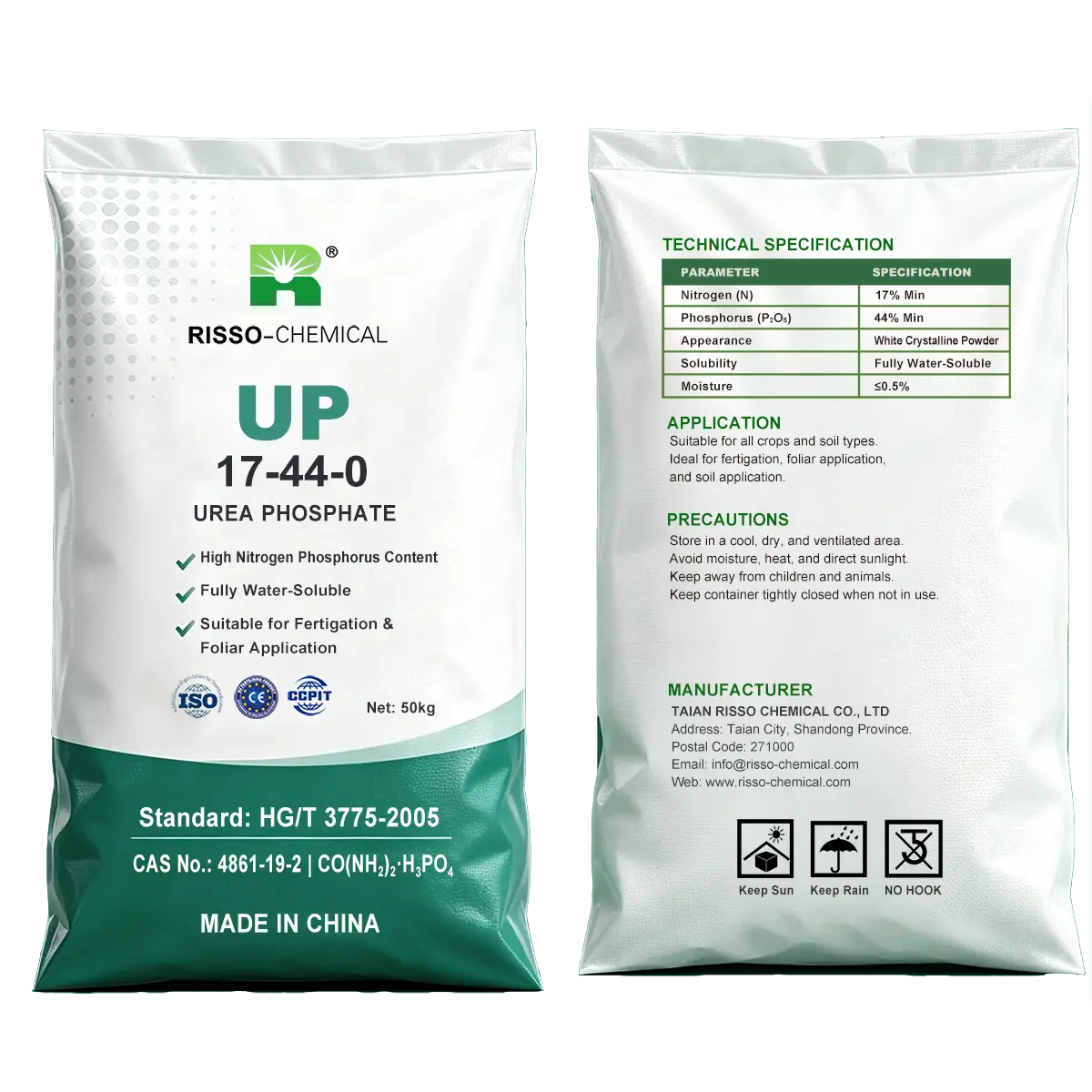
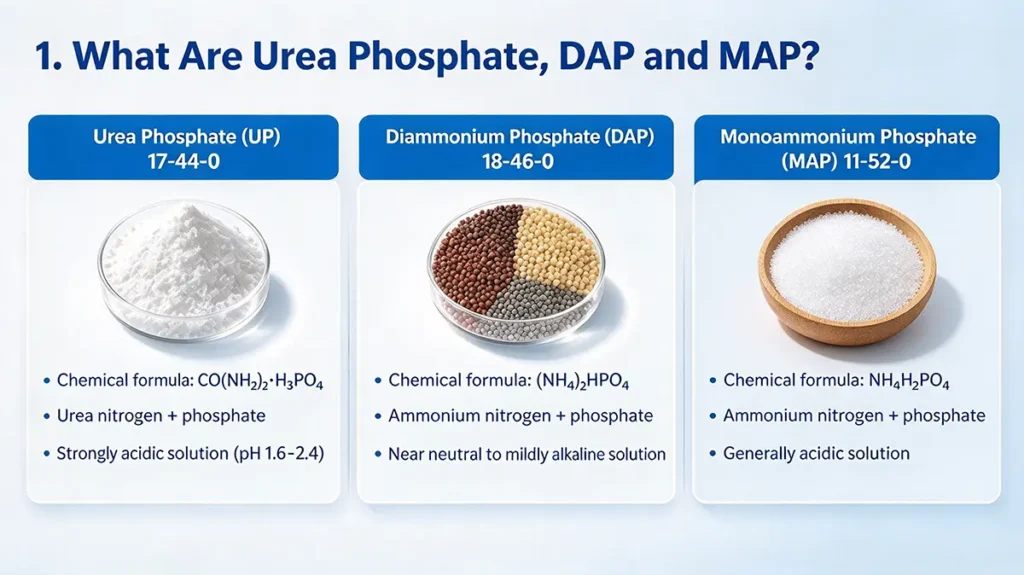
Urea phosphate has the chemical formula CO(NH₂)₂·H₃PO₄. A typical commercial grade contains approximately 17% nitrogen and 44% phosphate expressed as P₂O₅, with no declared potassium.
UP is generally supplied as white crystals or crystalline powder. Its main technical characteristics are high water solubility and a strongly acidic reaction in solution. Commercial specifications commonly report a pH around 1.6–2.4 for a 10% solution, although the actual value depends on the product and test method.
However, UP should not be treated as a universal soil acidifier or a guaranteed solution to irrigation-system scaling. Its performance depends on water alkalinity, calcium concentration, fertilizer dosage, and the overall nutrient program.
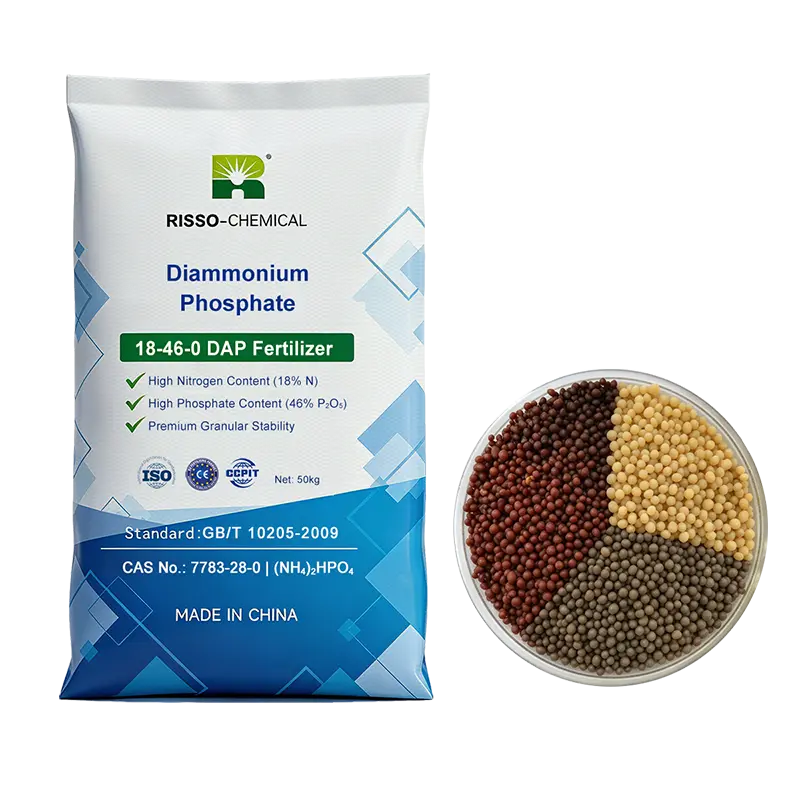
DAP has the chemical formula (NH₄)₂HPO₄. The standard commercial grade contains 18% ammonium nitrogen and 46% P₂O₅.
DAP is widely used for pre-plant fertilization, basal application, soil incorporation, and compound fertilizer production. Its relatively high nutrient concentration makes it practical for field-crop programs that require both nitrogen and phosphorus.Under certain conditions, this can increase ammonia-related injury risks when DAP is placed too close to germinating seeds. Appropriate placement and application rates are therefore important, especially for sensitive crops and dry soils.
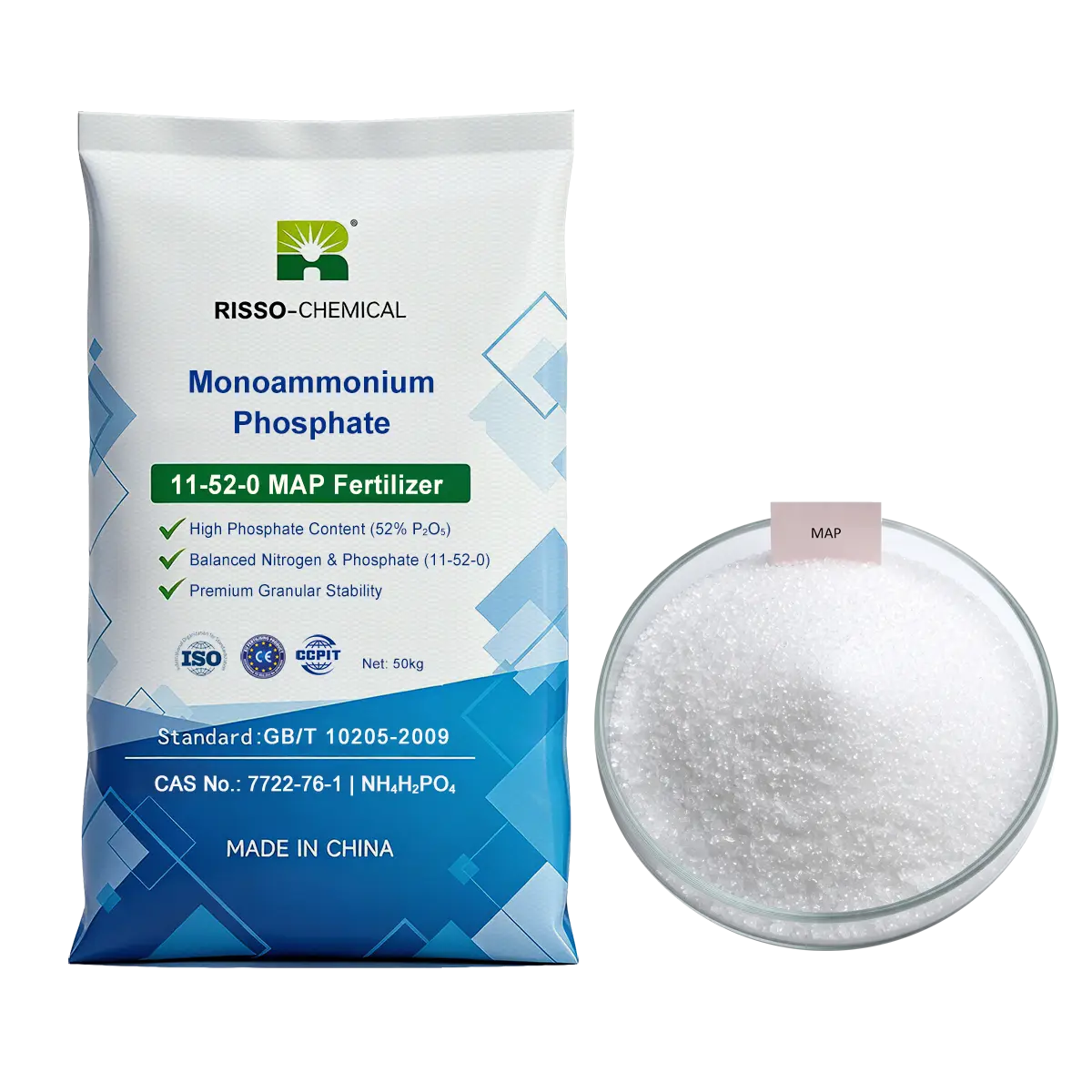
MAP has the chemical formula NH₄H₂PO₄. The common 11-52-0 grade contains 11% ammonium nitrogen and 52% P₂O₅.
MAP is widely used in starter fertilizer programs, basal applications, and fertilizer blends. Water-soluble grades are also used in fertigation when their purity, insoluble-matter content, and compatibility meet the requirements of the irrigation system.
Compared with DAP, MAP supplies more phosphate per unit of product weight but less nitrogen. This makes it useful when phosphorus demand is relatively high and the fertilizer program needs to limit additional nitrogen.
One qualification is important: MAP 11-52-0 is a common granular grade, not the only commercial MAP specification. Water-soluble MAP products may have different analyses, such as 12-61-0. The actual label and technical data sheet should always be used when comparing products.
|
Characteristic |
Urea Phosphate (UP) |
DAP |
MAP |
|---|---|---|---|
|
Typical grade |
17-44-0 |
18-46-0 |
11-52-0 |
|
Nitrogen content |
17% |
18% |
11% |
|
P₂O₅ content |
44% |
46% |
52% |
|
Nitrogen form |
Primarily urea nitrogen |
Ammonium nitrogen |
Ammonium nitrogen |
|
Chemical reaction |
Strongly acidic in solution |
Usually neutral to mildly alkaline in solution |
Acidic in solution |
|
Water solubility |
High |
High |
High |
|
Common physical form |
White crystals or crystalline granules |
Granules |
Granules or water-soluble products |
|
Typical application |
Specialty soluble fertilizer and fertigation |
Basal, pre-plant, and soil fertilization |
Starter fertilizer, soil application, and fertigation with suitable grades |
|
Main advantage |
Combines soluble N and P with an acidic reaction |
High N content and established bulk-fertilizer use |
High phosphate concentration and suitability for starter programs |
|
Main consideration |
Water chemistry, solution acidity, and compatibility |
Seed-placement risk and local alkalinity around dissolving granules |
Nitrogen supply must match crop demand; precipitation is possible in unsuitable irrigation water |
Choose UP when: the fertilizer program calls for soluble N and P together with an acidic solution reaction.
Choose DAP when: both nitrogen and phosphorus are required in a conventional soil-applied fertilizer program.
Choose MAP when: phosphorus supply is the priority and additional nitrogen should be relatively limited.
These are selection guidelines, not fixed rules. The application method and actual product specification can change which option is most suitable.
The typical grades of urea phosphate (UP), diammonium phosphate (DAP), and monoammonium phosphate (MAP) differ in their nitrogen and phosphorus concentrations. The table below compares their nutrient contributions per 100 kg of product.
| Nutrient | UP 17-44-0 | DAP 18-46-0 | MAP 11-52-0 |
|---|---|---|---|
| Nitrogen (N) | 17 kg | 18 kg | 11 kg |
| Phosphate (P₂O₅) | 44 kg | 46 kg | 52 kg |
| Elemental phosphorus (P), approx. | 19.2 kg | 20.1 kg | 22.7 kg |
| Potassium (K₂O) | 0 kg | 0 kg | 0 kg |
Elemental phosphorus is calculated using the conversion factor:
P ≈ P₂O₅ × 0.4364
Fertilizer grades conventionally express phosphorus content as P₂O₅, while soil and plant laboratory reports may express it as elemental P. Keeping these units consistent is essential when comparing fertilizer specifications with laboratory results.
| Fertilizer | P₂O₅ Content | Product Required (kg/ha) | Nitrogen Supplied (kg N/ha) |
|---|---|---|---|
| UP 17-44-0 | 44% | 113.6 | 19.3 |
| DAP 18-46-0 | 46% | 108.7 | 19.6 |
| MAP 11-52-0 | 52% | 96.2 | 10.6 |
That can be an advantage when the crop’s nitrogen requirement is already being met by urea, UAN, ammonium nitrate, or another nitrogen source.
However, this calculation does not establish which fertilizer will produce the best yield. Actual performance depends on soil-test phosphorus, fertilizer placement, moisture, root activity, and the timing of nutrient demand.
Plants primarily absorb phosphorus as the orthophosphate ions H₂PO₄⁻ and HPO₄²⁻. Their relative proportions change with pH. In soil, phosphorus can react with calcium, iron, and aluminum, reducing the concentration that remains readily available in soil solution.
The acidic reaction of UP and MAP can influence the immediate fertilizer zone, but neither product should be regarded as a permanent soil-pH correction.
This acidity can be useful in fertigation systems where bicarbonate-rich water or calcium-related precipitation is a concern. By lowering solution pH under suitable conditions, UP may reduce the likelihood of certain calcium-phosphate precipitates forming.
The actual effect depends on water alkalinity, calcium concentration, fertilizer concentration, temperature, and mixing sequence. A low fertilizer-solution pH does not automatically mean that the bulk soil pH will decrease substantially.
Placing an appropriate amount of phosphorus near developing roots can improve early nutrient access when soil conditions or phosphorus availability restrict uptake. Penn State Extension identifies MAP as a suitable starter fertilizer material, while emphasizing that rate and placement must be managed to avoid seedling injury.
This benefit is most relevant where soil-test results and growing conditions justify starter phosphorus. Additional phosphorus is not necessarily beneficial in fields already testing high in available phosphorus.
This does not make DAP unsuitable for field crops. It means that seed separation, rate, soil moisture, and crop sensitivity need to be considered together.
For corn and other susceptible crops, fertilizer placed beside and below the seed is often managed differently from fertilizer placed directly in the seed furrow. Follow locally validated recommendations rather than applying a single rate across all soils and planting systems.
Its strongest practical advantage is the combination of soluble N and P with an acidic solution reaction. This can be useful where irrigation-water chemistry needs to be considered alongside nutrient supply.
Before use, verify insoluble matter, dissolution behavior, compatibility with other fertilizers, and the irrigation system’s material requirements.
Its 18-46-0 grade supplies a relatively large amount of both nutrients in one product, which can simplify procurement and field application.
The main management priorities are matching the rate to the soil-test recommendation and avoiding excessive concentrations close to germinating seeds.
Its relatively high P₂O₅ concentration is useful when phosphorus demand is substantial but the grower wants to limit nitrogen applied with the phosphorus fertilizer.
For fertigation, select a grade specifically suited to dissolution and injection. Do not assume that every granular MAP product is suitable for concentrated stock solutions.
Crop choice alone should not determine the fertilizer. Corn, wheat, rice, soybeans, vegetables, and fruit crops can all require phosphorus, but the recommended product and rate vary with soil fertility, planting method, crop stage, and the complete nutrient program.
|
Production requirement |
Fertilizer to evaluate |
Technical reason |
|---|---|---|
|
Drip fertigation requiring soluble N and P |
UP |
High solubility and acidic solution reaction |
|
Basal fertilization for cereals and oilseeds |
DAP or MAP |
Established granular products with different N:P ratios |
|
Starter fertilizer for phosphorus-deficient soil |
MAP is often considered |
High P₂O₅ concentration and established starter use |
|
High phosphorus demand with limited additional nitrogen |
MAP |
Lower nitrogen contribution per unit of P₂O₅ |
|
Need for substantial N and P from one granular product |
DAP |
Typical 18-46-0 grade |
|
High-pH soil or bicarbonate-rich irrigation water |
Evaluate UP and other suitable acidifying options |
Potential to manage local solution chemistry, subject to soil and water analysis |
|
Fertilizer blending or water-soluble NP/NPK production |
UP, MAP, or other compatible raw materials |
Selection depends on target grade, solubility, and formulation chemistry |
Similarly, in acidic soils, phosphorus can be strongly associated with iron and aluminum compounds. Choosing a more acidic fertilizer does not necessarily solve that problem.
Soil testing should establish whether phosphorus is needed before the fertilizer source is selected. Where fertigation is involved, irrigation-water analysis should be reviewed separately.
UP’s acidity may reduce certain precipitation risks, but it does not eliminate them under all conditions. MAP and DAP can also be used in suitable fertigation systems when product quality and water compatibility have been verified. UF/IFAS guidance highlights the need to manage phosphate precipitation when selecting fertilizer sources for irrigation systems.
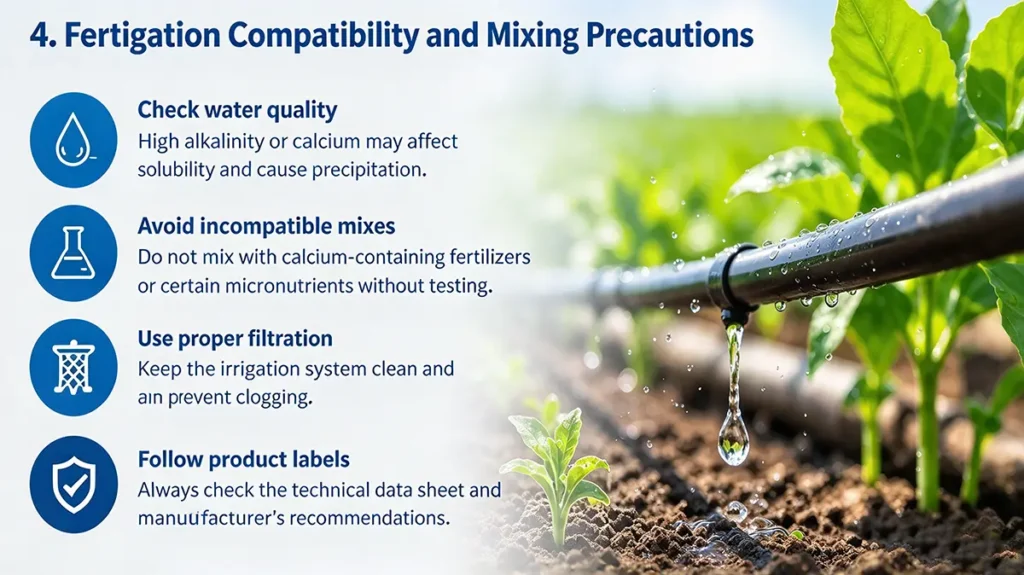
Before use, review:
Irrigation-water pH and alkalinity.
Calcium and magnesium concentrations.
Fertilizer solubility and insoluble-matter limits.
The intended stock-solution concentration.
Compatibility with other fertilizers and injection equipment.
A common approach is to use separate stock tanks for incompatible fertilizers and inject them according to a validated schedule. Flushing with clean water may also be required between applications.
A jar test using the actual irrigation water and intended mixing ratios can help identify visible precipitation. It does not, however, replace a complete compatibility assessment.
Two water sources with similar pH values can therefore respond differently when UP is dissolved. Where irrigation-water acidification is an objective, measure alkalinity and calculate the required treatment rather than relying on the fertilizer’s nominal pH.
Guaranteed nitrogen and P₂O₅ content.
Water solubility under stated test conditions.
Water-insoluble matter.
Moisture content and physical form.
Solution pH and the concentration used for measurement.
Relevant impurity limits and batch consistency.
Packaging, storage, and handling requirements.
For DAP and MAP, confirm the guaranteed grade, physical quality, moisture, granule characteristics where relevant, and any specifications required for blending or application.
A current certificate of analysis (COA) verifies the tested batch against the supplier’s declared specifications. A technical data sheet (TDS) explains the product’s standard properties and recommended handling conditions. Both are useful when evaluating a supplier, but neither replaces crop-specific agronomic recommendations.
For product specifications and supply enquiries, visit
Not universally. UP is particularly useful where soluble nitrogen and phosphorus are needed alongside an acidic solution reaction. DAP is widely used for conventional soil fertilization, while MAP offers a higher P₂O₅ concentration in common commercial grades. The best product depends on nutrient requirements, application method, soil conditions, and water quality.
Among the typical grades compared here, MAP 11-52-0 contains the most P₂O₅ at 52%, followed by DAP 18-46-0 at 46% and UP 17-44-0 at 44%. Other commercial grades, including water-soluble MAP 12-61-0 and UP products with slightly different analyses, are also available.
Yes. Suitable UP grades are used in drip and other fertigation systems. Confirm the product's solubility, insoluble-matter specification, and compatibility with irrigation water before use.
Some grades are suitable for fertigation, provided their purity, solubility, and compatibility meet system requirements. Ordinary granular products should not automatically be treated as suitable for preparing concentrated stock solutions.
UP creates an acidic solution when dissolved. However, the effect on bulk soil pH depends on application rate, soil buffering capacity, soil composition, and irrigation conditions. Its acidic reaction should not be treated as a substitute for a soil-pH management program.
MAP is a common starter fertilizer because it supplies concentrated phosphorus and ammonium nitrogen. DAP can present greater ammonia-related injury risks when concentrated too close to germinating seeds. Nevertheless, seed safety depends on rate, placement, soil moisture, and crop sensitivity. Follow local application recommendations rather than assuming any product is safe at every rate.
Not necessarily. The three products supply different proportions of nitrogen and P₂O₅ and have different chemical properties. Substitution requires recalculating the nutrient contributions and checking whether the replacement is suitable for the application system.
UP 17-44-0 combines urea nitrogen and phosphate with a strongly acidic solution reaction, making it relevant to selected fertigation programs and specialty fertilizer formulations. DAP 18-46-0 is an established option for supplying nitrogen and phosphorus in conventional field-crop fertilization. MAP 11-52-0 supplies more P₂O₅ per unit of product weight and is widely used in starter and basal fertilizer programs.
The decision should be based on the required nutrient rate, soil-test results, fertilizer placement, irrigation-water chemistry, product quality, and total delivered cost. For fertigation, compatibility and water-insoluble matter deserve particular attention because even a highly soluble fertilizer can cause operational problems under unsuitable mixing conditions.
Risso Fertilizer supplies UP 17-44-0 for agricultural applications and fertilizer production. Buyers evaluating this product can review the UP fertilizer specifications and applications and confirm the required grade, packaging, and technical documentation before placing an order.
If you want to know other questions about Urea phosphate Manufacturers or NPK fertilizers , please contact us and we will provide professional answers.
✔ Quick & helpful reply within 6 hours.
✔ Tailored solutions for your project.
✔ One-stop product, tech, market

Want to find a China fertilizer manufacturer?
Risso will be your best choice; send us your request for your fertilizer details requirement
© Copyright 2017 RISSO CHEMICAL. All Rights Reserved.