















2026-09-23
Select language:

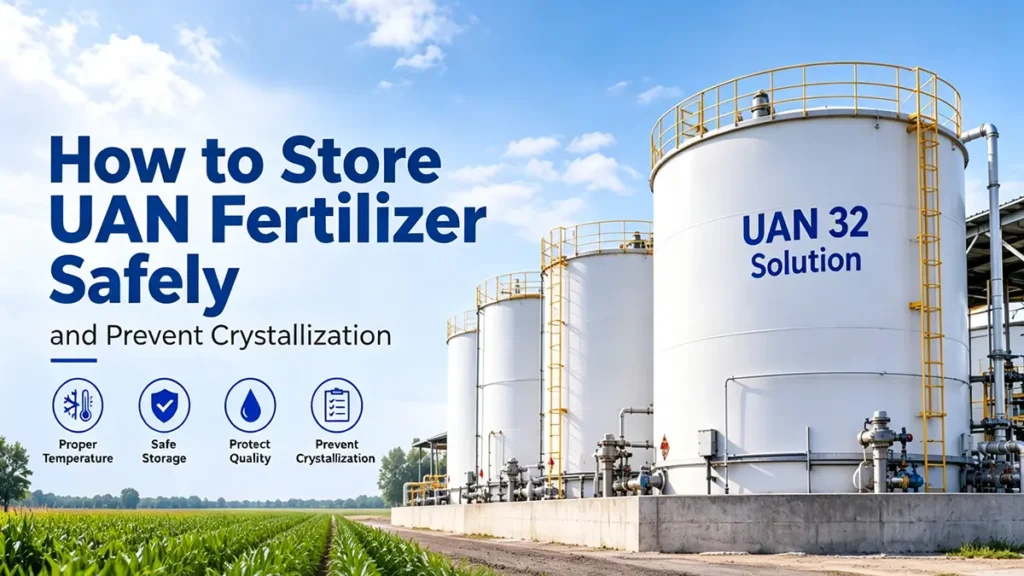
One of the main concerns during cold-weather storage is UAN crystallization, also known as salt-out. When the temperature of a UAN solution falls below its applicable salt-out temperature, dissolved fertilizer salts can begin to form crystals. In UAN 32, this can occur around the freezing range, making winter storage an important consideration.
Published technical information commonly places the salt-out temperature of UAN 32 at approximately 0°C to -2°C (32°F to 28°F), although the exact value can vary by formulation and product specification. For this reason, the manufacturer’s current TDS or product specification should always be used when planning storage.
For buyers sourcing UAN 32 for agricultural use, Risso provides UAN 32 solution together with product specifications, technical documentation, and packaging options for international fertilizer supply. Storage conditions should always be evaluated according to the actual product being supplied.
UAN 32 is generally identified as 32-0-0, containing approximately 32% total nitrogen by weight.
The nitrogen is supplied in three forms:This combination allows UAN to be used in a range of crop nutrition programs, including pre-plant applications, side-dressing, and other liquid nitrogen applications.
The relatively high concentration of UAN 32 also affects its physical behavior at low temperatures. As temperature decreases, the fertilizer salts become less soluble, which can eventually lead to crystallization.
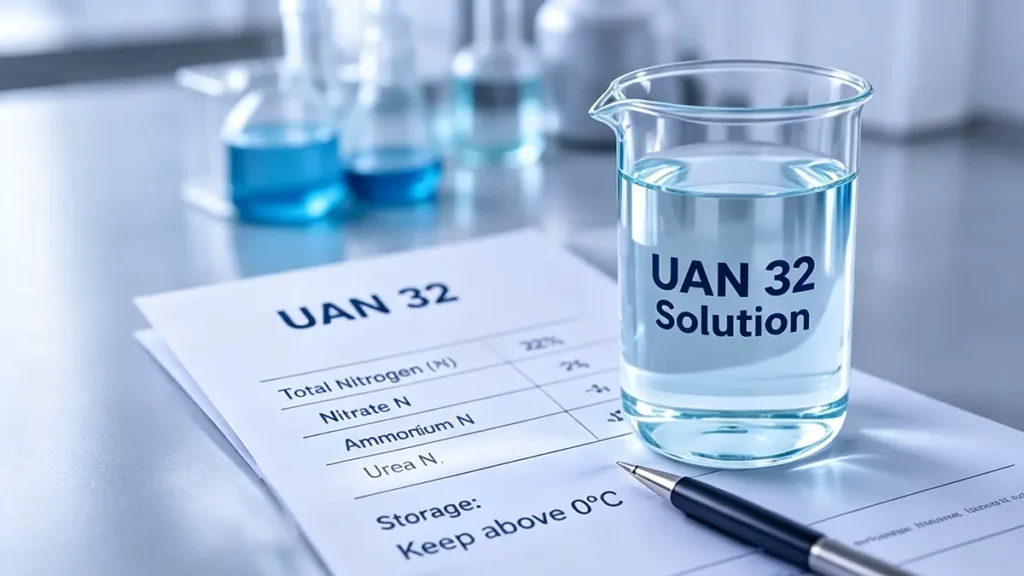
When the temperature falls, the solubility of the fertilizer components decreases. Once the solution reaches its salt-out temperature, part of the dissolved material can separate from the liquid and form crystals.
This process is commonly described as:The concentration of the UAN grade has a major influence on this behavior.
In general, higher-concentration UAN has a higher salt-out temperature. This is why UAN 32 requires more attention during cold-weather storage than UAN 28.
Typical technical data may show approximately:| UAN Grade | Approximate Salt-Out Temperature |
|---|---|
| UAN 28 | Around -18°C / 0°F |
| UAN 30 | Around -10°C / 14°F |
| UAN 32 | Around 0 to -2°C / 32 to 28°F |
These values are representative rather than universal. The actual salt-out temperature should always be confirmed from the specification of the product being stored.
For many commercial UAN 32 products, this temperature is around 0°C to -2°C (32°F to 28°F).
However, it is not advisable to treat this as one fixed value for every UAN 32 product.
Differences in formulation, concentration, and manufacturing specifications can affect the actual crystallization temperature.
This is particularly important for bulk fertilizer storage. If a supplier specifies a salt-out temperature of 0°C, operating the tank continuously at 0°C provides very little margin for temperature fluctuations.
A practical storage plan should maintain the product comfortably above the specified salt-out temperature, especially when the tank is outdoors or the fertilizer will remain in storage through winter.
Do not rely only on the local weather forecast. The temperature inside the tank, at the outlet, and in exposed transfer lines can be different.
Tank insulation or other temperature-management measures may be appropriate in colder regions, but the system should be designed according to the tank material, equipment, climate, and applicable safety requirements.
Contamination can affect product quality and may cause additional precipitation or compatibility problems.
The storage tank should also be protected from uncontrolled water entry.

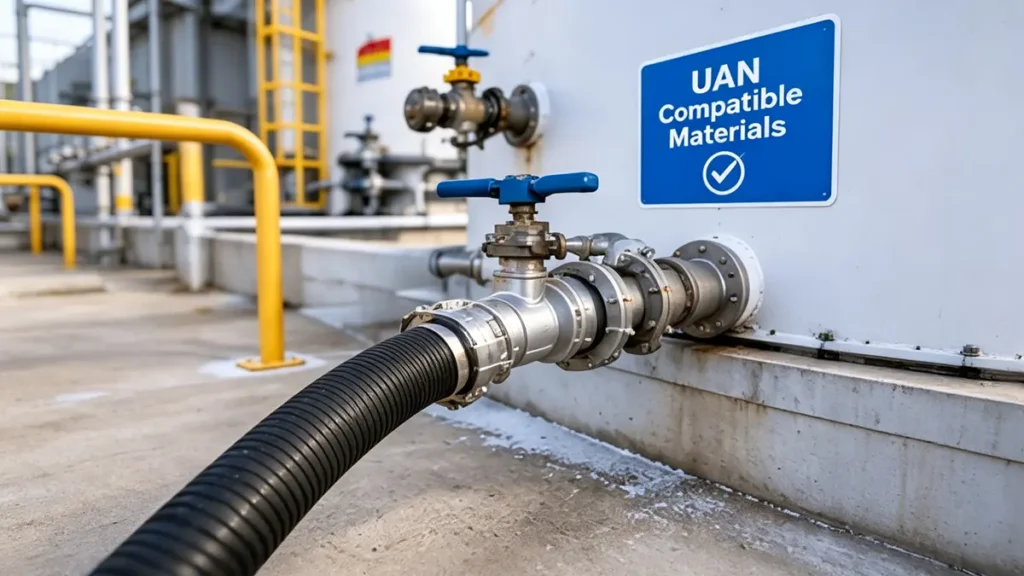
Suitable materials may include certain steel, fiberglass-reinforced plastic, polyethylene, and other compatible materials, depending on the product and equipment design.
Copper and copper-containing alloys such as brass should be avoided where the product specification identifies them as incompatible. UAN 32 SDS documentation from major suppliers specifically highlights this concern.
The tank itself is only part of the system. A compatible tank can still have problems if unsuitable valves, fittings, hoses, or pump components are installed.
Risso’s UAN 32 SDS notes that prolonged storage can result in corrosive sludge, making regular inspection particularly important for long-term storage systems.
For larger fertilizer storage facilities, continuous monitoring and temperature alarms can help operators respond before crystallization occurs.
A crystallized valve or filter can interrupt the entire transfer operation even when most of the tank remains liquid.
Inventory planning should consider:
This does not mean UAN 28 is always a better choice. Crop requirements, application equipment, logistics, nitrogen concentration, and economics should also be considered.
The product should be stored and transferred through equipment that is compatible with the fertilizer.
Before installing or replacing equipment, check the compatibility of:Copper and copper alloys are commonly identified as materials to avoid for UAN applications.
The manufacturer’s SDS and TDS should be reviewed before selecting materials for a new storage system.
For large or permanent installations, consultation with the tank or equipment manufacturer is recommended.
Crystallization does not necessarily mean that the fertilizer is permanently unusable. Depending on the product, crystals may return to solution after the temperature rises above the applicable crystallization point.
However, the recovery process should follow the supplier’s instructions.
Then consult the current product TDS and SDS.
Heating equipment must be suitable for the product and storage system. Risson’s UAN 32 SDS provides specific handling precautions and temperature limitations for equipment.
If warming is appropriate, it should be carried out using a controlled method consistent with the manufacturer’s instructions.
Inspect filters, valves, hoses, and other restricted areas before restarting the transfer system.
Once the product has returned to a suitable liquid condition, appropriate circulation may help restore uniformity, depending on the storage system and supplier recommendations.
Certain combinations can form insoluble precipitates, particularly under specific concentration, temperature, or water-quality conditions.
Before preparing a new fertilizer mixture:This is particularly important for UAN 32 fertigation because precipitation can cause problems with filters, injectors, emitters, and other components.
What is the exact UAN grade and nitrogen concentration?
What is the specified salt-out temperature?
What storage temperature is recommended?
Which tank and equipment materials are compatible?
Can you provide the current SDS and TDS?
What should be done if crystallization occurs?
Is the product suitable for outdoor storage in my climate?
Are there any restrictions on mixing it with other fertilizers?
For bulk UAN buyers, it is also useful to confirm:
A supplier that can provide clear product-specific information makes storage planning much easier.
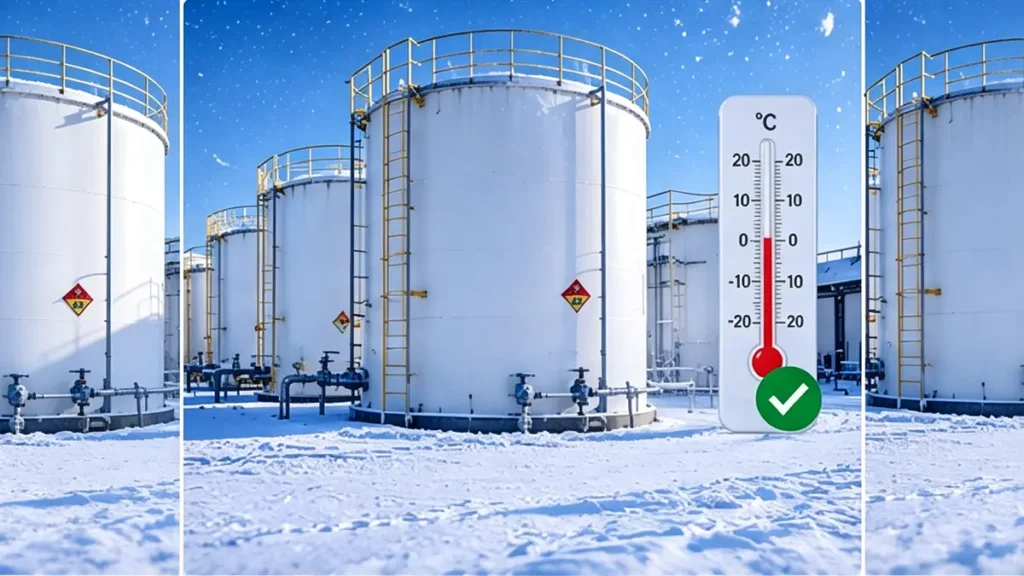
At a minimum, confirm four things:
Product specification — Know the actual salt-out temperature and physical properties.
Storage equipment — Confirm that the tank and wetted components are compatible.
Winter conditions — Understand the lowest expected temperatures and identify exposed equipment.
Inventory plan — Determine how much product needs to remain in storage and for how long.
This is particularly important when purchasing bulk UAN 32 fertilizer for international delivery. The appropriate storage strategy can be very different for a warm-climate distributor using short-term inventory and a cold-climate fertilizer terminal holding UAN through the winter.
For UAN 32, the salt-out temperature is typically around 0°C to -2°C, but the exact value should always be confirmed from the specification of the actual product being stored.
The most important considerations are:
For agricultural distributors, commercial growers, and fertilizer importers, good storage planning can prevent avoidable equipment problems and product-handling delays.
Risso can support buyers looking for UAN 32 fertilizer with product specifications, technical documentation, packaging options, and international supply solutions. Storage and handling should always be planned according to the actual product specification, local climate, equipment, and applicable safety requirements.
The objective is simple: keep UAN stable, keep the storage system reliable, and prevent crystallization before it becomes an operational problem.
If you want to know other questions about NPK Fertilizer Manufacturers or NPK fertilizers , please contact us and we will provide professional answers.
✔ Quick & helpful reply within 6 hours.
✔ Tailored solutions for your project.
✔ One-stop product, tech, market

Want to find a China fertilizer manufacturer?
Risso will be your best choice; send us your request for your fertilizer details requirement
© Copyright 2017 RISSO CHEMICAL. All Rights Reserved.