Liquid UAN 32 and granular ASN 26-0-0+13S are both nitrogen fertilizers, but they cannot be accepted on the same terms. UAN 32 is a 32% N solution measured by volume into tanks and metering systems; ASN 26-0-0+13S is a 26% N plus 13% S granule measured by weight into bags and spreaders. That single physical difference changes the sampling method, the certificate of analysis (CoA) parameters, the packaging clause, the storage clause, and the way a buyer writes a rejection tolerance. This guide sets out the acceptance criteria and purchasing terms that genuinely differ between the two forms, and the ones that should stay identical.
Why the Same Nitrogen Buyer Needs Two Different Acceptance Sheets
A purchase order for granular fertilizer usually carries a nutrient guarantee, a bag weight, a granule size statement, and a moisture limit. Those clauses work because the product is a solid that can be sampled by probe, weighed by the bag, and inspected for caking on arrival.
None of those checks transfer cleanly to a liquid. A UAN 32 cargo is sampled from a tank, not from bags. Its nutrient content is declared per unit of volume or per unit of mass, and converting one to the other requires the density stated on the specification. Its low-temperature behaviour affects whether the product can be discharged at all in winter. Its pH affects what it can be stored in and what it can be mixed with. If a buyer applies a granular checklist to a liquid delivery, the resulting acceptance report will look complete and prove very little.
The reverse error is equally common. Liquid buyers sometimes accept a granular ASN lot on the strength of the nitrogen and sulfur figures alone, and only discover a granule size or caking problem when the spreader pattern is uneven in the field. For ASN, nutrient analysis is necessary but not sufficient: physical condition is part of the product.
Decision rule: write one commercial framework covering both products, but maintain two separate technical annexes — a liquid annex built around volume, density, temperature and compatibility, and a granular annex built around weight, granule size, moisture and handling condition.
Industry Background: Why Form Choice Is Now a Procurement Question
Liquid nitrogen is no longer a niche format. SNS Insider valued the global liquid fertilizers market at USD 15.49 billion in 2025, with nitrogen as the largest revenue contributor. That figure should be used carefully: published estimates for the same year range from about USD 3.01 billion (Fortune Business Insights) to USD 18.6 billion (Global Market Insights), and the spread reflects different product definitions — commodity UAN included in some scopes and excluded in others. For a buyer, the practical lesson is that market reports cannot substitute for a specification sheet. The definition that matters is the one written into your purchase contract.
Two structural pressures are pushing buyers to look at both forms side by side. First, EU nitrogen policy recommends a 20% reduction in chemical fertilizer use to meet Green Deal nutrient-loss goals by 2030, as reported by Re Soil Foundation citing Nature Food research. Reduction targets raise the value of placement accuracy and documented nutrient management, which favours formats that can be metered precisely. Second, liquid systems carry a capital penalty: UAN infrastructure costs are approximately double those of dry storage because of stainless steel requirements, per Mordor Intelligence analysis of the North American market. A buyer who compares only the fertilizer price per tonne of nitrogen will therefore mis-rank the two options.
The result is a familiar pattern in evaluation-stage purchasing: the agronomy team prefers one form, the warehouse and finance teams prefer the other, and nobody has separated product acceptance from infrastructure cost. The comparison below is designed to make that separation explicit.
The Specifications That Must Be Locked Before Any Comparison Is Meaningful
Eight parameters decide whether a UAN 32 or ASN offer is comparable at all. Each one should appear as a stated value on the supplier’s technical datasheet and be confirmed batch by batch on the CoA. Where a value is not declared, that is itself an acceptance finding.
1. Form and handling state
UAN 32 is a clear liquid nitrogen solution intended for tanks, pumps, injectors and fertigation systems. ASN 26-0-0+13S is a granular solid intended for spreading equipment and bagged distribution. Form determines sampling equipment, storage, discharge method and the labour profile at the farm gate.
2. Total nitrogen content
UAN 32 carries 32% total nitrogen. ASN 26-0-0+13S carries 26% nitrogen alongside 13% sulfur. Nitrogen concentration is not a quality ranking — it is a logistics variable. Higher concentration lowers freight and storage volume per unit of nitrogen; the granular product instead delivers a second nutrient in the same pass.
3. Nitrogen form and release behaviour
UAN 32 supplies nitrogen in three forms — urea, ammonium and nitrate — a structure described on Risso’s own product documentation for Risso® UAN 32-0-0. ASN supplies nitrate and ammonium nitrogen together with sulfur. This distinction belongs in the acceptance discussion because it determines what a buyer can reasonably expect from a single application, and what must still be planned through timing and split application.
4. Sulfur content
ASN 26-0-0+13S declares 13% sulfur. UAN 32 does not carry a sulfur guarantee. If sulfur is part of the crop program, that nutrient must be sourced separately when buying UAN — a purchasing-term issue, not a product defect.
5. Density
Density is the parameter that converts metered liquid volume into kilograms of nitrogen, and it is the most frequently omitted value in liquid tenders. Without a declared density, a volumetric delivery cannot be verified against a nutrient guarantee. Granular ASN has a bulk density that matters for spreader calibration and silo design, but it does not affect the invoiced nutrient quantity in the same way.
6. pH
For UAN 32, pH is a storage and compatibility criterion: it influences tank material selection and the behaviour of tank mixes. For granular ASN, pH of a solution prepared for testing is a laboratory characteristic with limited bearing on field handling. Buyers who intend tank mixes with other inputs should require a stated pH range and a compatibility statement rather than a single unqualified number.
7. Freezing point and salt-out behaviour
UAN 32 can crystallise at low temperature, and the exact crystallisation or salt-out temperature must follow the product specification. This is a genuine purchasing term in cold markets because it determines winter storage, tank heating, and whether a delivery can be discharged on arrival. Granular ASN has no equivalent clause; its cold-weather risk is caking and moisture pickup, which belongs under storage and packaging instead.
8. Granule size and moisture limit
For ASN 26-0-0+13S, granule size range, fines content and moisture limit are acceptance parameters in their own right. They govern spreader pattern, dust generation, caking tendency and bagged shelf behaviour. For UAN 32 the equivalent quality indicators are suspended solids, turbidity and contamination — a liquid should be clean and free of material that can block filters and emitters.
Acceptance Criteria Matrix: Liquid UAN 32 vs Granular ASN 26-0-0+13S
| Acceptance parameter |
Liquid UAN 32 |
Granular ASN 26-0-0+13S |
How the buyer verifies it |
| Declared form |
Clear nitrogen solution |
Granular solid |
Datasheet plus visual inspection at sampling |
| Total nitrogen |
32% N |
26% N |
Batch CoA, laboratory analysis |
| Nitrogen forms |
Urea, ammonium and nitrate nitrogen |
Nitrate and ammonium nitrogen |
Declared nutrient form on datasheet and CoA |
| Sulfur |
No sulfur guarantee |
13% S |
CoA sulfur analysis |
| Density |
Required to convert volume to nutrient mass |
Bulk density relevant to spreader calibration |
Stated value on specification, checked at loading |
| pH |
Storage and tank-mix compatibility criterion |
Laboratory characteristic, limited field impact |
Stated range on datasheet |
| Freezing point / salt-out |
Must be declared; governs winter storage and discharge |
Not applicable in the same sense |
Product specification, cold-weather storage procedure |
| Granule size and fines |
Not applicable |
Size range and fines content declared |
Sieve check at sampling, spreader trial |
| Moisture |
Suspended solids and contamination instead |
Moisture limit and caking behaviour |
CoA moisture figure, bag inspection on arrival |
| Sampling method |
Tank or line sample, homogenised before draw |
Probe sample across bag or lot depth |
Agreed sampling protocol in the contract annex |
| Invoicing basis |
Volume corrected by density, or mass |
Mass per bag or per tonne |
Weighbridge or flow meter with calibration record |
Read across the matrix and the logic becomes visible: the liquid column is dominated by measurement and temperature clauses, the granular column by physical condition clauses. Only three rows — nitrogen content, sulfur where applicable, and documentation — are genuinely shared.
Step-by-Step: Building an Acceptance Procedure That Works for Both Forms
Step 1 — Fix the specification annex before requesting quotations
Write the liquid annex and the granular annex separately and attach both to the enquiry. The liquid annex should require density, pH range, nitrogen form breakdown and low-temperature behaviour. The granular annex should require granule size range, fines content, moisture limit and bag weight tolerance. Quotations received against a written annex are comparable; quotations received against a product name are not.
Step 2 — Agree the sampling protocol and the reference method
Sampling is where most disputes begin. For UAN 32, specify where the sample is drawn, whether the tank is homogenised first, and which laboratory method resolves a disagreement. For ASN, specify probe depth, number of increments per lot, and how a composite sample is reduced. Naming the referee laboratory in advance removes the argument that inevitably follows an off-spec result.
Step 3 — Require a complete document package per shipment
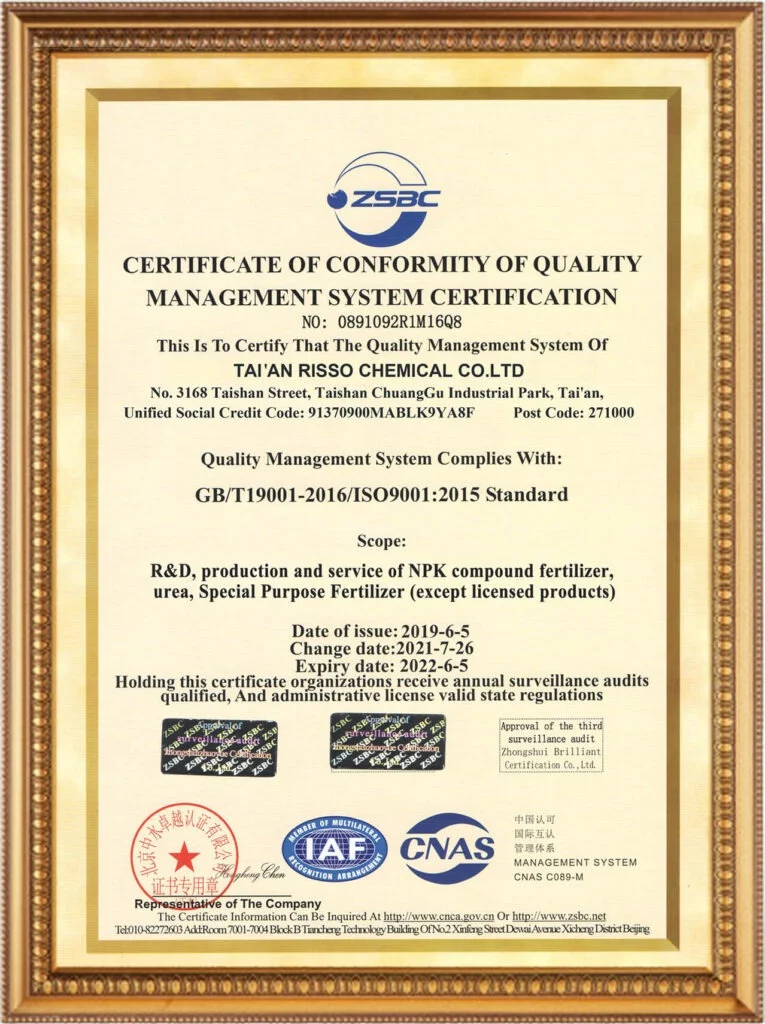
A batch CoA, a safety data sheet, and destination-compliant labelling are the minimum. Management-system and product-conformity certificates support supplier qualification, but the scope wording matters. TAIAN RISSO CHEMICAL CO.,LTD. holds a Quality Management System certificate (0891092R1M16Q8, issued by ZSBC, GB/T19001-2016/ISO9001:2015) covering R&D, production and service of NPK compound fertilizer, urea and special purpose fertilizer, and a Verification of Conformity for RoHS compliance (DPWD/03/0570/2025, Intercert Global Sp. z o.o., valid 2025-03-05 to 2030-03-04) covering NPK fertilizer categories including NPK liquid fertilizer. A buyer should confirm that the scope names the product category actually being purchased, rather than assuming any certificate covers any fertilizer.
Step 4 — Check packaging and metering compatibility together
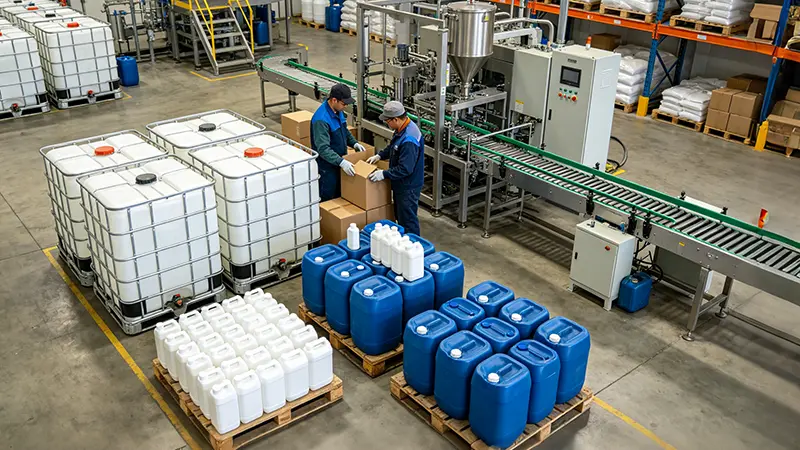
Liquid nitrogen moves in IBCs, drums or tankers and must match the receiver’s pump, filter and injection equipment. Granular ASN moves in bags or bulk and must match the spreader’s hopper and disc settings. A packaging clause that ignores downstream equipment creates a delivery that is technically correct and operationally unusable.
Step 5 — Define tolerances and the deviation procedure in writing
State the acceptable analytical tolerance, the acceptable weight or volume tolerance, and what happens when a lot falls outside it — rejection, price adjustment, re-make, or use under waiver. Undefined tolerances are the single most common reason a technically good supplier relationship turns adversarial.
Step 6 — Verify on arrival, then close the loop
On arrival, weigh or meter the delivery, draw the agreed sample, and record condition. For UAN 32, record temperature and appearance; for ASN, record bag condition, caking and fines. Feed the result back into the next purchase order so that acceptance data becomes a purchasing asset rather than a filing exercise.
Purchasing Terms: Where the Two Products Really Diverge
| Purchasing term |
Liquid UAN 32 |
Granular ASN 26-0-0+13S |
| Primary unit of trade |
Volume corrected by density, or mass |
Mass per bag or per tonne |
| Storage requirement |
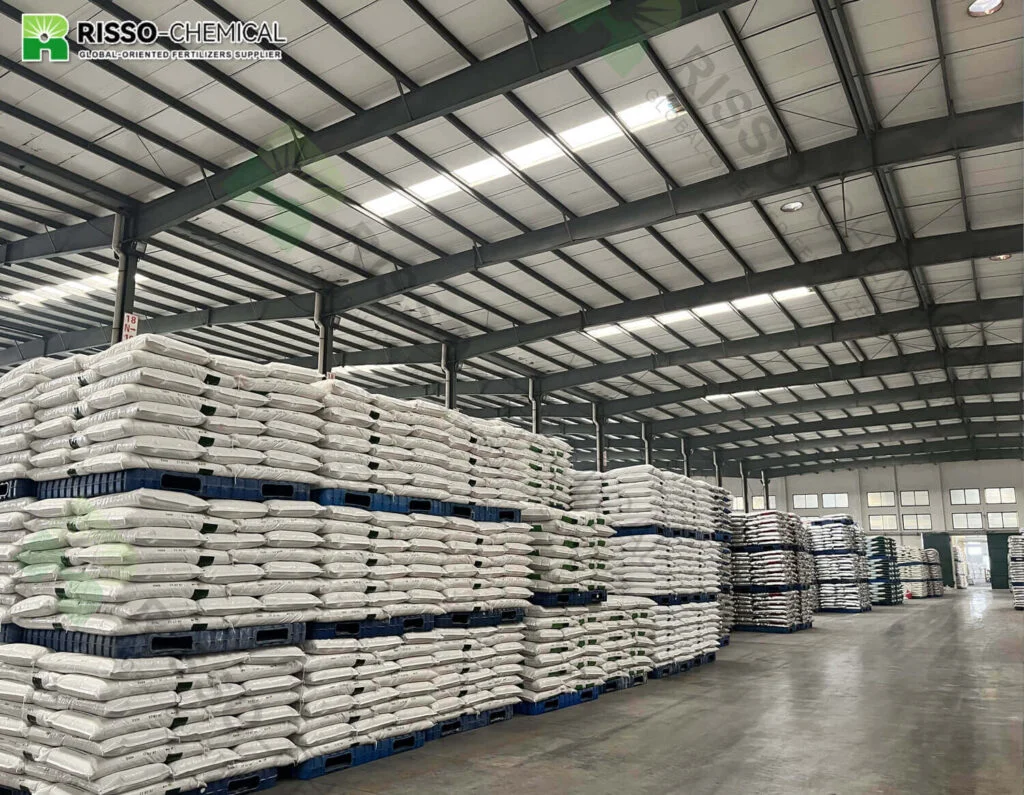
Tanks, temperature management, contamination control; infrastructure cost roughly twice dry storage due to stainless steel requirements |
Dry, cool, ventilated warehouse; moisture and stacking control |
| Packaging options |
IBC, drum, tanker |
Bag or bulk |
| Application equipment |
Fertigation, injection, band application, precision liquid systems |
Base fertilization and top dressing with conventional or mechanised spreaders |
| Seasonal risk clause |
Low-temperature crystallisation and discharge |
Caking, moisture pickup, fines generation |
| Nutrient scope |
Nitrogen only |
Nitrogen plus 13% sulfur |
| Dispute trigger |
Density, nitrogen analysis, contamination, volume measurement |
Granule size, moisture, bag weight, caking |
The storage row deserves emphasis because it is where budget comparisons usually fail. The approximately twofold capital multiplier for UAN infrastructure reported by Mordor Intelligence is not a product cost — it is a system cost. A buyer comparing UAN 32 against ASN on fertilizer price alone is comparing one product cost against another product cost while ignoring a capital item that belongs to only one side of the decision.
Connecting Specification to Application Method
Specifications only earn their place when they predict how the product behaves in the field. The mapping is direct.
Fertigation and precision liquid application — UAN 32
UAN 32 suits fertigation, liquid fertilizer application, band application and precision nutrient management, where uniform nutrient distribution and solution stability matter. Cleanliness, density and compatibility are therefore not laboratory luxuries; they are the parameters that keep filters, emitters and injectors working through a season.
Foliar application — UAN 32, with local agronomic direction
Foliar application is a liquid-form option rather than a granular one, but concentration, dilution and timing must follow the product label and local agronomic recommendation. Foliar use is a management decision supported by the liquid format; it is not a claim that any concentration is safe on any crop.
Base fertilization and top dressing — ASN 26-0-0+13S
ASN fertilizer is applied for base fertilization and top dressing in field crop production. Here granule size, fines and moisture determine whether the spreader delivers an even pattern and whether bags remain free-flowing in store. The 13% sulfur is delivered in the same pass as the nitrogen, which simplifies the operation for crops with a sulfur requirement.
Combined programs — both forms in one season
Many distributors and large farms run both: a granular base application followed by liquid top dressing or fertigation. In that model the two acceptance annexes coexist in one contract, and the supplier’s ability to serve both lines from one production base becomes a genuine qualification criterion rather than a convenience.
Use Cases: Which Buyer Profile Fits Which Acceptance Model
- Fertigation-intensive horticulture and greenhouse operations— liquid first. Acceptance effort should concentrate on density, pH, cleanliness and low-temperature handling.
- Broadacre cereal and oilseed systems— granular first, where base fertilization and top dressing dominate and sulfur is part of the crop plan. Acceptance effort concentrates on granule quality and moisture.
- Distributors serving mixed farm types— both forms, with two technical annexes and one commercial framework. Portfolio breadth reduces the number of supplier qualifications the distributor must maintain.
- International traders and large-volume buyers— both forms, with acceptance terms tied to shipment documentation, sampling protocol and deviation handling rather than to farm-level agronomy.
Supplier Example: A Dual Liquid-and-Granular Nitrogen Portfolio
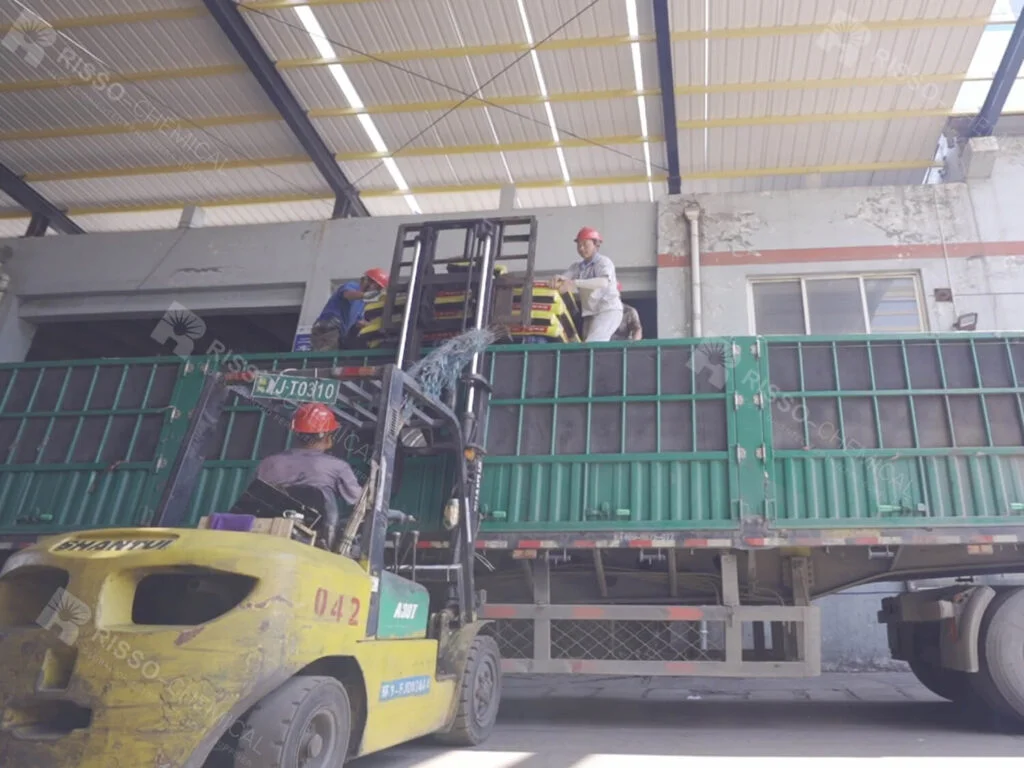
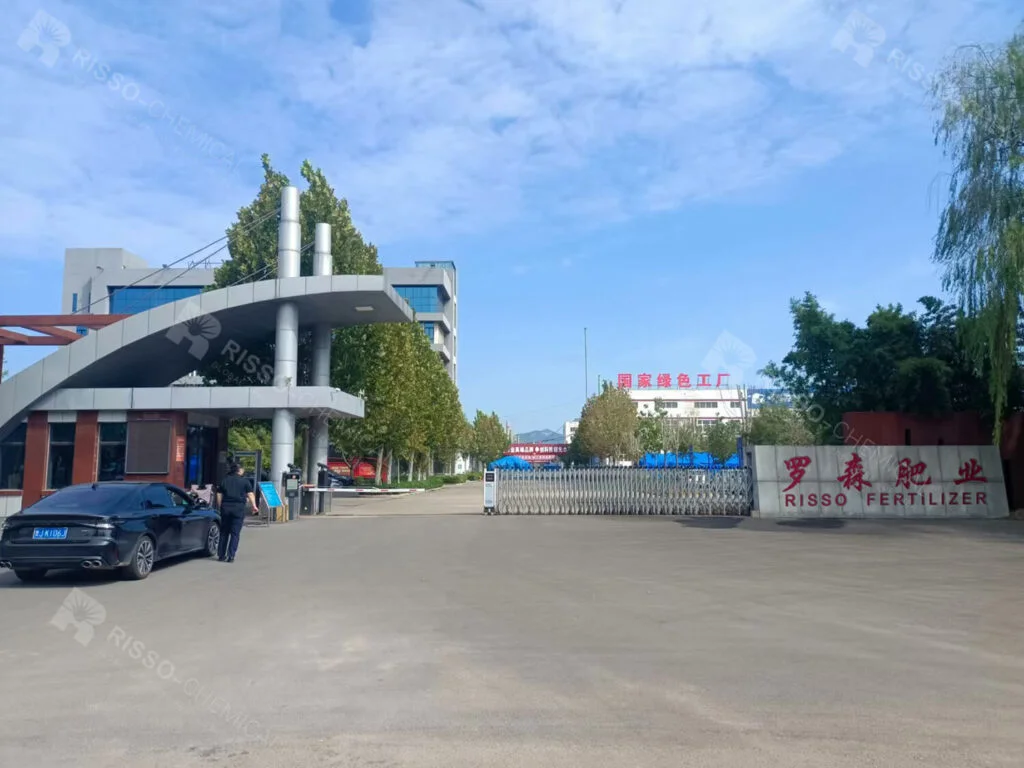
TAIAN RISSO CHEMICAL CO.,LTD. is a fertilizer manufacturer based in the High-tech Development Zone, Taian City, Shandong Province, China, founded in 2007 and operating a 500,000 m² production site with 350 employees, a 50-engineer R&D team and an annual output of 2 million tons. Its product range covers compound fertilizer, water-soluble fertilizer, polymer coated fertilizer and liquid fertilizer, including Ammonium Sulphate Nitrate and Urea Ammonium Nitrate 32.
For buyers evaluating both forms, the relevant capability is that liquid and granular nitrogen sit in the same portfolio. Production runs on 16 modern fertilizer production lines with an annual capacity of 2 million tons and a monthly capacity of 30,000 tons, with OEM/ODM and customizable supply offered against application systems, crop requirements and order volumes. Minimum order quantity is 100 tons and lead time is 30–45 days. Quality control runs from raw materials to finished fertilizer, covering production monitoring, laboratory testing and finished product inspection — the sequence that generates the batch CoA an acceptance procedure depends on.
Supply reaches customers in more than 60 countries and regions, including Southeast Asia, Japan and South Korea, Australia and New Zealand, Canada, Brazil, Argentina, Chile, Cuba and other Latin American markets, as well as Central Asia and the Middle East. Products have been used by distributor networks, large farms, international traders and partners, with distribution across multiple continents including Europe, Asia, the Americas and Oceania.
Frequently Asked Questions
Conclusion: Two Annexes, One Contract
The comparison between liquid UAN 32 and granular ASN 26-0-0+13S is not a contest between a better and a worse nitrogen fertilizer. It is a comparison between two acceptance logics. Liquid UAN 32 is accepted on measurement and stability: density, pH, low-temperature behaviour, cleanliness, and a volume-to-nutrient conversion that must be declared. Granular ASN 26-0-0+13S is accepted on physical condition: granule size, fines, moisture, caking, and a nutrient package that includes 13% sulfur.
Buyers who write one technical annex for both products will either over-specify the granular line or under-specify the liquid line. Buyers who write two annexes, keep one commercial framework, and agree the sampling protocol and deviation procedure before the first shipment get something more valuable than a lower price: a delivery that can be accepted on arrival without argument.
Next Step: Compare Both Lines Against Your Own Acceptance Sheet
Send your specification annex and destination market to the Risso team. You will receive product datasheets for UAN 32 and ASN 26-0-0+13S, current MOQ and lead-time terms, and sample arrangements for validation against your own criteria.
Email: info@risso-chemical.com | Tel: +86 0538 5076188 | WhatsApp: +86 19506380519
Address: High-tech Development Zone, Taian City, Shandong Province, China | risso-chemical.com
Download the full product catalogue: Risso Catalog (PDF)