Calcium nitrate fertilizer is a water-soluble source of nitrogen and calcium used in vegetable production, fruit cultivation, greenhouse farming, and fertigation. It supplies readily available nitrate nitrogen and calcium, an essential nutrient for cell wall development, membrane stability, and normal plant growth.
A common agricultural grade is 15.5-0-0 + approximately 26% CaO, containing 15.5% total nitrogen and approximately 18.6–19% calcium by elemental weight. Actual nutrient content varies by formulation, so buyers should check the product specification rather than relying on the fertilizer name alone.
For growers, the primary value of calcium nitrate is its ability to supply nitrogen and calcium in one fertilizer. For distributors and agricultural input buyers, nutrient analysis, water solubility, product quality, and compatibility with other fertilizers are equally important.
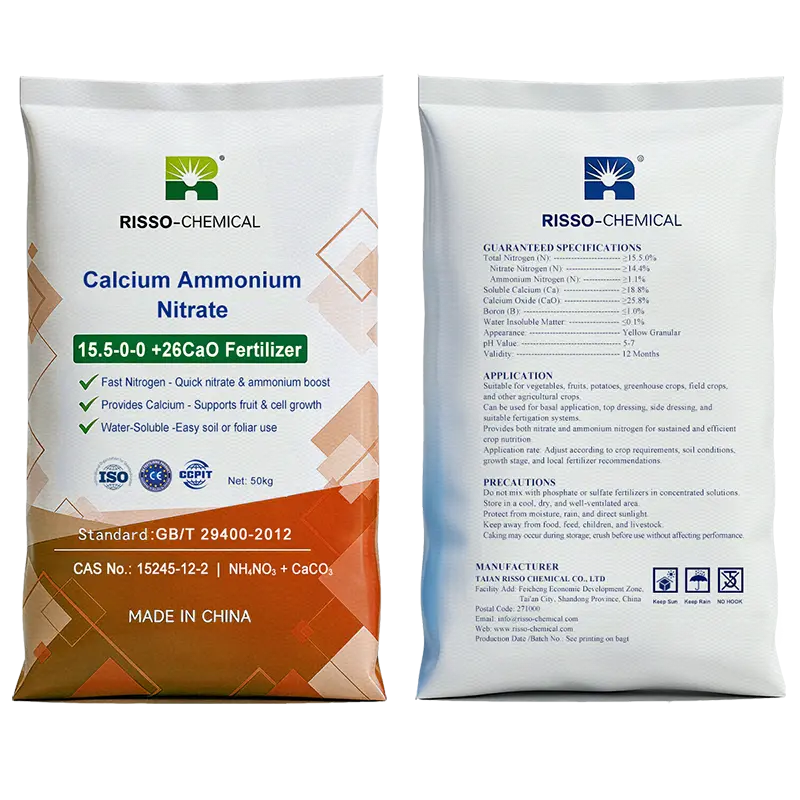
Risso Fertilizer offers granular Calcium Nitrate 15.5-0-0 with a published specification of 15.5% total nitrogen, at least 18.8% water-soluble calcium, and at least 0.3% boron. These figures apply to the specific Risso product and should not be treated as universal values for all calcium nitrate fertilizers. View Risso Calcium Nitrate Fertilizer
1. What Is Calcium Nitrate Fertilizer?
Calcium nitrate fertilizer supplies plants with nitrogen and calcium. Its conventional chemical formula is
Ca(NO₃)₂, although commercial fertilizer formulations can contain additional components and may differ in their exact nutrient composition.
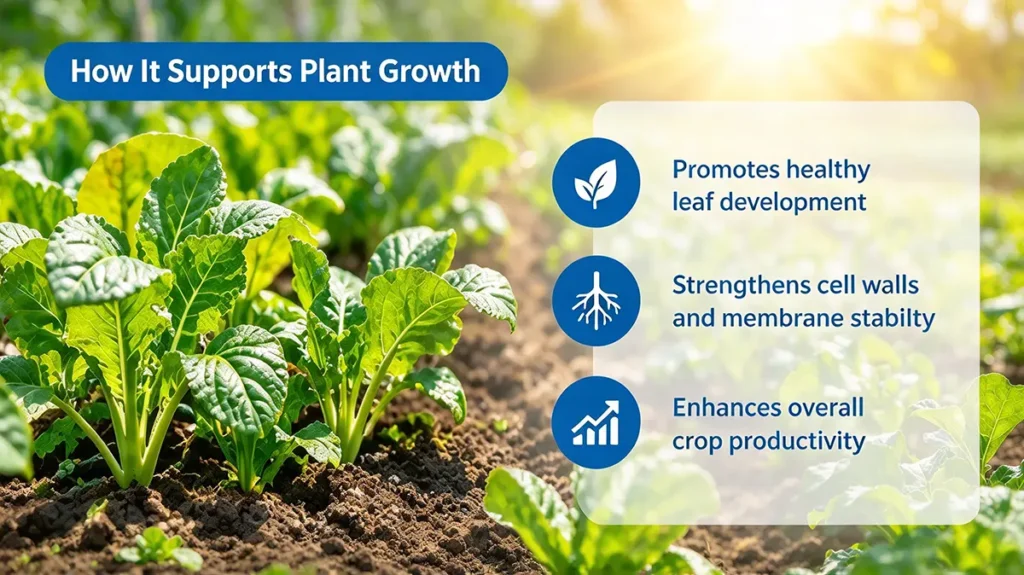
Nitrogen supports leaf development, photosynthesis, protein synthesis, and overall crop growth. Calcium contributes to cell wall structure, membrane function, and the development of young tissues.
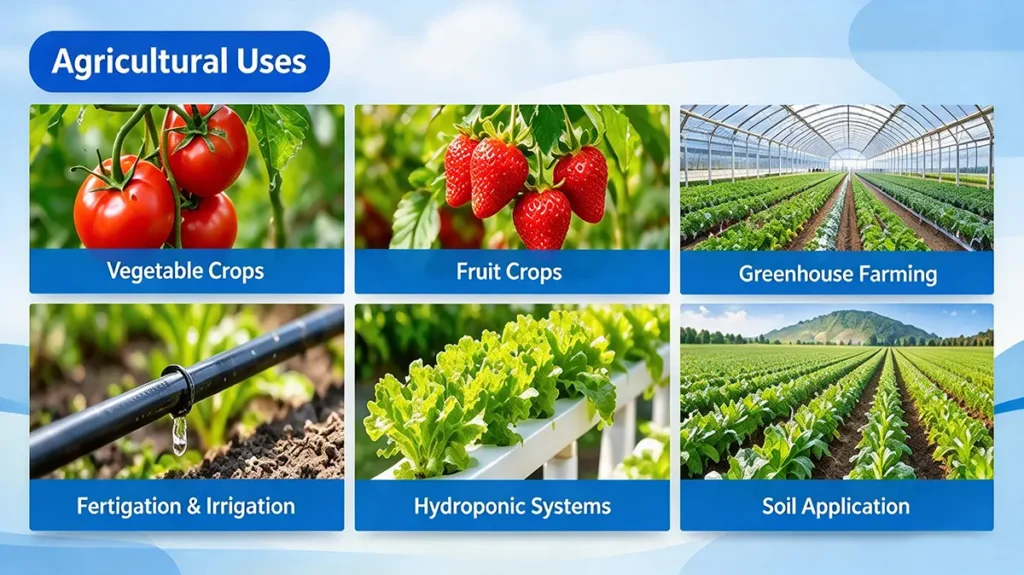
Calcium nitrate is commonly used in:
- Vegetables such as tomatoes, peppers, cucumbers, and lettuce
- Fruit crops, including strawberries, melons, apples, and citrus
- Greenhouse and protected cultivation
- Drip irrigation and suitable fertigation systems
- Selected hydroponic and soilless growing systems
- Soil-applied and top-dressing nutrient programs
Its main advantage is the combined supply of readily available nitrogen and calcium. However, it is not automatically the best fertilizer for every crop. The choice depends on nutrient requirements, soil conditions, irrigation water, crop growth stage, and the cost of alternative nutrient sources.
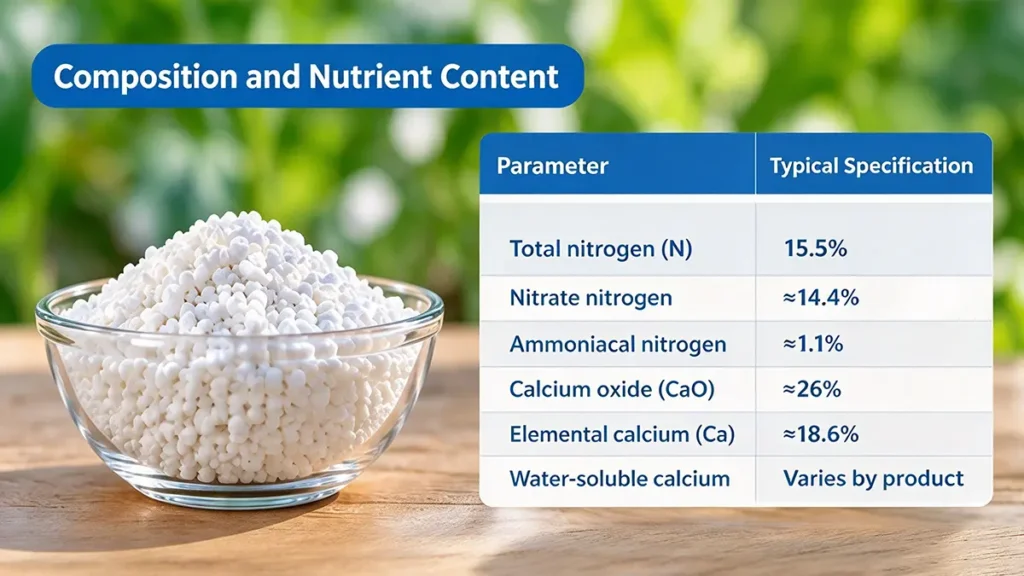
2. Calcium Nitrate Fertilizer Composition and Nutrient Content
The nutrient composition of calcium nitrate depends on the commercial grade and manufacturing process. A widely used agricultural grade contains approximately 15.5% total nitrogen and 26% calcium oxide equivalent (CaO).
Typical nutrient composition
| Parameter | Typical commercial specification |
| Fertilizer grade | 15.5-0-0 + approximately 26% CaO |
| Total nitrogen (N) | 15.5% |
| Nitrate nitrogen | Approximately 14.4% |
| Ammoniacal nitrogen | Approximately 1.1% |
| Calcium oxide equivalent (CaO) | Approximately 26% |
| Elemental calcium (Ca) | Approximately 18.6% |
| Water-soluble calcium | Depends on product specification |
This is a representative nutrient profile, not a universal standard. For example, Haifa’s commercial calcium nitrate grades specify 15.5% total nitrogen, divided into approximately 14.4% nitrate nitrogen and 1.1% ammoniacal nitrogen, with around 26–26.5% Ca
Understanding nitrogen forms
Nitrate nitrogen (NO₃-N) is readily available for plant uptake. Because nitrate moves readily with soil water, its management should be coordinated with irrigation and crop demand to reduce losses below the root zone.
Ammoniacal nitrogen (NH₄-N) provides another form of plant-available nitrogen. The proportion in calcium nitrate fertilizer is generally smaller than the nitrate fraction in conventional 15.5-0-0 grades.
When comparing fertilizers, buyers should examine total nitrogen and its individual forms rather than relying on the total nitrogen figure alone.
Understanding calcium and CaO
Fertilizer labels may express calcium as elemental calcium (Ca) or as calcium oxide equivalent (CaO). These measurements use different reporting bases.
The approximate conversion is:
Elemental Ca = CaO × 0.715
For instance, 26% CaO corresponds to approximately 18.6% elemental calcium.
When comparing calcium nitrate products, confirm whether the stated value represents elemental calcium, calcium oxide equivalent, or water-soluble calcium. These figures should not be compared as though they were identical.
Example: Risso Calcium Nitrate 15.5-0-0
Risso’s published product specifications provide a more specific example:
| Parameter |
Published specification |
| Total nitrogen (N) |
≥15.5% |
| Nitrate nitrogen |
≥14.4% |
| Ammoniacal nitrogen |
≥1.1% |
| Water-soluble calcium |
≥18.8% |
| Calcium oxide equivalent |
≥25.8% |
| Boron (B) |
≥0.3% |
| Water-insoluble matter |
≤0.1% |
| pH |
5–7 |
| Appearance |
Yellow granules |
These specifications describe Risso’s particular granular fertilizer. The latest Technical Data Sheet (TDS) and batch-specific Certificate of Analysis (COA) should be used to confirm the applicable commercial values.
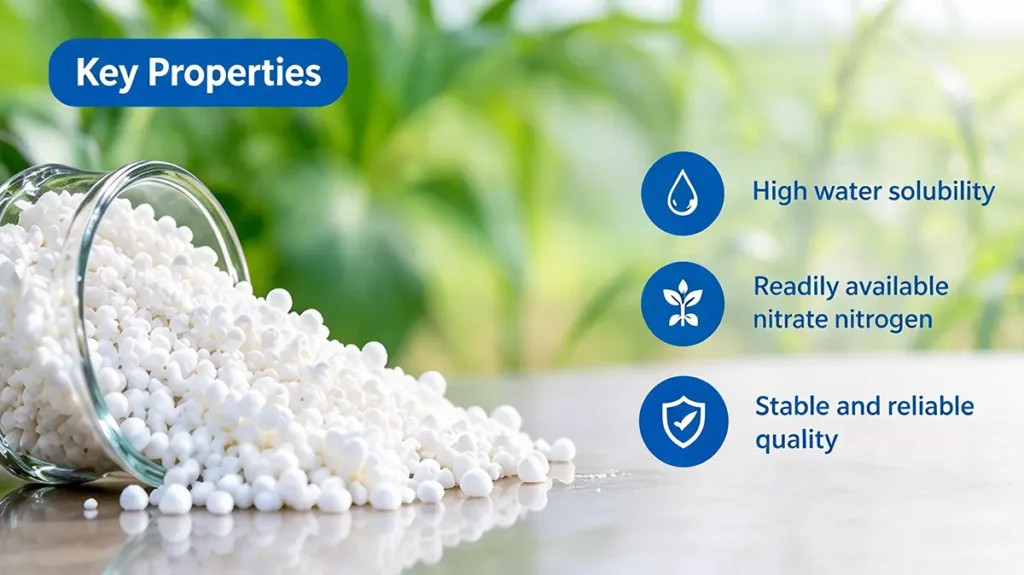
3. Key Properties of Calcium Nitrate
Calcium nitrate is valued for its nutrient availability and its suitability for a range of soil and irrigation-based fertilizer programs. Four properties are particularly relevant to agricultural use.
3.1 Water solubility
Suitable calcium nitrate grades dissolve readily in water, making them useful in fertigation and other applications that require nutrients in solution.
For drip irrigation, solubility alone is not enough. Insoluble matter, irrigation-water quality, solution concentration, and compatibility with other fertilizers can affect system performance.
3.2 Readily available nitrogen
The nitrate fraction provides nitrogen that plants can absorb directly. This makes calcium nitrate useful during periods of active growth, provided nitrogen is needed.
Excessive nitrogen application can promote excessive vegetative growth, increase nutrient imbalance, or delay maturity in certain crops. Application rates should therefore be based on crop demand rather than applied routinely.
3.3 Calcium supply
Calcium plays an essential role in cell walls, cell membranes, and the development of growing tissues.
A reliable calcium supply is particularly important for crops susceptible to calcium-related physiological disorders. However, the presence of calcium in soil or fertilizer does not guarantee that enough will reach every growing organ.
Water movement, root activity, salinity, and nutrient balance all influence calcium uptake and distribution.
3.4 Physical properties and quality
Commercial calcium nitrate fertilizers may be supplied as white or yellow granules, depending on the product and manufacturing process.
Appearance alone does not establish fertilizer quality. Relevant purchasing specifications include nutrient analysis, calcium solubility, insoluble matter, granule characteristics, moisture condition, and batch consistency.
For fertigation, low insoluble matter and appropriate water compatibility are particularly important.
4. How Calcium Nitrate Supports Plant Growth
Calcium nitrate supplies two nutrients with different but complementary physiological functions.
Nitrogen supports vegetative growth
Nitrogen is required for amino acids, proteins, chlorophyll, and many other essential plant compounds. Adequate nitrogen supports leaf development, photosynthesis, and overall crop growth.
Nitrate nitrogen is readily absorbed by plant roots. However, excessive supply can produce overly vigorous vegetative growth and disturb the balance between leaves, roots, and reproductive development.
The objective is to match nitrogen supply with crop demand throughout the growing season.
Calcium supports cell structure
Calcium contributes to cell wall strength, membrane stability, and normal tissue development. Its role is particularly important in actively growing tissues.
Unlike nitrogen, calcium is poorly redistributed through the phloem in most plants. Its movement to growing organs depends largely on water transport through the xylem.
Consequently, a plant may experience calcium-related disorders even when soil calcium is adequate. Restricted root activity, irregular watering, high salinity, and competition among developing plant organs can all affect calcium delivery.
Calcium nitrate and blossom-end rot
Blossom-end rot in tomatoes and peppers is associated with inadequate calcium delivery to developing fruit. It is not always caused by a shortage of calcium in the soil.
Fluctuating soil moisture, root-zone stress, and rapid plant growth can interfere with calcium transport. Calcium nitrate may be part of an appropriate nutrient program, but correcting the problem also requires attention to irrigation consistency and root health.
UGA Cooperative Extension
For this reason, calcium nitrate should not be promoted as a guaranteed treatment for blossom-end rot or other calcium-related disorders.
5. Agricultural Uses of Calcium Nitrate Fertilizer
5.1 Vegetable production
Tomatoes, peppers, cucumbers, lettuce, cabbage, broccoli, and other vegetables may benefit from calcium nitrate when both nitrogen and calcium are required.
In fruiting vegetables, it can contribute to nitrogen supply during active growth while supporting the root-zone supply of calcium. In leafy vegetables, sufficient calcium is important for normal development of young leaves.
For susceptible crops, fertilizer application should be combined with appropriate irrigation, balanced nutrition, and management of root-zone conditions.
5.2 Fruit crops
Strawberries, melons, citrus, apples, grapes, and other fruit crops may require careful calcium management during fruit development.
Calcium nitrate can be incorporated into soil-applied or fertigation programs when the crop requires both nutrients. The appropriate rate and timing depend on the crop, growing conditions, soil or substrate analysis, and the nutrient contribution from other fertilizers.
Calcium application alone does not guarantee increased fruit firmness, extended storage life, or improved marketability. Such outcomes depend on multiple factors, including variety, maturity, water management, and overall crop nutrition.
5.3 Greenhouse and protected cultivation
Greenhouse crops often require more precise nutrient management than crops grown under open-field conditions. Calcium nitrate can supply nitrogen and calcium through soil application or suitable fertigation systems.
In substrate-grown and soilless systems, nutrient concentrations, irrigation frequency, drainage, and electrical conductivity (EC) should be monitored carefully. Poorly managed nutrient solutions can contribute to excessive salt accumulation or nutrient imbalance.
5.4 Hydroponics and soilless systems
Calcium nitrate is commonly incorporated into hydroponic nutrient solutions to supply calcium and nitrate nitrogen.
The final nutrient solution must also account for potassium, magnesium, phosphorus, and other essential nutrients. Excessive calcium or unsuitable nutrient ratios can interfere with balanced nutrient uptake.
Because calcium can precipitate with phosphate or sulfate under appropriate chemical conditions, concentrated stock solutions generally require separate preparation where
5.5 Field crops
Calcium nitrate can also be used in selected field-crop programs, including side-dressing and split nitrogen applications.
Its economic suitability depends on the crop’s calcium requirement, soil fertility, target yield, and the cost of alternative fertilizers.
Where the primary objective is to supply large quantities of nitrogen, a different nitrogen fertilizer may be more economical. Calcium nitrate is most useful when its combined nitrogen and calcium supply fits the agronomic objective.
6. How to Apply Calcium Nitrate Fertilizer
The correct application method depends on the fertilizer grade, crop, production system, and growing environment.
Soil application and top dressing
Granular calcium nitrate may be applied as a basal fertilizer, side dressing, or top dressing where its nutrient composition is appropriate.
Application rates should be based on soil testing, crop nutrient demand, expected yield, and the amount of nitrogen and calcium already supplied by other sources.
A single application rate should not be assumed to suit every crop, soil, or production system.
Fertigation
Water-soluble calcium nitrate grades can be injected through suitable drip irrigation and fertigation systems.
A well-managed fertigation program should consider:
- Product solubility and insoluble matter
- Irrigation-water quality
- Crop growth stage and nutrient demand
- Injection concentration and irrigation frequency
- Compatibility with other fertilizers
- Filtration, flushing, and emitter maintenance
Foliar application
Foliar application should only be used when the specific product label and crop recommendations support it.
Although calcium can be absorbed by treated plant tissues, calcium moves poorly from leaves to developing fruit through the phloem. Therefore, foliar spraying may not reliably correct calcium-related disorders in fruit. Application concentration, weather, crop sensitivity, and timing also matter.
7. Calcium Nitrate Fertigation and Fertilizer Compatibility
Fertilizer compatibility is one of the most important practical considerations when calcium nitrate is used in irrigation systems.
Compatibility with phosphate fertilizers
Concentrated calcium nitrate should not be mixed directly with concentrated phosphate fertilizers unless compatibility has been confirmed.
Calcium may react with phosphate to form poorly soluble calcium phosphate compounds. These precipitates can accumulate in tanks, filters, pipes, and drip emitters. The University of Florida’s fertigation guidance specifically identifies calcium nitrate and diammonium phosphate as incompatible for direct mixing.
Compatibility with sulfate fertilizers
Concentrated calcium-containing solutions can also react with sulfate to form calcium sulfate, which may precipitate depending on concentration and water chemistry.
For this reason, concentrated calcium fertilizers are generally stored separately from concentrated phosphate or sulfate fertilizers when compatibility is uncertain.
Practical precautions
For commercial fertigation systems:
- Prepare calcium-containing stock solutions separately from concentrated phosphate and sulfate solutions where required.
- Check irrigation-water quality and the intended injection concentration.
- Use a compatibility or jar test when appropriate, following technical guidance.
- Maintain suitable filtration and flush the system according to the irrigation and fertilizer recommendations.
- Confirm compatibility with the supplier before introducing a new fertilizer into an established system.
A clear jar test does not guarantee long-term compatibility under all operating conditions. Water analysis and system-specific guidance remain important.
8. Calcium Nitrate vs. Other Fertilizers
Calcium nitrate should be selected according to nutrient requirements and the intended application method, rather than on the basis of calcium content alone.
| Fertilizer | Main nutrients supplied | Key consideration |
| Calcium nitrate | Nitrogen and calcium | Suitable when both nutrients are required |
| Urea | Nitrogen | Concentrated nitrogen source; does not supply calcium |
| Calcium chloride | Calcium and chloride | Chloride sensitivity and application suitability must be considered |
| Gypsum | Calcium and sulfur | Supplies calcium and sulfur; does not supply nitrogen |
| Calcium ammonium nitrate (CAN) | Nitrogen, with calcium in some grades | Nitrogen forms and calcium content vary by formulation |
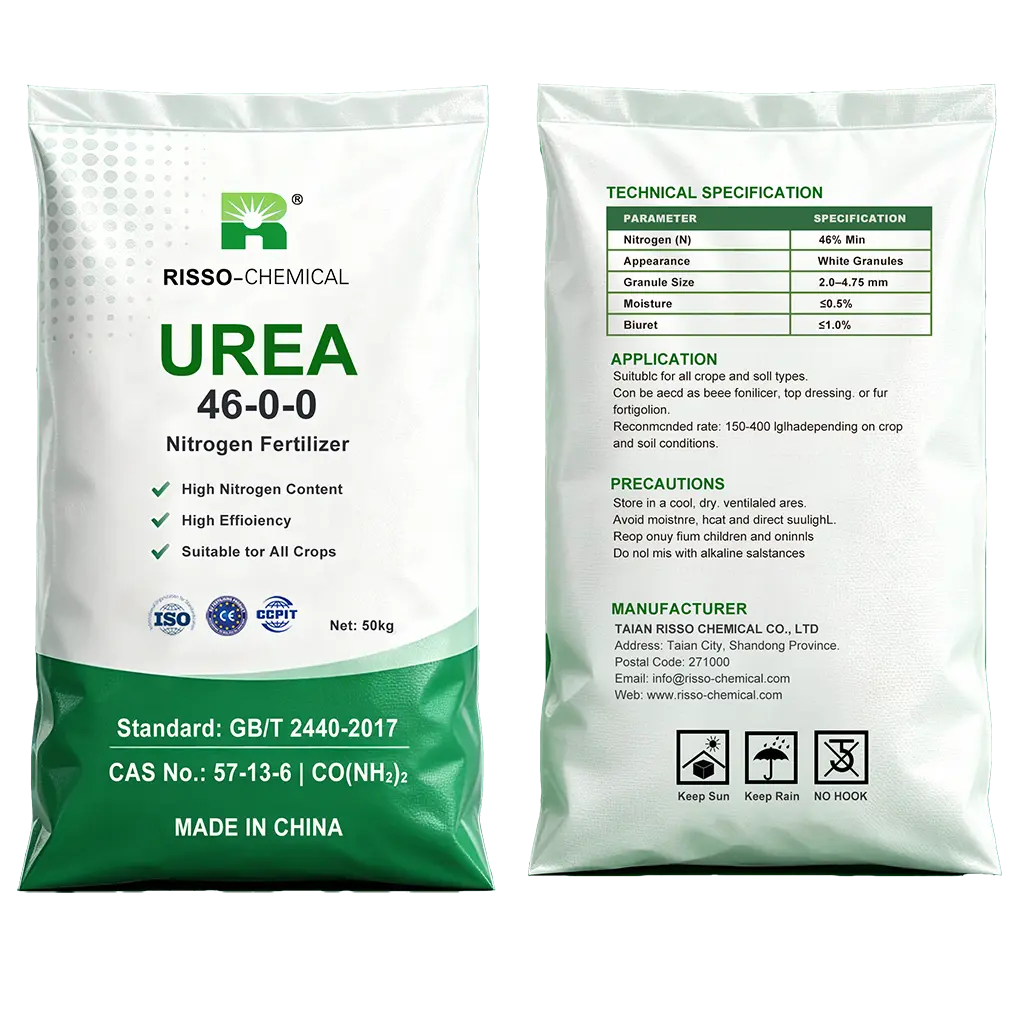
Calcium nitrate vs. urea: Urea may be a more economical choice when nitrogen is the main requirement. Calcium nitrate may be preferable when a crop also needs calcium and a nitrate-based nitrogen source.
Calcium nitrate vs. gypsum: Gypsum provides calcium and sulfur without nitrogen. The choice depends on whether the crop also requires nitrogen and whether the application method suits the product.
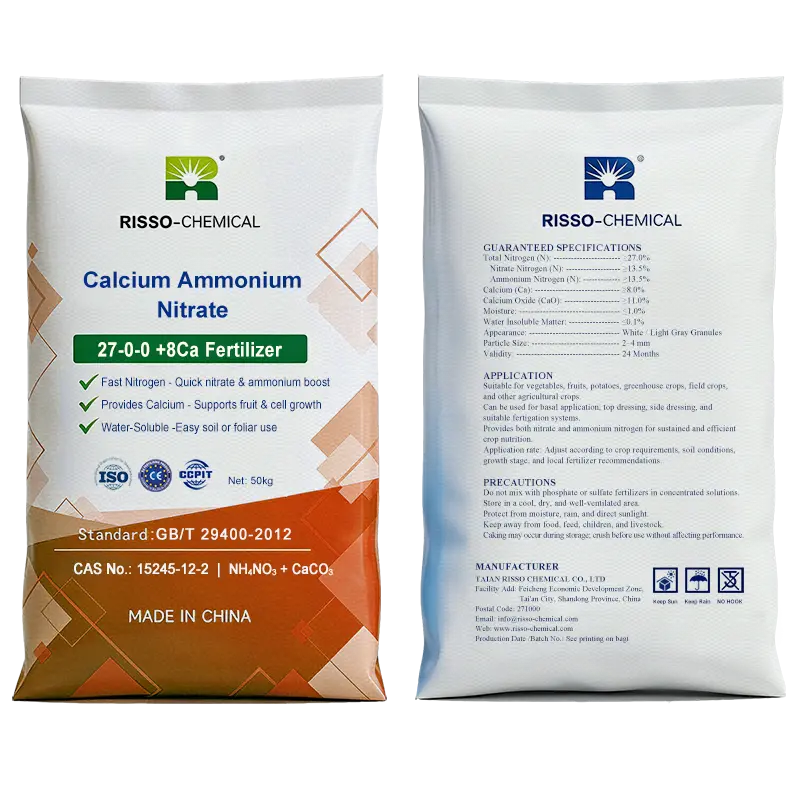
Calcium nitrate vs. calcium ammonium nitrate: These products may differ in nitrogen forms, calcium content, and suitability for fertigation. The actual nutrient analysis should be compared because product names and formulations vary by supplier.
The most appropriate fertilizer is the one that meets crop requirements and fits the soil, water, application method, and cost constraints.
9. How to Choose a Calcium Nitrate Fertilizer
For agricultural distributors, importers, fertilizer formulators, and commercial growers, the product name alone is not a sufficient purchasing specification.
Before purchasing calcium nitrate fertilizer, review the following parameters.
Nutrient analysis: Confirm total nitrogen, nitrate nitrogen, ammoniacal nitrogen, calcium content, and any additional nutrients such as boron.
Calcium reporting basis: Establish whether calcium is declared as elemental Ca, CaO equivalent, or water-soluble calcium.
Solubility and insoluble matter: These are particularly important for drip irrigation, hydroponics, and other systems requiring reliable dissolution and filtration.
Physical properties: Check granule characteristics, moisture condition, packaging, and storage requirements for the intended handling and application method.
Quality documentation: Request the Technical Data Sheet (TDS), Safety Data Sheet (SDS), and batch-specific Certificate of Analysis (COA). Confirm any additional regulatory or customer requirements where applicable.
Application suitability: Verify whether the product is intended for soil application, fertigation, greenhouse use, or another specific process. A product suitable for one application is not automatically suitable for all others.
For B2B buyers evaluating a specific grade, Risso Fertilizer publishes technical specifications for its granular Calcium Nitrate 15.5-0-0, including nitrogen forms, water-soluble calcium, boron, insoluble matter, and pH. Buyers should confirm the latest documentation and intended-use suitability before placing an order.
Frequently Asked Questions (FAQs)
Conclusion
Calcium nitrate fertilizer is a useful source of readily available nitrogen and calcium for vegetable production, fruit cultivation, greenhouse farming, and suitable fertigation systems. Its main advantage is the combined supply of two essential nutrients in a single product.
Successful use depends on more than the fertilizer grade. Crop demand, irrigation consistency, root-zone conditions, nutrient balance, product solubility, and compatibility with other fertilizers all influence the result.
For commercial buyers, the most reliable approach is to compare nutrient analysis, calcium reporting basis, insoluble matter, product quality, and technical documentation rather than relying on the name “calcium nitrate” alone.
Risso Fertilizer offers a granular Calcium Nitrate 15.5-0-0 grade with specified nitrogen, water-soluble calcium, and boron content for agricultural nutrient programs. The current product specification and batch documentation should be used to confirm suitability for each intended application.
Fertilizer Related Products
If you want to know other questions about Calcium Nitrate or NPK fertilizers , please contact us and we will provide professional answers.