Controlled-release fertilizer (CRF) can be used together with conventional fertilizer to provide both immediate and gradual nutrient availability throughout the growing season. This article explains how controlled-release and conventional fertilizers work together, which fertilizer types can be combined, and what to consider before blending them. It also covers chemical compatibility, particle size, coating integrity, moisture control, and fertilizer application methods.
A practical nitrogen blending example demonstrates how to calculate fertilizer quantities based on nutrient requirements. Whether used in corn, tomato, or watermelon production, the right fertilizer combination can support more efficient nutrient management when tailored to crop needs, soil conditions, and product specifications.
1. Can Controlled-Release Fertilizer Be Mixed with Conventional Fertilizer?
Yes. Controlled-release fertilizer (CRF) can be combined with conventional fertilizer in many agricultural applications. This approach allows growers to manage immediate nutrient availability while maintaining a gradual supply of nutrients throughout the growing season.
However, the suitability of a fertilizer combination depends on the products’ chemical compatibility, physical characteristics, nutrient composition, and intended application method.
There are two main ways to use controlled-release and conventional fertilizers together.
Dry Granular Blending
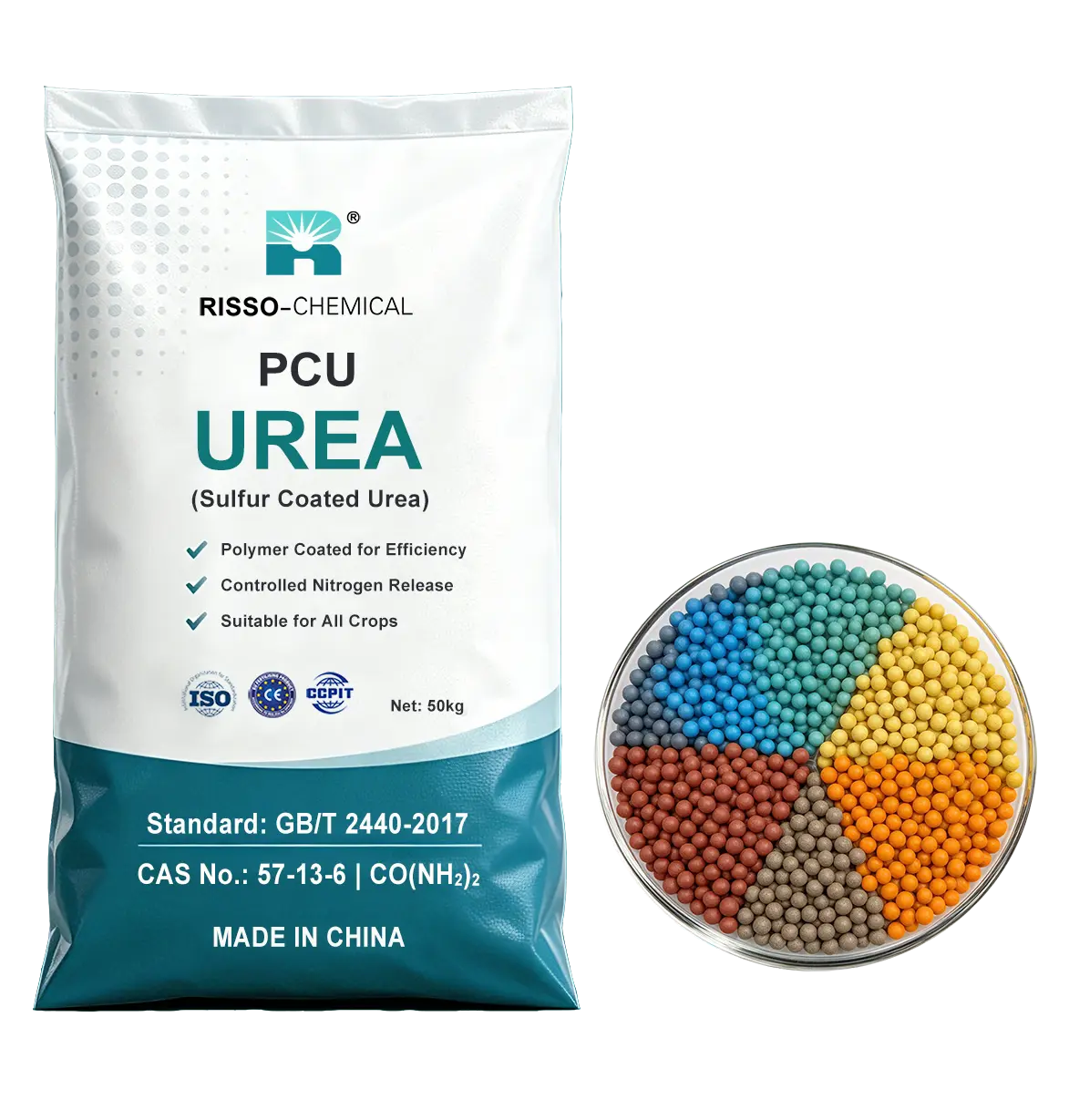
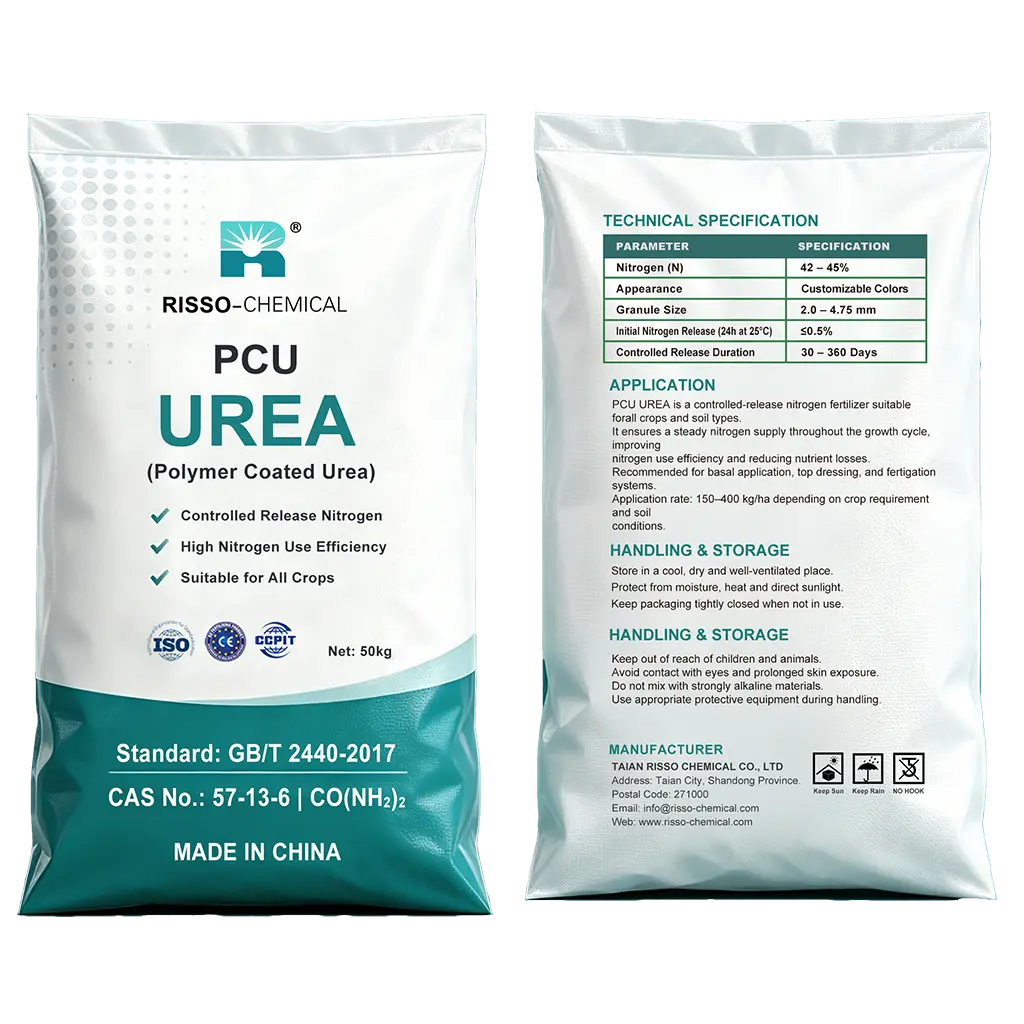
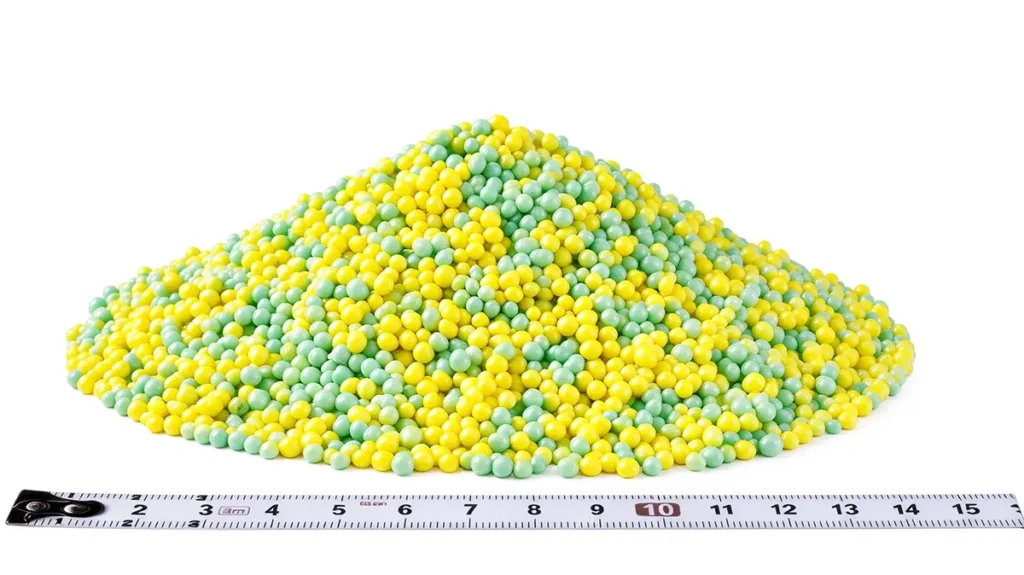
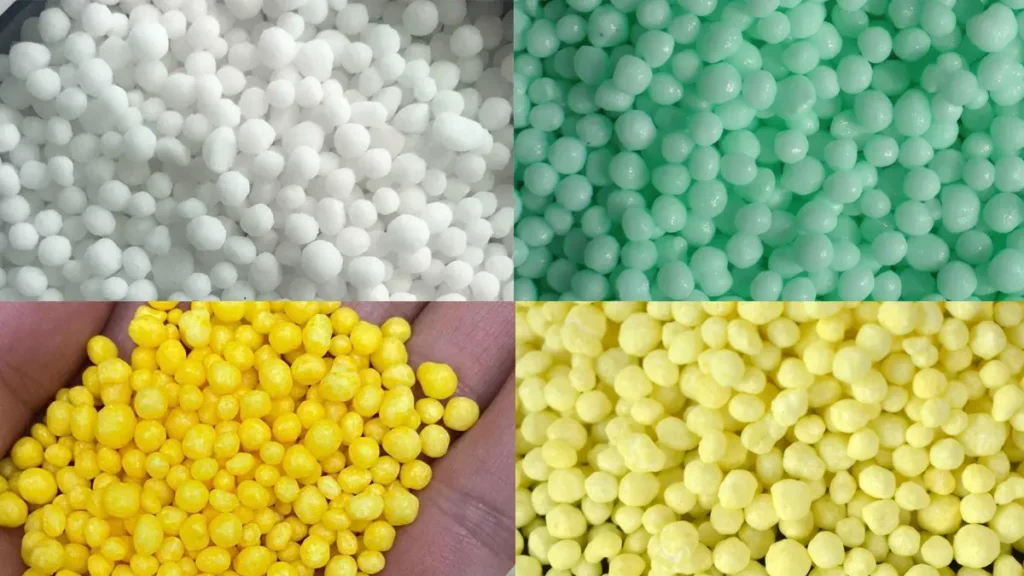
Dry blending involves physically mixing controlled-release fertilizer granules with conventional fertilizer granules before application. A common example is combining polymer-coated urea (PCU) with conventional urea to produce a nitrogen fertilizer blend containing both coated and uncoated granules.
Combined Fertilizer Application Program
This approach uses both fertilizer types within the same nutrient management program without necessarily physically mixing them.
For example, a grower may apply polymer-coated urea before planting and use conventional urea as a supplementary nitrogen source during vegetative growth. In another system, controlled-release NPK may be incorporated into the soil while water-soluble fertilizers are subsequently supplied through drip irrigation.
These methods serve different purposes and require different management considerations.
University of Florida IFAS Extension documents the use of controlled-release and conventional fertilizers together in commercial tomato production, demonstrating how different fertilizer sources can be incorporated into one nutrient management program.
For fertilizer manufacturers and agricultural buyers, the important consideration is not simply whether two products can be mixed, but whether the resulting fertilizer combination can deliver the intended nutrient supply without compromising product quality or application performance.
At Risso, controlled-release fertilizer technology and conventional nutrient formulations are relevant parts of a broader fertilizer product portfolio. Understanding how different fertilizer sources work together helps growers and distributors evaluate product specifications and develop more suitable nutrient management programs.
2. Why Combine Controlled-Release and Conventional Fertilizers?
Controlled-release fertilizers and conventional fertilizers have different nutrient release characteristics. Combining them can help address changes in crop nutrient demand throughout the growing season.
There are three main reasons growers consider this approach.
2.1 Provide Immediately Available Nutrients
Conventional fertilizers such as urea, ammonium sulfate, ammonium nitrate, MAP, and conventional NPK fertilizers generally provide nutrients more rapidly than coated fertilizers.
This is important during early crop development, when plants require accessible nutrients to support root establishment, leaf formation, and vegetative growth.
Controlled-release fertilizers regulate nutrient release through coating materials or other release-control mechanisms. Their nutrient availability may be relatively slow under certain environmental conditions.
For example, polymer-coated urea may release nitrogen more slowly during cold spring conditions because lower temperatures reduce the rate of nutrient diffusion through the coating.
University of Minnesota Extension discusses this limitation in corn production and recommends evaluating conventional nitrogen sources alongside polymer-coated urea when early nitrogen availability is important.
Combining different nitrogen sources can therefore provide greater flexibility when planning fertilizer applications.
2.2 Maintain Nutrient Availability During Crop Development
Crop nutrient requirements change as plants progress through different growth stages.
Corn, rice, wheat, vegetables, and fruit crops do not require the same nutrient quantities throughout their entire growing cycles.
For nitrogen management, a combined fertilizer program may include:
-
Conventional urea for a relatively rapid nitrogen supply.
-
Polymer-coated urea for gradual nitrogen release.
-
Additional nitrogen applications when crop demand and field conditions justify them.
The objective is to coordinate nutrient availability with crop development rather than applying the entire nitrogen requirement at one time.
However, a gradual nutrient supply does not automatically guarantee that nitrogen will be available at the exact time a crop needs it. Release characteristics, temperature, moisture, and application timing must all be considered.
2.3 Manage Fertilizer Costs and Application Efficiency
Controlled-release fertilizers generally involve additional manufacturing processes and coating materials, which can increase production costs compared with conventional fertilizer products.
Combining a portion of controlled-release fertilizer with conventional fertilizer may reduce the quantity of coated product required while maintaining a more gradual nutrient supply.
UF/IFAS describes this approach in tomato nutrient management, where controlled-release and conventional fertilizer sources are used together to balance crop nutrition and fertilizer costs.
Nevertheless, the most economical combination depends on more than the purchase price per metric ton.
Growers should also consider:
-
Total nutrient cost per hectare.
-
Expected nutrient losses.
-
Number of fertilizer applications.
-
Labor and equipment costs.
-
Crop yield and quality requirements.
-
Soil and irrigation conditions.
A lower-cost fertilizer blend is not necessarily the most economical option if it requires additional applications or produces an unsuitable nutrient release pattern.
3. How Does a Controlled-Release Fertilizer Blend Work?
To understand how a blended fertilizer performs, it is important to distinguish between the nutrient release mechanisms of conventional fertilizer and controlled-release fertilizer.
3.1 Conventional Urea: Relatively Rapid Nitrogen Availability
Conventional urea is one of the most widely used nitrogen fertilizers, typically containing 46% nitrogen.
After application, urea dissolves in soil water and undergoes hydrolysis, a process facilitated by the enzyme urease. This converts urea into ammonia and ammonium forms.
Depending on soil conditions, ammonium can subsequently be converted into nitrate through nitrification.
These processes make conventional urea a relatively rapid nitrogen source compared with polymer-coated urea.
However, the actual availability of nitrogen to plants depends on fertilizer placement, soil moisture, temperature, pH, and microbial activity.
Surface-applied urea may also experience ammonia volatilization losses, particularly when it remains on the soil surface without sufficient rainfall, irrigation, or incorporation.
3.2 Polymer-Coated Urea: Controlled Nitrogen Release
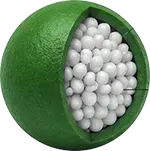
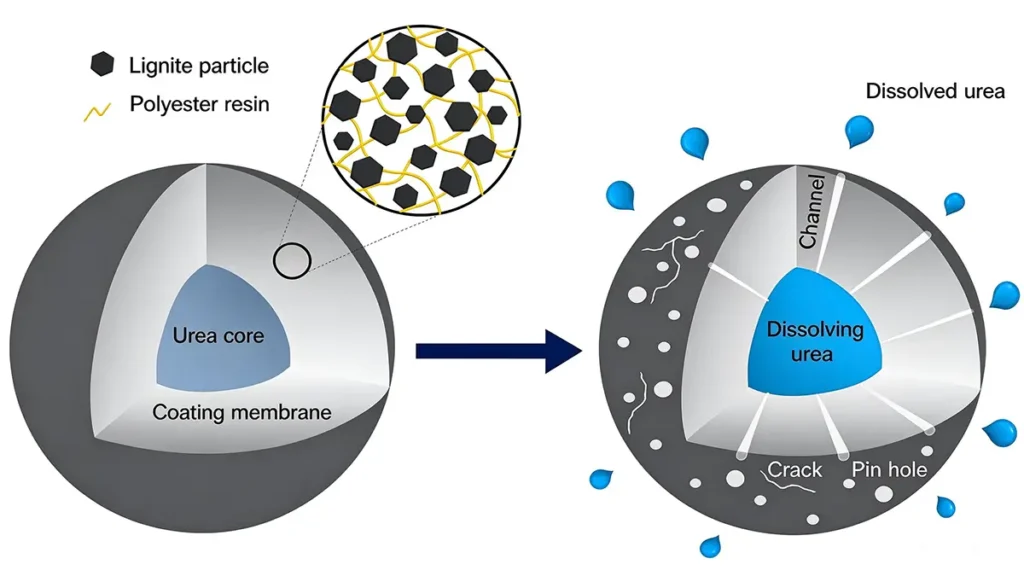
Polymer-coated urea uses a protective polymer membrane to regulate the movement of water and dissolved nutrients.
Its nutrient release process generally involves three stages:
Water penetration: Soil moisture gradually passes through the polymer coating and dissolves the urea inside the granule.
Solution formation: A concentrated urea solution develops within the coated granule.
Nutrient diffusion: Dissolved urea gradually moves through the polymer membrane into the surrounding soil.
The coating characteristics determine how quickly water enters and dissolved nutrients diffuse out of the granule.
Temperature is particularly important. Higher temperatures generally accelerate nutrient release from many polymer-coated fertilizers, while lower temperatures slow the process.
3.3 How Do the Two Fertilizer Sources Work Together?
When conventional urea and polymer-coated urea are used together, their individual release characteristics are generally maintained.
| Fertilizer source |
Typical nitrogen content |
Nutrient release characteristics |
| Conventional urea |
46% N |
Relatively rapid after application |
| Polymer-coated urea |
Product-dependent |
Gradual, coating-controlled release |
| Combined fertilizer program |
Depends on formulation |
Immediate and gradual nitrogen supply |
The conventional urea does not become controlled-release fertilizer simply because it is mixed with coated granules.
Instead, the final blend contains two types of fertilizer particles with different nutrient release behaviors.
This distinction is important when calculating application rates, selecting fertilizer proportions, and estimating nutrient availability throughout the growing season.
4. Which Conventional Fertilizers Can Be Mixed with Controlled-Release Fertilizer?
The appropriate conventional fertilizer depends on the nutrient requirements of the crop and the nutrient composition of the controlled-release product.
Several common granular fertilizer sources may be considered for dry blending, provided their chemical and physical compatibility has been verified.
| Conventional fertilizer |
Typical grade |
Main nutrient contribution |
Potential blending purpose |
| Urea |
46-0-0 |
Nitrogen |
Supplementary nitrogen |
| Ammonium sulfate |
21-0-0 |
Nitrogen and sulfur |
Nitrogen and sulfur management |
| MAP |
11-52-0 |
Nitrogen and phosphorus |
Supplementary phosphorus |
| DAP |
18-46-0 |
Nitrogen and phosphorus |
Nitrogen and phosphorus supply |
| MOP |
0-0-60 |
Potassium |
Supplementary potassium |
| Conventional NPK |
Product-dependent |
N, P₂O₅ and K₂O |
Balanced nutrient supply |
These are common commercial grades. Actual nutrient content and compatibility should always be confirmed against product specifications.
4.1 Polymer-Coated Urea + Conventional Urea
This is one of the most straightforward combinations when the objective is to manage nitrogen availability.
Polymer-coated urea supplies nitrogen gradually, while conventional urea provides a relatively rapid nitrogen source.
For example, in corn production, PCU may be incorporated into a pre-plant fertilizer program, with conventional urea used as a supplementary source when crop nitrogen requirements increase.
The appropriate ratio depends on soil nitrogen availability, expected rainfall, soil temperature, crop yield targets, and the release characteristics of the coated product.
4.2 Sulfur-Coated Urea + Conventional NPK Fertilizer
Sulfur-coated urea (SCU) is primarily a nitrogen fertilizer. Its sulfur coating provides an additional sulfur source, but it does not necessarily supply enough phosphorus or potassium to meet total crop requirements.
Conventional NPK fertilizer can therefore complement SCU by supplying additional nutrients.
For example, a crop requiring substantial nitrogen, phosphorus, and potassium may use SCU as part of its nitrogen supply while receiving phosphorus and potassium from suitable conventional fertilizer sources.
UF/IFAS tomato production guidance discusses the use of sulfur-coated urea alongside other fertilizer sources to address the complete nutrient requirements of the crop.
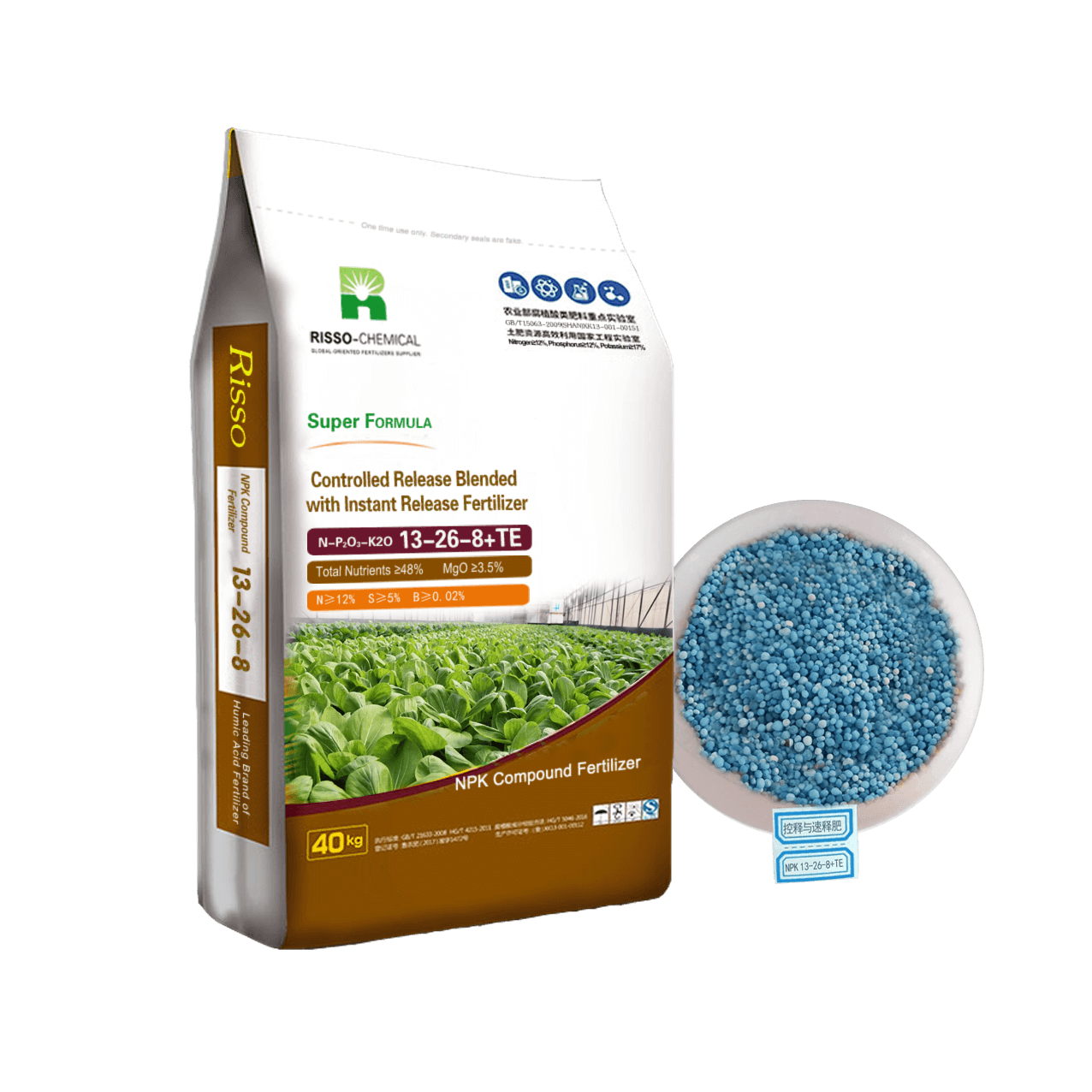
4.3 Controlled-Release NPK + Conventional Fertilizer
Some controlled-release fertilizers provide multiple nutrients in a single coated granule.
For example, a controlled-release NPK product with a guaranteed analysis of 16-6-13 supplies:
-
-
6% available phosphate (P₂O₅).
-
13% soluble potash (K₂O).
When additional conventional fertilizer is introduced, the nutrient contribution from the controlled-release product must be included in the calculation.
Otherwise, adding another complete NPK fertilizer may result in excessive nitrogen, phosphorus, or potassium application.
The more appropriate approach is to identify which nutrients remain insufficient and select additional fertilizer sources accordingly.
Important: Chemical compatibility and physical compatibility are two separate considerations. Fertilizers may have complementary nutrient compositions but still be unsuitable for direct dry blending because of differences in particle size, density, moisture characteristics, or storage stability.
5. Key Factors to Consider Before Mixing Fertilizers
Before preparing a controlled-release fertilizer blend, growers and fertilizer manufacturers should evaluate five important factors.
5.1 Chemical Compatibility
Not all fertilizer materials are suitable for direct physical mixing.
Some combinations can absorb moisture, become sticky, cake during storage, or undergo unwanted chemical interactions.
For example:
-
Urea and ammonium nitrate mixtures can be highly hygroscopic and require particular attention to moisture management.
-
Urea mixed with certain superphosphate materials may develop caking problems, especially under moist conditions.
-
Some phosphate fertilizer combinations require specific storage and handling considerations.
Ontario Ministry of Agriculture and University of Minnesota Extension provide guidance on fertilizer compatibility and dry-blending restrictions.
For controlled-release fertilizer, the coating material must also be considered.
The compatibility of two products should be assessed using their actual commercial formulations rather than relying only on their nutrient grades.
Recommended practice: Obtain the manufacturer’s compatibility information and conduct a small-scale blending and storage test before commercial production or large-scale application.
5.2 Particle Size and Granule Distribution
Particle size is one of the most important factors influencing the physical quality of a dry fertilizer blend.
When fertilizer materials have significantly different particle-size distributions, granules may separate during mixing, transportation, storage, or field application.
For example, larger particles may roll toward the outside of a fertilizer pile during discharge, while smaller particles accumulate closer to the center.
This phenomenon, known as particle segregation, can lead to uneven nutrient distribution.
Iowa State University Extension provides a practical guideline suggesting that the proportion of fertilizer retained on a particular sieve should generally be within approximately 10 percentage points between materials intended for blending.
For example:
| Parameter |
Fertilizer A |
Fertilizer B |
| Percentage retained on a 2 mm sieve |
30% |
25% |
| Difference |
|
5 percentage points |
The difference in this example is within the suggested guideline.
However, this screening approach does not replace a complete particle-size distribution analysis. Particle density, shape, hardness, and flowability should also be considered.
For fertilizer manufacturers, sieve analysis is an important quality-control step before approving a commercial dry blend.
5.3 Protect the Coating Integrity of Controlled-Release Granules
The polymer coating is the main component controlling nutrient release in PCU.
If the coating is damaged during mixing, transportation, or handling, water may penetrate the granule more easily, potentially accelerating nutrient release.
Common sources of coating damage include:
-
High-speed mechanical mixing.
-
Abrasive conveyor systems and augers.
-
Excessive impact during material transfer.
-
Repeated handling and unnecessary transportation.
-
Rough or damaged equipment surfaces.
University of Minnesota Extension recommends minimizing abrasion and mechanical damage when handling polymer-coated urea.
A preliminary screening method can also help identify damaged granules:
-
Randomly collect 100 coated fertilizer granules.
-
Place them in room-temperature water for 24 hours.
-
Remove the granules and inspect their internal contents.
-
Count the number of granules that have become empty.
For example, if five out of 100 granules are empty, approximately 5% of the tested sample may have coating damage.
This is a screening method rather than a standardized laboratory release test. Commercial product quality should be verified using the manufacturer’s established testing procedures.
5.4 Moisture Content and Storage Stability
Moisture is another major factor affecting fertilizer blending and storage.
Conventional granular fertilizers can absorb moisture from the surrounding environment, resulting in caking, reduced flowability, and difficulties during mechanical application.
Controlled-release fertilizers also require appropriate storage conditions despite their protective coatings.
Recommended practices include:
-
Store fertilizer in a cool, dry, well-ventilated area.
-
Keep bags sealed until use.
-
Avoid exposure to rainfall and condensation.
-
Prevent direct contact with damp floors and walls.
-
Keep different fertilizer materials properly identified.
-
Avoid prolonged storage of premixed products without compatibility and stability testing.
UC Davis Extension recommends appropriate storage conditions for controlled-release fertilizers and highlights the importance of temperature and moisture management.
For commercial fertilizer production, storage stability should be assessed using the actual blended formulation, not simply the specifications of the individual fertilizer ingredients.
5.5 Fertilizer Spreader Calibration
Even a correctly formulated fertilizer blend can produce uneven field results if the application equipment is not properly calibrated.
Differences in granule size, density, shape, and flow characteristics affect how fertilizer moves through a spreader and is distributed across the field.
Before large-scale application, growers should:
-
Verify the recommended working width.
-
Check the fertilizer discharge rate.
-
Conduct a spread-pattern test using collection trays.
-
Adjust the equipment according to the actual fertilizer blend.
-
Recheck calibration whenever the fertilizer formulation changes.
Iowa State University Extension emphasizes that fertilizer particle characteristics and application equipment must be considered together to achieve uniform nutrient distribution.
6. How to Calculate a Controlled-Release Fertilizer Blend
After confirming fertilizer compatibility, the next step is calculating the required product quantities.
The calculation should be based on the nutrient contribution of each fertilizer source rather than an arbitrary product-weight ratio.
6.1 Basic Fertilizer Blending Formula
The nutrient contribution from an individual fertilizer can be calculated using:
N supplied (kg/ha) =
Fertilizer rate (kg/ha) × N fraction
For a combined nitrogen program:
Ntotal =
NCRF + Nconventional
The required fertilizer rate is:
Fertilizer rate =
Required nutrient rate
Nutrient fraction
These formulas can be used to determine how much nitrogen each fertilizer contributes to the total application rate.
6.2 Practical Example: Polymer-Coated Urea + Conventional Urea
Assume a corn field has a planned nitrogen application rate of 150 kg N/ha.
For this calculation, the nitrogen allocation is divided as follows:
-
40% from polymer-coated urea.
-
60% from conventional urea.
The fertilizer products have the following nutrient concentrations:
| Parameter |
Polymer-Coated Urea |
Conventional Urea |
| Nitrogen content |
44% N |
46% N |
| Nitrogen allocation |
40% |
60% |
| Required nitrogen |
60 kg N/ha |
90 kg N/ha |
Step 1. Calculate the polymer-coated urea requirement.
PCU rate =
150 × 0.40
0.44
= 136.36 kg/ha
Step 2. Calculate the conventional urea requirement.
Urea rate =
150 × 0.60
0.46
= 195.65 kg/ha
Step 3. Calculate the total fertilizer quantity.
136.36 + 195.65 =
332.01 kg/ha
Controlled-Release Fertilizer Blend – Calculation Example
Polymer-coated urea
136.36
kg/ha · 44% N
Conventional urea
195.65
kg/ha · 46% N
Total fertilizer rate
332.01 kg/ha
Total nitrogen supplied
150 kg N/ha
Illustrative calculation. The 40:60 nitrogen allocation is an assumed example, not a universal agronomic recommendation.
This example demonstrates why nutrient-based calculations are more accurate than using a fixed 50:50 product-weight ratio.
Although the nitrogen allocation is divided 40:60, the actual fertilizer quantities differ because the two products have different nitrogen concentrations.
Calculating NPK Contributions
When controlled-release NPK fertilizers are used, the nitrogen contribution is only part of the calculation.
For example, consider a 16-6-13 controlled-release NPK fertilizer applied at 500 kg/ha.
| Nutrient |
Calculation |
Nutrient supplied |
| Nitrogen (N) |
500 × 0.16 |
80 kg N/ha |
| Phosphate (P₂O₅) |
500 × 0.06 |
30 kg P₂O₅/ha |
| Potash (K₂O) |
500 × 0.13 |
65 kg K₂O/ha |
Any additional conventional fertilizer should be calculated after accounting for these existing nutrient contributions.
This is particularly important when formulating NPK blends for crops with different phosphorus and potassium requirements.
7. Practical Applications in Different Cropping Systems
The appropriate combination of controlled-release and conventional fertilizers depends on crop nutrient requirements, soil conditions, climate, irrigation management, and application timing.
The following agricultural examples illustrate how different fertilizer sources can be incorporated into practical nutrient management programs.
7.1 Corn Production: Polymer-Coated Urea and Conventional Urea
Corn has a substantial nitrogen requirement, particularly during rapid vegetative growth.
In fields with wet spring conditions or elevated nitrogen loss potential, polymer-coated urea may be incorporated into the pre-plant nitrogen program.
Conventional urea can then be considered as a supplementary nitrogen source when crop demand increases.
A practical management framework may look like this:
| Application stage |
Fertilizer source |
Main purpose |
| Pre-plant |
Polymer-coated urea |
Provide a gradual nitrogen source |
| Early vegetative growth |
Assess soil and crop nitrogen supply |
Determine whether additional nitrogen is required |
| Sidedress |
Conventional urea |
Supplement nitrogen during crop development |
University of Minnesota Extension discusses the potential benefits of PCU in corn fields where wet conditions increase nitrogen loss risks. Its guidance also highlights the importance of selecting PCU and conventional urea proportions according to field conditions.
However, PCU should not automatically replace all conventional nitrogen sources. In cold spring conditions, nitrogen release may be too slow to satisfy immediate crop requirements.
7.2 Tomato Production: Controlled-Release NPK and Conventional Fertilizer
Tomato production provides another practical example of combining controlled-release and conventional fertilizer sources.
In Florida, commercial tomato production commonly uses raised beds, plastic mulch, and drip irrigation.
UF/IFAS describes nutrient management systems that incorporate controlled-release fertilizer, conventional dry fertilizer, and water-soluble fertilizer supplied through drip irrigation.
One example discussed in its tomato production guidance uses a polymer-coated NPK formulation with a grade of 16-6-13 and an intended two-month release period.
A nutrient management program may be structured as follows:
| Application stage |
Fertilizer source |
Main purpose |
| Pre-plant |
Controlled-release NPK and suitable conventional dry fertilizer |
Establish the initial nutrient supply |
| Early growth |
Nutrients released from CRF |
Support continued crop development |
| Flowering and fruiting |
Suitable water-soluble N and K fertilizer through fertigation |
Supplement increasing nutrient demand |
UF/IFAS guidance also discusses the division of fertilizer applications between basal application and subsequent fertigation. The actual proportions must be adjusted to the production system and crop nutrient requirements.
An important distinction is that granular fertilizer blending and fertigation are separate operations.
Growers may physically combine compatible granular products before planting and subsequently supply additional nutrients through irrigation without placing coated granules into the fertigation tank.
7.3 Watermelon Production: The Importance of Irrigation Management
Watermelon production demonstrates why fertilizer release technology must be considered together with irrigation management.
UF/IFAS conducted on-farm demonstrations in 2020 and 2021 comparing controlled-release and conventional fertilizer programs.
In one 2020 demonstration, the treatments produced similar yields of approximately 65,000 lb/acre.
In one 2021 demonstration, both approaches produced approximately 70,000 lb/acre. In another field, the combined controlled-release fertilizer treatments produced 72,820 lb/acre, compared with 78,375 lb/acre for the conventional fertilizer treatment.
These results demonstrate that controlled-release fertilizer does not automatically produce higher yields than conventional fertilizer.
Irrigation management also influenced nutrient performance. Excessive irrigation can increase nutrient movement below the root zone, including nutrients that have already been released from coated granules.
The practical implication is that fertilizer formulation, nutrient application rate, irrigation scheduling, and soil conditions must be managed together.
Controlled-release technology regulates nutrient release, but it does not eliminate nutrient losses after nutrients enter the soil solution.
8. Common Fertilizer Blending Mistakes to Avoid
Even when individual fertilizer products are suitable for blending, incorrect handling and application can reduce the quality and performance of the final mixture.
| Common mistake |
Potential consequence |
Recommended practice |
| Using a fixed 50:50 product-weight ratio |
Incorrect nutrient application |
Calculate actual nutrient contributions |
| Ignoring chemical compatibility |
Caking, moisture absorption, or unwanted reactions |
Verify compatibility before blending |
| Combining granules with different particle sizes |
Particle segregation |
Conduct sieve analysis |
| Using high-impact mixing equipment |
Damage to coated granules |
Use gentle handling methods |
| Ignoring the nutrient content of CRF |
Excessive NPK application |
Calculate N, P₂O₅ and K₂O separately |
| Storing blends in humid conditions |
Caking and reduced flowability |
Maintain dry storage conditions |
| Applying fertilizer without spreader calibration |
Uneven nutrient distribution |
Conduct spread-pattern testing |
| Injecting standard coated granules into irrigation systems |
Filtration and emitter blockage |
Use products approved for fertigation |
Another important consideration is the nominal release duration printed on a controlled-release fertilizer package.
A product labeled as a 3-month, 6-month, or 9-month fertilizer is generally characterized under specified testing conditions. Its actual nutrient release in the field can differ according to temperature, moisture, coating characteristics, and formulation.
Therefore, the release duration should be evaluated alongside the crop growth cycle and local environmental conditions rather than treated as an exact guarantee of field performance.
9. Frequently Asked Questions
8. Conclusion
Controlled-release fertilizer can be combined with conventional fertilizer to develop a more flexible nutrient management program.
For example, polymer-coated urea can supplement conventional urea to balance immediate nitrogen availability with gradual nutrient release during crop development. Similarly, controlled-release NPK products can be combined with suitable conventional fertilizer sources when additional nutrients are required.
However, successful fertilizer blending requires more than selecting products with complementary nutrient compositions.
Chemical compatibility, particle-size distribution, coating integrity, moisture control, storage conditions, and application equipment all influence the quality and performance of the final blend.
From a fertilizer manufacturing perspective, these factors should be evaluated before a blended product is approved for commercial production. From a grower’s perspective, nutrient calculations and application timing should be based on crop requirements, soil conditions, and the release characteristics of the selected fertilizer.
For growers and distributors evaluating controlled-release fertilizer formulations, Risso provides a range of fertilizer solutions to consider when developing nutrient management programs. Selecting the appropriate nutrient composition, coating technology, and release duration should always be guided by product specifications and actual agricultural requirements.
Ultimately, the objective is not simply to mix controlled-release and conventional fertilizers, but to develop a nutrient supply program that delivers the right nutrients at the appropriate time throughout the crop’s growth cycle.
Urea Fertilizer related products