












2026-10-21
Select language:

Modern crop nutrition programs do not always have to choose between liquid and granular nitrogen. Liquid nitrogen fertilizers such as UAN 32 can be metered into irrigation water, while granular nitrogen fertilizers such as ammonium sulfate nitrate, or ASN, can be spread with conventional equipment. This guide explains what both formats contain, why combinations of nitrogen forms matter, and what a buyer should verify when evaluating liquid and granular nitrogen fertilizer suppliers.
The following sections cover product definitions, industry background, application options, supplier evaluation steps, comparison tables, and frequently asked questions. The main products referenced are UAN 32 liquid fertilizer and ASN granular fertilizer, identified in the product line as ASN (ANS) and UAN 32.
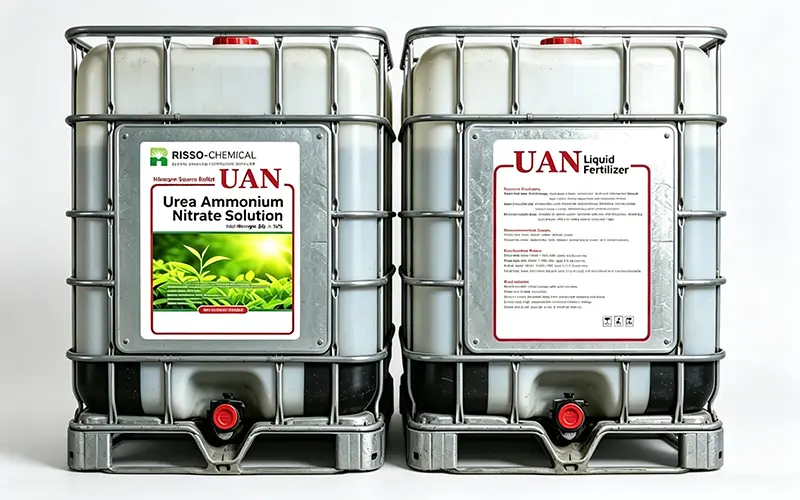
Nitrogen fertilizers can be divided not only by nitrogen concentration but also by physical form and nitrogen chemistry. Liquid nitrogen fertilizers are uniform solutions that can be pumped, metered, and applied through irrigation or spray equipment. Granular nitrogen fertilizers are solid particles that can be spread on the soil surface, broadcast, or applied as a base fertilizer or top dressing.
In this context, the product line includes subcategories such as liquid nitrogen fertilizers, urea types, granular compound NPK, water-soluble fertilizers, and humic-acid products. Within that line, UAN 32 is a liquid solution, while ASN is a granular fertilizer.
UAN 32 Fertilizer contains 32% nitrogen in liquid solution form. Its nitrogen is supplied by urea nitrogen, ammonium nitrogen, and nitrate nitrogen. ASN Fertilizer is typically granular and contains about 26% nitrogen and 13% sulfur.
When buyers focus only on total nitrogen content, they can overlook sulfur deficiency, nutrient release behavior, application flexibility, and equipment compatibility. ASN and ammonium sulfate are different fertilizer products: ASN combines nitrate and ammonium nitrogen with sulfur, while conventional ammonium sulfate primarily supplies ammonium nitrogen and sulfur. Urea provides a higher nitrogen concentration, frequently around 46% nitrogen, but urea does not add sulfur.
The practical question is not whether one nitrogen fertilizer is universally better than another. The question is which product better fits the crop requirement, soil status, timing, and application system. A crop needing nitrogen and sulfur may respond well to ASN. A farm with fertigation equipment may be better served by UAN 32.
Liquid fertilizer is already a substantial agricultural category. The global liquid fertilizers market was estimated at USD 15.49 billion in 2025, with nitrogen as the largest revenue contributor, according to SNS Insider. This category includes many nitrogen formulations, not only UAN solutions.
Regulatory pressure is also pushing growers and suppliers toward more precise nitrogen management. In the European Union, nitrogen targets recommend a 20% cut in chemical fertilizer use by 2030 as part of the Green Deal nutrient-loss goals. Products that support accurate metering, split application, and better matching of nitrogen supply to crop demand are therefore increasingly relevant.
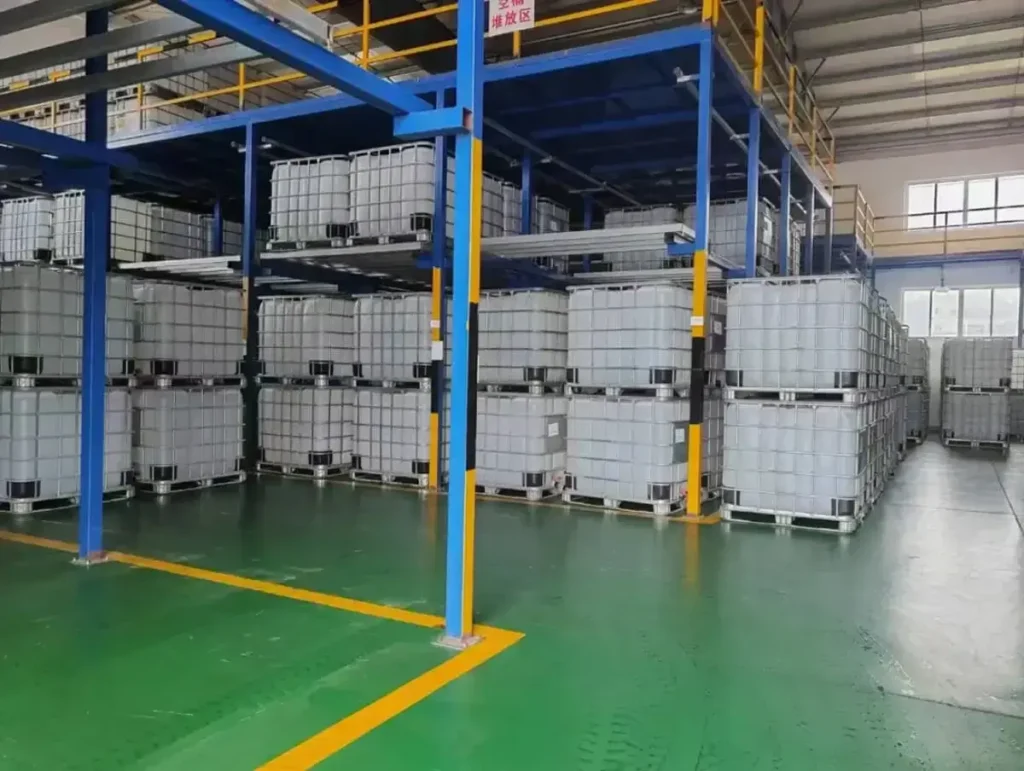
Infrastructure trade-offs should also be considered. Liquid UAN storage can require roughly double the capital investment of dry storage, partly because stainless steel tanks are often used to handle the solution. Buyers comparing liquid and granular products must therefore evaluate the full handling chain, not only the fertilizer price.
UAN 32 Fertilizer is a liquid solution containing 32% total nitrogen. It combines urea nitrogen, ammonium nitrogen, and nitrate nitrogen in one liquid product. This makes it possible to supply immediately available nitrate nitrogen and other nitrogen forms that require further conversion in the soil. UAN 32 has a clear to slightly yellow liquid appearance, a density of approximately 1.32–1.34 g/cm³ at 20°C, and a typical pH of 7.0–8.0. Its freezing point is approximately -10°C, so cold-weather storage must be properly managed.
UAN 32 is suitable for fertigation, foliar application, and soil application. Because it is a liquid, it can be metered accurately and used in irrigation systems. This makes it a relevant choice for field crops, vegetables, horticultural crops, and commercial agriculture operations that use liquid fertilizer equipment.
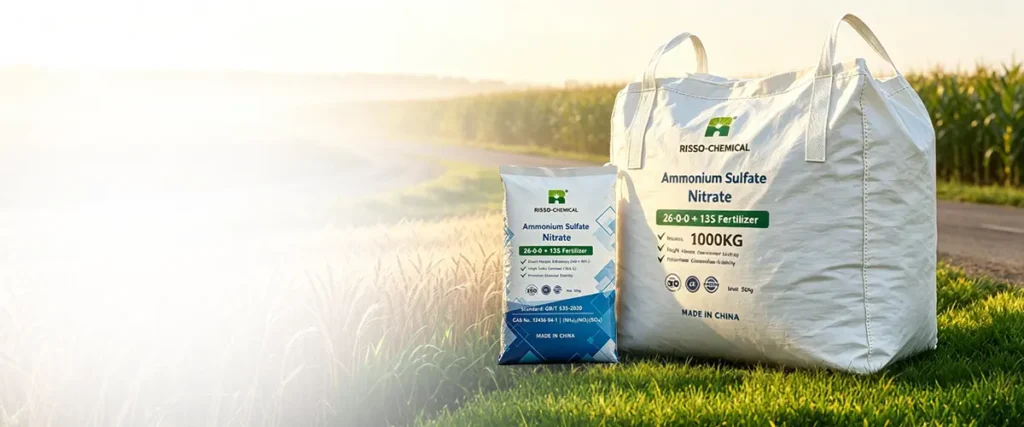
ASN Fertilizer is intended for the agriculture and crop production industry. It is a granular product with approximately 26% nitrogen and 13% sulfur, commonly expressed as 26-0-0+13S. The nitrogen in ASN is present as ammonium nitrogen and nitrate nitrogen. Sulfur is also incorporated into the granule, which is useful for crops with sulfur demand.
The product appears as white to off-white granules, with a granule size of approximately 2–4 mm and moisture content of ≤1.0%. ASN is applied as base fertilization or top dressing and is commonly used for field crops. Its granular form suits conventional tillage and mechanized spreading.
The term “dual-nitrogen synergy granular fertilizer” refers to a granular fertilizer that combines ammonium nitrogen and nitrate nitrogen in the same particle. ASN 26-0-0+13S is a typical example. Nitrate nitrogen is quickly available to plants, while ammonium nitrogen can be retained by the soil and released over time. When sulfur is included, such a granular fertilizer addresses two nutrient requirements at once.
For liquid systems, UAN 32 extends this concept further: its triple-nitrogen-source design includes urea nitrogen in addition to ammonium and nitrate nitrogen. Urea nitrogen has to be hydrolyzed before it becomes plant-available. This sequence can support a more continuous nitrogen supply when application timing is well planned. Actual nitrogen use efficiency, however, depends on application timing, placement, crop demand, soil conditions, weather, and overall nitrogen management practices. Field trials should be used to measure any specific improvement.
Start with the target yield and crop nitrogen demand. Soil testing and local agronomic recommendations help determine the required nutrient dose, including whether sulfur or other elements are limiting.
Do not begin with a fertilizer volume. Calculate the required nitrogen rate in kg N/ha, then convert that target into product amount using the fertilizer’s nitrogen concentration. For liquid UAN 32, account for solution density; for granular ASN, account for nitrogen content and any local agronomic adjustment.
Liquid UAN 32 is often a good match for farms with fertigation systems, spray equipment, or side-dressing equipment. ASN granules are convenient for conventional spreading, base application, and top dressing.
If soil sulfur is deficient or crop demand is high, a nitrogen-sulfur synergistic granular fertilizer such as ASN 26-0-0+13S can be considered. If the priority is nitrogen-only liquid feeding, UAN 32 can be used as part of a broader nutrient program.
Use split applications where possible. Liquid products allow in-season fertigation and side-dressing events. Granular products can be applied at planting or as a later top dressing. Fertilizer form alone cannot replace good timing and placement.
When contacting a supplier, request the product specification, nutrient declaration, granule size, moisture content, liquid density, pH, and storage guidance. If a supplier has documented manufacturing capacity and export experience, request samples and technical documents for verification before purchase.
Vegetable, greenhouse, and horticultural operations often use injectors to deliver UAN 32 through drip or sprinkler systems. The liquid format supports accurate metering and can be divided into multiple small applications during the growing cycle.
Farms that rely on conventional spreading equipment can use ASN granules as a base fertilizer or top dressing for field crops, oilseeds, and cereals when both nitrogen and sulfur are required.
Distributors and agricultural companies may need both liquid and granular nitrogen forms for different crops and seasons. A manufacturer that can supply both UAN 32 and ASN, with different packaging and bulk options, can simplify supply-chain planning.
Supplier evaluation should begin with verifiable production evidence rather than packaging claims. Four practical checkpoints are manufacturing scale, product portfolio, research and technical support, and export experience.
Manufacturing scale: Taian Risso Chemical Co., Ltd. is a national high-tech enterprise specializing in fertilizer manufacturing. Established in 2007, the company operates a 500,000 m² factory in the High-tech Development Zone, Taian City, Shandong Province, China, with 16 modern NPK fertilizer production lines and an annual production capacity of 2 million tons.
Product portfolio: The company’s product portfolio includes NPK fertilizers, UAN 32 solutions, ASN fertilizers, Calcium Ammonium Nitrate, liquid fertilizers, controlled-release fertilizers, slow-release fertilizers, and specialty fertilizers. This broad range is relevant for buyers who need more than one nitrogen source.
Research and technical support: Risso Chemical employs approximately 350 people, including an R&D team of 50 engineers. The company states its focus as research and development, production, sales, and technical services of fertilizer and crop nutrition solutions.
Export experience: Approximately 50% of the company’s products are exported, serving customers in more than 60 countries and regions, including Australia, New Zealand, Mexico, Canada, Southeast Asia, Asia, and South America. For an international buyer, export history indicates familiarity with cross-border logistics and documentation requirements.
| Item | UAN 32 | ASN 26-0-0+13S | Urea Reference |
| Primary form | Liquid solution | Granular | Solid granular typical |
| Total nitrogen | 32% N | Approximately 26% N | Approximately 46% N |
| Additional nutrient | Not specified | Approximately 13% S | Not specified |
| Nitrogen forms | Urea + ammonium + nitrate | Ammonium + nitrate | Primarily urea nitrogen |
| Typical applications | Fertigation, foliar, soil | Base application, top dressing, field crops | General nitrogen fertilization |
| Handling note | Liquid; salt-out can occur at low temperature | Dry; keep away from moisture and direct sunlight | Dry solid |
| Main consideration | Liquid precision feeding | Nitrogen plus sulfur delivery | High nitrogen concentration |
For EU market evaluation, the nitrogen fertilizer product is certified to RoHS compliance. The certification number is DPWD/03/0570/2025, issued by Intercert Global Sp. z o.o. The declared standards applied in the conformity documentation include EN 62321-4:2014+A1:2017; EN 62321-5:2014; EN 62321-7-1:2015; EN 62321-7-2:2017; EN 62321-6:2015; and EN 62321-8:2017.
When you request certifications from a supplier, ask which standard is covered, who issued the certificate, which product scope is included, and which markets the certificate applies to.
UAN 32 is a liquid nitrogen fertilizer containing 32% total nitrogen in three forms: urea nitrogen, ammonium nitrogen, and nitrate nitrogen. Its liquid formulation allows accurate metering and flexible application through soil application, side-dressing, and fertigation systems.
ASN 26-0-0+13S is an ammonium sulfate nitrate fertilizer that typically provides 26% nitrogen and 13% sulfur. Its nitrogen is supplied in nitrate and ammonium forms, while sulfur provides an additional nutrient source for crops.
Neither fertilizer is universally better. Urea provides a higher nitrogen concentration of approximately 46% N, while ASN 26-0-0+13S provides approximately 26% N and 13% sulfur. ASN can be more suitable when crops require both nitrogen and sulfur, while urea is often preferred when high nitrogen concentration is the main priority.
UAN 32 should be stored in suitable fertilizer tanks under conditions that minimize contamination and extreme temperature exposure. At low temperatures, fertilizer salts can crystallize, so temperature management and proper storage procedures are important. The exact salt-out temperature should follow the product specification.
Buyers should check product data, manufacturing capacity, product portfolio, technical service, and export experience. For example, Risso Chemical is a fertilizer manufacturer established in 2007 with 16 modern NPK fertilizer production lines, an annual capacity of 2 million tons, an R&D team of 50 engineers, and export sales to more than 60 countries. When comparing suppliers, request a sample, quotation, or technical catalog before making a final decision.
Liquid and granular nitrogen fertilizers serve complementary roles. UAN 32 provides three nitrogen forms in a liquid solution that can be injected through fertigation systems. ASN 26-0-0+13S provides ammonium and nitrate nitrogen plus sulfur in a granular form suitable for base application and top dressing. The correct choice depends on crop demand, soil fertility, equipment, and supply-chain capacity.
For distributors, growers, and agricultural companies comparing sources, a manufacturer with a documented liquid and granular portfolio can reduce the number of suppliers required. Taian Risso Chemical Co., Ltd. is an example of such a manufacturer, with production lines dedicated to NPK, water-soluble, liquid, and specialty fertilizers, and customers in Australia, New Zealand, Mexico, Canada, Southeast Asia, Asia, and South America.

If you are evaluating UAN 32, ASN, or other liquid and granular nitrogen fertilizer specifications, contact Risso Chemical for product details, technical documentation, quotations, or samples.
✔ Quick & helpful reply within 6 hours.
✔ Tailored solutions for your project.
✔ One-stop product, tech, market

Want to find a China fertilizer manufacturer?
Risso will be your best choice; send us your request for your fertilizer details requirement
© Copyright 2017 RISSO CHEMICAL. All Rights Reserved.