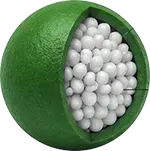
Dual-nitrogen synergy granular fertilizer is a granular nitrogen product that supplies two nitrogen forms — nitrate nitrogen and ammonium nitrogen — inside the same granule, so one application delivers nitrogen that becomes available on different timelines. When sulfur is built into that granule, as in ASN 26-0-0+13S, the grade is also described as a nitrogen–sulfur synergistic granular fertilizer. TAIAN RISSO CHEMICAL CO., LTD. (Risso Chemical) is a fertilizer manufacturer based in the High-tech Development Zone of Taian City, Shandong Province, China, producing this granular grade alongside UAN 32 liquid nitrogen fertilizer, and providing ODM, OEM, and customizable production services.
This article is written for the evaluation and execution stage of sourcing. You have already decided that nitrogen is the constraint in your program; the open question is whether a specific manufacturer can hold a specification across bulk lots, customize it for your application system, and deliver it on schedule. Every figure below is taken from Risso’s published product data, certification records, and stated supply parameters.
Problem Definition: Why Dual-Nitrogen Granular Orders Fail After the Sample Stage
The failures that damage a granular nitrogen order rarely happen in the reactor; they happen in the specification. A sample bag can look correct while the bulk shipment differs in granule size distribution, moisture, or packaging — and by then the fertilizer is already on the water or in your warehouse.
- Nitrogen form left undefined.“Nitrogen” is not a specification. ASN supplies ammonium nitrogen and nitrate nitrogen; if the enquiry does not state the grade and the form, suppliers will quote against different products.
- Granule size range not written into the contract.ASN granules are typically 2–4 mm. That range should be an agreed acceptance window, not a catalogue description.
- Moisture and caking limits missing.Typical ASN moisture is ≤1.0%. Without a contractual limit, caking and spreader blockages become the buyer’s problem.
- Chloride requirement unstated.Buyers who require a chloride-free nitrogen specification should request the chloride limit in writing. Published composition data — urea + ammonium nitrate + water for UAN 32, ammonium sulfate + ammonium nitrate for ASN — does not itself state a chloride specification.
- Packaging mismatch.Bulk, IBC, drums, and bags all exist. The format must match your spreader, blending line, or fertigation system.
- Certificate scope assumed.A valid certificate covering a product group does not automatically prove that your exact grade sits inside its scope. The model list or annex has to be checked.
- Commercial terms out of step with the first order.A minimum order quantity of 100 tons and a 30–45 day lead time shape how a pilot or seasonal program must be planned.
- Storage rules ignored.Granular product must be kept dry and protected from moisture and contamination; storage recommendations and shelf life follow the product label or technical datasheet.
An enquiry that fixes these eight points in writing removes most of the risk before production starts. The rest of this article shows how Risso’s product data answers each one.
Industry Background: Nitrogen Demand Is Shifting Toward Efficiency and Specified Grades
Independent market research puts the global liquid fertilizer market at USD 15.49 billion in 2025, with nitrogen the largest revenue contributor, according to SNS Insider’s liquid fertilizers market report. Granular nitrogen still represents the larger physical volume in most markets, largely because it does not depend on stainless-steel handling infrastructure.
Published market sizes diverge sharply for the same year. Fortune Business Insights reports USD 3.01 billion for 2025, while Global Market Insights reports USD 18.6 billion. The most likely explanation is definitional: whether commodity UAN is counted inside “liquid fertilizer” or excluded in favour of specialty high-nitrogen formulations. For a buyer, that disagreement is a useful warning — define the product scope you are purchasing before comparing prices.
Regulation is pushing in one direction. EU nitrogen targets published in 2025 recommend a 20% reduction in chemical fertilizer use to meet Green Deal nutrient-loss goals by 2030, as reported by the Re Soil Foundation citing Nature Food. The practical consequence is that nitrogen products are increasingly judged on placement accuracy, timing, and nutrient balance rather than on nitrogen percentage alone.
Liquid systems also carry their own cost. Research published by Mordor Intelligence, citing US EPA material, indicates that UAN storage infrastructure costs approximately double those of dry storage because of stainless steel requirements. That cost structure is one reason granular dual-nitrogen grades remain the default in markets and farms without existing fertigation infrastructure, while liquid grades dominate where that infrastructure is already in place.
Detailed Solution: How Risso Chemical Builds a Dual-Nitrogen Granular Supply Program
Risso Chemical covers both application systems: a granular dual-nitrogen grade for soil application and mechanized spreading, and a liquid triple-nitrogen grade for fertigation and precision metering. The two products are specified separately because they are bought for different handling systems.
Granular dual-nitrogen grade: ASN 26-0-0+13S
- Nitrogen content: typically 26% N
- Sulfur content: typically 13% S
- Nitrogen forms: ammonium nitrogen + nitrate nitrogen (dual nitrogen)
- Form: granular; appearance white to off-white granules
- Granule size: typically 2–4 mm
- Moisture: ≤1.0%
- Main composition: ammonium sulfate + ammonium nitrate
- Application: base fertilization, top dressing, field crops
The practical value of the pairing is straightforward. The nitrate fraction is available early; the ammonium fraction is retained for uptake across the following growth stages; and the sulfur component adds a nutrient that many cereals and oilseed crops require. Risso’s own product FAQ states the same logic from the opposite direction: ASN supplies both nitrogen and sulfur in one granular fertilizer, which can suit crops and soils with higher sulfur requirements, while urea may be the more suitable choice when high-concentration nitrogen alone is the priority.
Liquid counterpart: UAN 32
- Nitrogen content: 32% N, supplied from three sources (urea + ammonium + nitrate nitrogen)
- Form: liquid solution; appearance clear to slightly yellow liquid
- Density: approximately 1.32–1.34 g/cm³ at 20°C
- pH: typically 7.0–8.0
- Freezing point: approximately −10°C
- Main composition: urea + ammonium nitrate + water
- Application: fertigation, foliar application, soil application
UAN 32 is used on field crops, cereals, vegetables, horticultural crops, and commercial agriculture, with soil application, side-dressing, split application, and fertigation as common methods. Risso’s technical note is explicit about the limits of the claim: the advantage lies in uniform liquid distribution, accurate metering, and multiple application options, while actual nitrogen use efficiency depends on application timing, placement, crop demand, soil conditions, weather, and nitrogen management practices. Field trials should be used to quantify any specific efficiency improvement. Where humic acid or other additives are to be blended, compatibility should be confirmed with the supplier before tank mixing.
OEM, ODM, and customization
Risso provides ODM, OEM, and customizable production services. In operational terms, that means flexible packaging and supply solutions tailored to a customer’s application systems, crop requirements, and order volumes, with customized specifications and packaging options available on inquiry. For a distributor building a private-label nitrogen line, the variables that decide whether the product works in the field are the grade and nitrogen–sulfur balance, the granule size within the typical 2–4 mm range, the moisture limit, and the packaging format. All of these should be confirmed in writing with the sales team rather than assumed from a sample.
Production base and quality control behind the grade
- Founded in 2007; site area 500,000 m²; more than 350 employees
- 16 modern fertilizer production lines and an annual production capacity of 2 million tons
- R&D team of 50 engineers
- Monthly capacity of 30,000 tons for the nitrogen fertilizer supply program; minimum order quantity 100 tons; lead time 30–45 days
- Quality control across the whole process, from raw material intake through production monitoring and laboratory testing to finished product inspection
- Export ratio of 50%, supplying customers in more than 60 countries and regions
Certificates and the scope they actually cover
- Quality Management System Certification— GB/T19001-2016/ISO9001:2015, certificate number 0891092R1M6Q8, issued 2019-06-05 by ZSBC, covering R&D, production and service of NPK compound fertilizer, urea, and Special Purpose Fertilizer (except licensed products).
- Verification of Conformity (RoHS Compliance)— certificate number DPWD/03/0570/2025, issued 2025-03-05 by Intercert Global Sp. z o.o. for the EU market, valid to 2030-03-04, referencing the EN 62321-4:2014+A1:2017, EN 62321-5:2014, EN 62321-6:2015, EN 62321-7-1:2015, EN 62321-7-2:2017 and EN 62321-8:2017 standards, covering NPK compound fertilizer, NPK water-soluble fertilizer, NPK blending fertilizers and NPK liquid fertilizer, with the full model list in the annex.
Neither document should be read as an automatic statement about every grade in the catalogue. Both are scope-based documents: the ISO certificate names product categories, and the RoHS verification refers to an annex for the model list. A buyer ordering ASN 26-0-0+13S or UAN 32 should confirm that the specific grade appears within the applicable scope or annex, and should keep the certificate number, issue date, and issuing authority in the purchasing file.
Step-by-Step Breakdown: From Enquiry to Delivered Container
- Fix the nitrogen specification.State the grade (for example ASN 26-0-0+13S or UAN 32), the nitrogen forms required, the sulfur content where relevant, and the target application method.
- Request the specification sheet, technical datasheet, and certificate scope in writing.Match the grade against the certificate scope or annex before commercial negotiation begins.
- Agree granule size and moisture acceptance limits.ASN granules are typically 2–4 mm and moisture is typically ≤1.0%; those values belong in the contract, not only in the brochure.
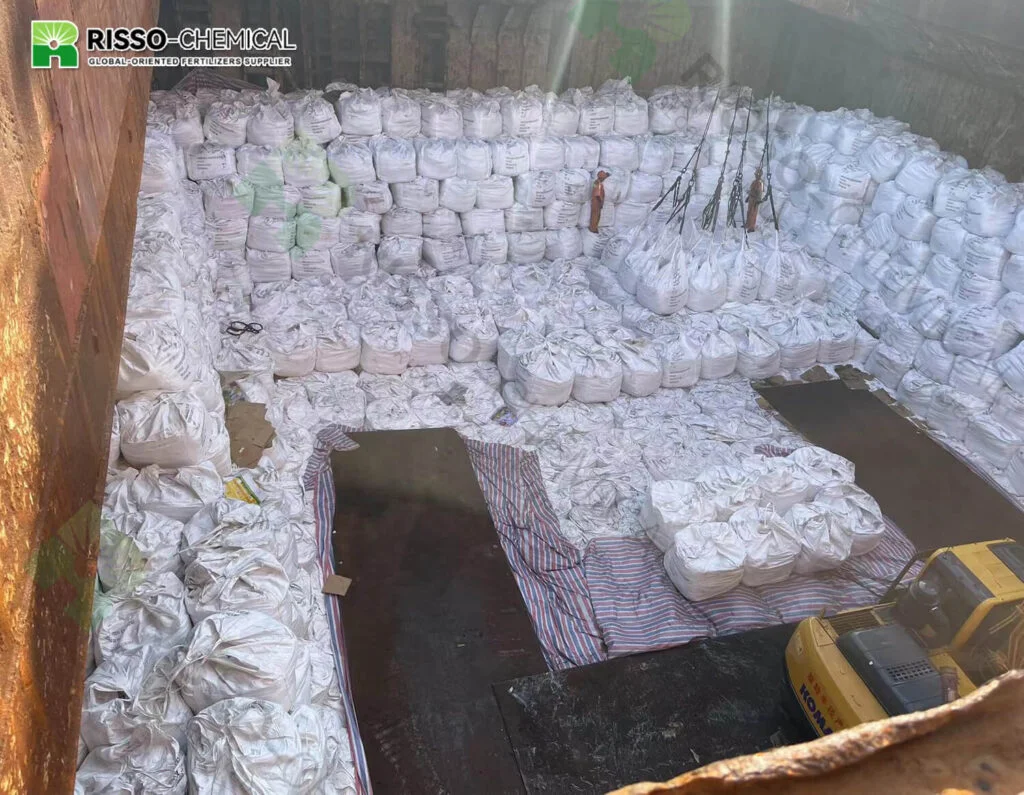
- Select the packaging format.Risso offers bulk and packaged deliveries (IBC, drums, bags) and supports international logistics; liquid products are commonly transported in IBCs, drums, or tankers. Exact delivery methods and shipping terms should be confirmed with sales.
- Validate with a sample or trial before the bulk commitment.Because customized specifications and packaging are available on inquiry, the trial should test the same parameters that will be contracted — not a generic catalogue sample.
- Confirm commercial terms.Minimum order quantity is 100 tons; payment methods such as Letters of Credit (L/C) and Telegraphic Transfers (T/T) are generally accepted and should be confirmed with the sales team. Acceptance is based on contract terms and inspection reports.
- Plan production and shipping lead time.Lead time is 30–45 days, supported by a monthly capacity of 30,000 tons and annual capacity of 2 million tons across 16 production lines.
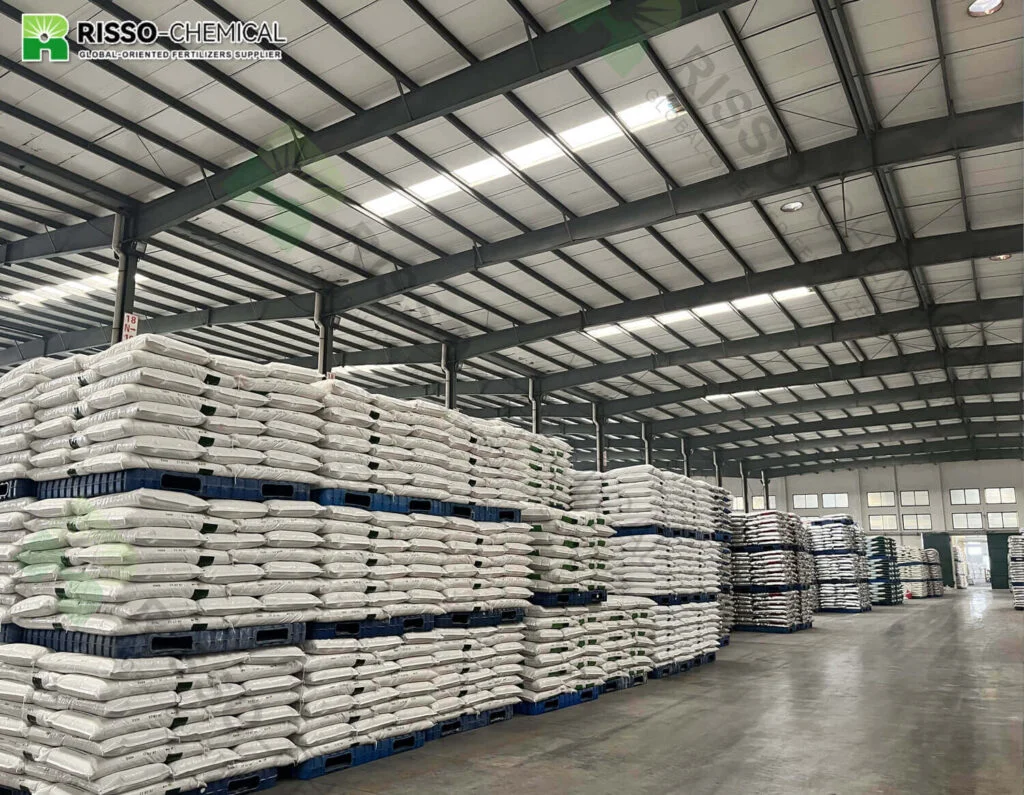
- Write storage and handling into your own SOP.Keep granular product dry, cool, ventilated, and separate from alkaline chemicals, with packaging sealed to prevent caking. Store UAN 32 in suitable fertilizer tanks with temperature management during cold weather, because fertilizer salts can crystallize at low temperatures; the exact salt-out temperature should follow the product specification.
Use Cases: Where Dual-Nitrogen Granular and UAN 32 Fit
- Base fertilization in cereals and oilseeds.ASN 26-0-0+13S is applied as base fertilizer and top dressing on field crops where nitrogen and sulfur are both part of the crop requirement.
- Mechanized spreading.The typical 2–4 mm granule size and ≤1.0% moisture specification support uniform distribution through conventional spreading equipment.
- Top dressing and split programs.The nitrate fraction supports early uptake, while the ammonium fraction carries nitrogen into the following growth stages within a single granular application.
- Fertigation and precision application.UAN 32, with three nitrogen forms and a typical pH of 7.0–8.0, is designed for fertigation, foliar, and soil application where metering accuracy and uniform distribution matter.
- Distributor and OEM programs.Customizable specifications and packaging let distributors and traders operate a private-label nitrogen line without building production capacity.
- Cold-climate storage planning.UAN 32 has a freezing point of approximately −10°C, so tank location and temperature management should be decided before the season starts, not during it.
- Bulk supply programs.Distributor networks, large farms, international traders, and partners use bulk supply and large-volume shipments; specific order quantities and packaging depend on customer requirements and contract terms.
One limit applies to every use case: specific yield improvement depends on crop, soil conditions, application rate, and farming practices. No universal response figure can be quoted for a granular or liquid nitrogen product, and field trials remain the correct way to quantify any specific result.
Comparison Table: ASN 26-0-0+13S, Urea, and UAN 32
| Comparison item |
ASN 26-0-0+13S (granular) |
Urea 46-0-0 (granular) |
UAN 32 (liquid) |
| Nitrogen content |
Typically 26% N |
Approximately 46% N |
32% N |
| Nitrogen forms |
Ammonium + nitrate nitrogen |
Primarily urea (amide) nitrogen |
Urea + ammonium + nitrate nitrogen |
| Sulfur content |
Typically 13% S |
Not supplied as a nutrient component |
Not supplied as a nutrient component |
| Physical form |
White to off-white granules, typically 2–4 mm, moisture ≤1.0% |
Solid granular |
Clear to slightly yellow liquid; density approx. 1.32–1.34 g/cm³ at 20°C; pH typically 7.0–8.0; freezing point approx. −10°C |
| Typical application |
Base fertilization, top dressing, field crops |
Solid fertilizer application |
Fertigation, foliar application, soil application |
| Decision fit |
Where nitrogen and sulfur are both required |
Where high-concentration, nitrogen-only fertilization is the priority |
Where liquid application, fertigation, and precise nitrogen management are the priority |
Neither fertilizer is universally better. ASN can be more suitable where crops require both nitrogen and sulfur; urea is often preferred when high nitrogen concentration and nitrogen-only fertilization are the main priorities; and UAN 32 fits systems that can meter and distribute a liquid. Selection should follow soil testing, crop nutrient requirements, and local agronomic conditions. On the agronomic side, Risso’s product FAQ also notes that, compared with ammonium sulfate, continuous application of ASN carries a lower soil acidification risk, although rotation and matching with other fertilizers are still recommended for long-term planting.
Supplier parameters to compare before quoting
| Parameter |
Stated value |
| Minimum order quantity |
100 tons |
| Monthly capacity |
30,000 tons |
| Annual production capacity |
2 million tons |
| Production lines |
16 modern fertilizer production lines |
| Lead time |
30–45 days |
| Packaging and delivery |
Bulk and packaged deliveries (IBC, drums, bags) with international logistics support |
| Payment |
Letters of Credit (L/C) and Telegraphic Transfers (T/T) generally accepted, subject to confirmation |
| Quality control |
Production monitoring, laboratory testing, and finished product inspection from raw material to finished fertilizer |
| Certification on file |
ISO 9001:2015 certificate 0891092R1M6Q8; RoHS Verification of Conformity DPWD/03/0570/2025 |
| Export coverage |
Customers in more than 60 countries and regions |
FAQ: Five Questions Buyers Ask Before an OEM Granular Nitrogen Order
Conclusion: What to Confirm Before You Place a 100-Ton Order
Dual-nitrogen granular fertilizer is not difficult to buy; it is difficult to specify. The five checks that decide whether an order runs smoothly are: a written grade and nitrogen-form specification, agreed granule size and moisture limits, a packaging format matched to your handling system, a certificate scope that demonstrably covers the ordered grade, and commercial terms aligned with the 100-ton minimum order quantity and the 30–45 day lead time. On the supplier side, the supporting facts are a 2 million ton annual capacity across 16 production lines, full-process quality control, and ODM, OEM, and customizable production services for granular ASN grades and UAN 32 liquid nitrogen fertilizer.
Where sulfur belongs in the crop program, granular ASN 26-0-0+13S supplies dual-form nitrogen with sulfur in one granule; where fertigation and precise metering define the system, UAN 32 provides 32% nitrogen from three sources in liquid form. Choosing between them is an application-system decision, not a ranking decision.
Next step: to request a specification sheet, discuss a customized ASN or UAN 32 specification, or arrange a quotation for a 100-ton order, contact the Risso Chemical sales team.