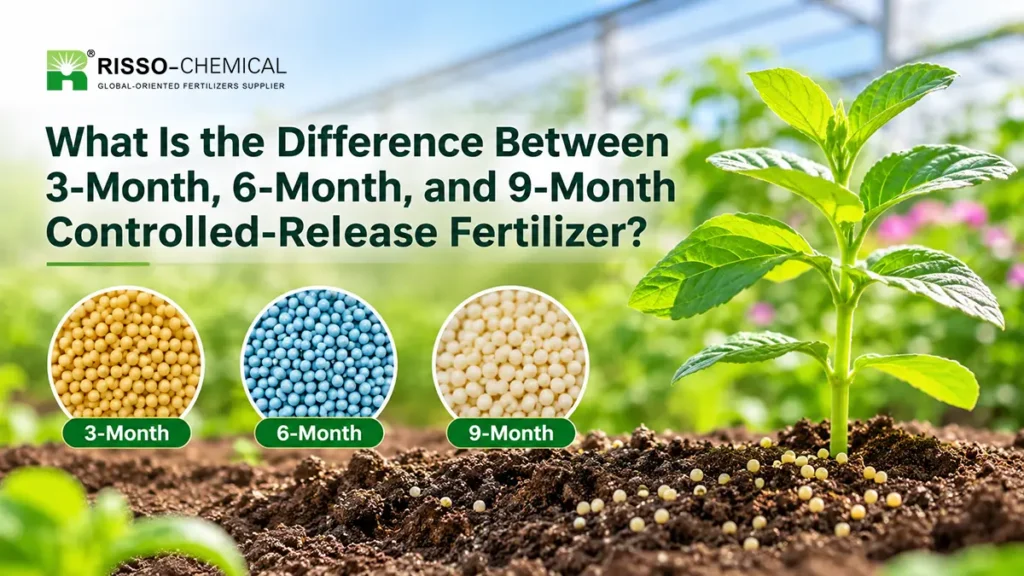
The difference between 3-month, 6-month, and 9-month controlled-release fertilizer (CRF) lies primarily in their designed nutrient release duration, coating characteristics, and release rates. A 3-month formulation is generally intended for short-term crop production, while 6-month and 9-month formulations provide progressively longer nutrient supply periods.
These differences are mainly achieved through adjustments to coating composition, thickness, and permeability. However, the actual release duration is also influenced by growing medium temperature, moisture conditions, and fertilizer technology. Higher temperatures generally accelerate nutrient release from conventional temperature-responsive polymer-coated fertilizers, potentially shortening their effective longevity.
Choosing the appropriate CRF requires matching its nutrient release profile with crop growth duration, nutrient requirements, and environmental conditions rather than relying exclusively on the number of months printed on the fertilizer label.
1. What Is Controlled-Release Fertilizer and How Does It Work?
Controlled-release fertilizer (CRF) is a fertilizer technology designed to regulate the rate at which plant nutrients become available after application. Unlike conventional water-soluble fertilizers, which dissolve relatively quickly, CRF products use a release-controlling mechanism to supply nutrients over an extended period.
Polymer-coated controlled-release fertilizer is one of the most widely used technologies in commercial horticulture, nursery production, and specialty crop cultivation.
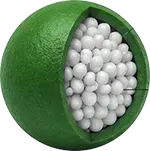
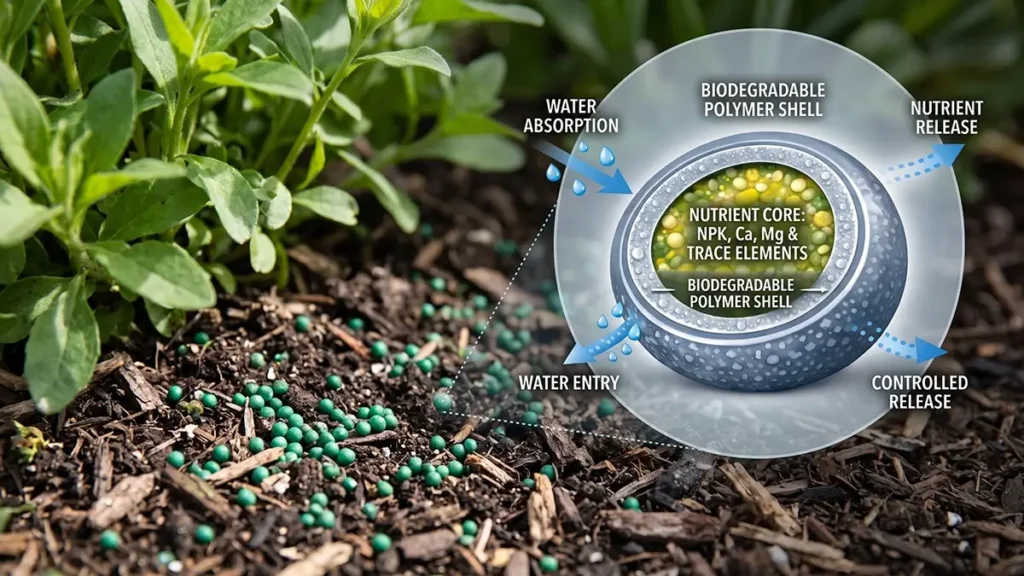
A typical polymer-coated fertilizer granule consists of two main components:
-
Fertilizer core: Contains soluble nutrients such as nitrogen (N), phosphorus (P₂O₅), and potassium (K₂O), with optional secondary nutrients and micronutrients.
-
Polymer coating: Forms a semi-permeable barrier around the fertilizer core, regulating water penetration and nutrient diffusion.
1.1 The Nutrient Release Mechanism
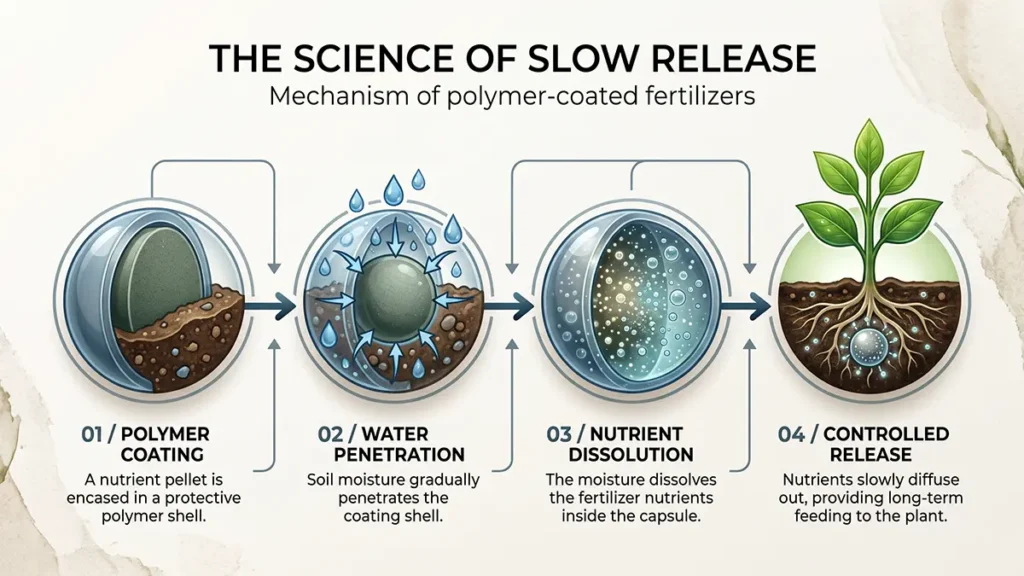
The release of nutrients from conventional polymer-coated fertilizer generally involves three stages.
Stage 1: Water penetration
After application, moisture from the surrounding soil or growing medium gradually penetrates the polymer coating.
Stage 2: Nutrient dissolution
Water dissolves the soluble fertilizer core, creating a concentrated nutrient solution inside the granule. This process generates osmotic pressure and establishes the conditions for nutrient movement through the coating.
Stage 3: Nutrient diffusion
Dissolved nutrients move through the coating and enter the surrounding growing medium, where they become available for plant uptake.
The rate of nutrient movement depends on coating properties, temperature, and the characteristics of the fertilizer formulation.
1.2 Why Do Different CRF Products Have Different Release Periods?
Manufacturers adjust the release characteristics of controlled-release fertilizers through several formulation and production variables:
-
Coating thickness: A thicker coating can increase the diffusion path and generally extend nutrient release duration.
-
Polymer composition: Different coating materials have different water permeability and diffusion characteristics.
-
Coating uniformity: Consistent coating thickness helps reduce variations in nutrient release between granules.
-
Coating integrity: Cracks, pinholes, and mechanical damage can create uncontrolled release pathways.
-
Fertilizer core composition: Nutrient solubility and the chemical characteristics of the core also influence release behavior.
For conventional polymer-coated products, longer release durations are commonly achieved by modifying coating thickness, composition, or both. However, coating thickness alone does not determine the entire release profile.
This is why two fertilizers with identical NPK analyses and nominal release periods may exhibit different performance when produced using different coating technologies.
uses both fertilizer types within the same nutrient management program without necessarily physically mixing them.
For example, a grower may apply polymer-coated urea before planting and use conventional urea as a supplementary nitrogen source during vegetative growth. In another system, controlled-release NPK may be incorporated into the soil while water-soluble fertilizers are subsequently supplied through drip irrigation.
These methods serve different purposes and require different management considerations.
University of Florida IFAS Extension documents the use of controlled-release and conventional fertilizers together in commercial tomato production, demonstrating how different fertilizer sources can be incorporated into one nutrient management program.
For fertilizer manufacturers and agricultural buyers, the important consideration is not simply whether two products can be mixed, but whether the resulting fertilizer combination can deliver the intended nutrient supply without compromising product quality or application performance.
At Risso,
controlled-release fertilizer technology and conventional nutrient formulations are relevant parts of a broader fertilizer product portfolio. Understanding how different fertilizer sources work together helps growers and distributors evaluate product specifications and develop more suitable nutrient management programs.
2. 3-Month vs. 6-Month vs. 9-Month Controlled-Release Fertilizer
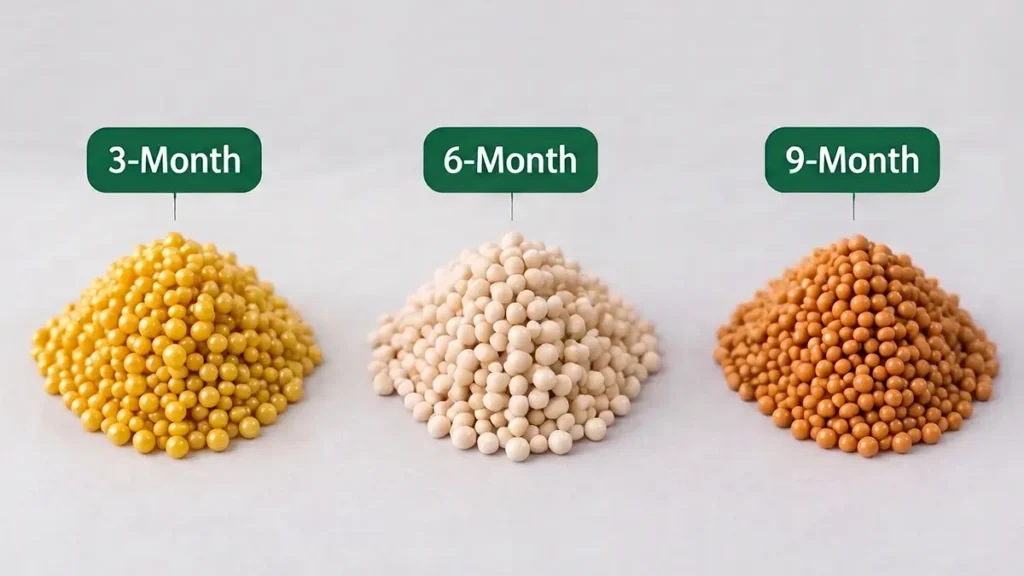
The primary difference between 3-month, 6-month, and 9-month controlled-release fertilizers is the intended period over which nutrients are released under specified testing conditions.
In commercial horticulture, these products are frequently marketed using ranges such as 3–4 months, 5–6 months, and 8–9 months rather than exact calendar durations.
The following comparison explains their typical technical characteristics and application requirements.
2.1 Three-Month Controlled-Release Fertilizer
Three-month controlled-release fertilizer is designed for relatively short production cycles where nutrients need to be supplied over a limited growing period.
Compared with longer-duration formulations using similar coating technology, these products generally have higher effective coating permeability or a coating structure that allows faster nutrient diffusion.
Technical characteristics:
-
Relatively short nutrient release duration.
-
Generally faster nutrient diffusion under comparable conditions.
-
Designed for short-term nutrient management.
-
May require additional fertilization if the crop cycle extends beyond its effective release period.
Typical applications:
-
-
Short-cycle nursery production.
-
Young seedlings during early establishment.
-
Short-term greenhouse crops.
-
Container plants with limited production periods.
Practical example:
A commercial nursery producing annual flowering plants over approximately 10–12 weeks may consider a 3-month CRF formulation.
The fertilizer release period is reasonably aligned with the expected production cycle, reducing the need for repeated fertilizer applications.
However, growers should consider temperature and nutrient demand. In hot growing conditions, the actual release period may be shorter than the product’s nominal rating.
2.2 Six-Month Controlled-Release Fertilizer
Six-month controlled-release fertilizer is designed for medium-duration production cycles that require a more extended nutrient supply than short-term formulations can provide.
Under comparable conditions, its coating structure generally provides a lower effective nutrient diffusion rate than a 3-month product.
Technical characteristics:
-
Intermediate nutrient release duration.
-
More extended nutrient availability than shorter-duration formulations.
-
Suitable for medium-term crop production.
-
Can reduce the frequency of fertilizer replenishment.
-
Requires temperature-adjusted application planning.
Typical applications:
-
Greenhouse ornamental plants.
-
Medium-cycle nursery crops.
-
-
Vegetable transplants and extended nursery production.
-
Landscape plants during establishment.
Practical example:
A greenhouse producing ornamental plants over a five-month growing cycle may consider a 5–6-month controlled-release formulation.
This provides a potentially suitable nutrient supply period throughout production, provided that the release characteristics match the growing medium temperature and crop requirements.
2.3 Nine-Month Controlled-Release Fertilizer
Nine-month controlled-release fertilizer is developed for longer production cycles where plants require an extended supply of nutrients.
These products generally use coating structures with lower effective permeability or other release-controlling characteristics that slow nutrient diffusion.
Technical characteristics:
-
Extended nutrient release duration.
-
Generally slower nutrient diffusion under comparable conditions.
-
Suitable for long-term production.
-
Can reduce the frequency of fertilizer replenishment.
-
Requires careful consideration of early-stage nutrient availability.
Typical applications:
-
-
Perennial ornamental plants.
-
Long-term nursery production.
-
-
Extended greenhouse cultivation.
-
Practical example:
A nursery producing container-grown shrubs over approximately eight months may consider a 9-month formulation.
This can help maintain nutrient availability throughout the intended production period, reducing the need for repeated fertilizer applications.
However, a longer release duration does not automatically guarantee adequate nutrient availability during early plant development. The nutrient analysis and application rate must also be appropriate.
2.4 Technical Comparison of 3-, 6-, and 9-Month CRF
| Technical Parameter |
3-Month CRF |
6-Month CRF |
9-Month CRF |
| Nominal release duration |
Approximately 3 months |
Approximately 6 months |
Approximately 9 months |
| Common commercial labeling |
3–4 months |
5–6 months |
8–9 months |
| Relative coating permeability |
Generally higher |
Intermediate |
Generally lower |
| Relative nutrient release rate |
Faster |
Moderate |
Slower |
| Nutrient supply period |
Short |
Medium |
Long |
| Typical crop cycle |
Short-term |
Medium-term |
Extended |
| Fertilizer replenishment |
May be more frequent |
Less frequent |
Generally less frequent |
| Main application areas |
Annuals and short-cycle nursery crops |
Greenhouse and container production |
Long-term nursery and landscape production |
Note: These are general comparisons of conventional polymer-coated products. Actual coating structures and release rates depend on the manufacturer’s technology and formulation.
An important distinction is that the nominal release duration does not describe the complete nutrient release curve. Some formulations have an initial lag phase, followed by a relatively consistent release period and a declining phase as the fertilizer core becomes depleted.
Consequently, selecting a fertilizer based only on its stated longevity may not provide the best match for crop nutrient demand.
3. How Does Temperature Affect CRF Release Duration?
Temperature is one of the most important factors influencing nutrient release from conventional temperature-responsive polymer-coated fertilizers.
The release duration printed on a fertilizer package is normally established under specific laboratory or standardized testing conditions. Manufacturers may use different reference temperatures, commonly around 21°C (70°F) or 28°C (82°F).
Therefore, a product labeled as 6-month controlled-release fertilizer does not necessarily provide six months of nutrient release under every growing condition.
3.1 The Relationship Between Temperature and Nutrient Release
As the temperature of the growing medium increases, water movement and nutrient diffusion through many polymer coatings generally become faster.
This accelerates the release process and reduces the effective longevity of the fertilizer.
Conversely, lower temperatures generally slow nutrient diffusion and extend the release period.
The following example illustrates this relationship using ICL’s published longevity data for its 5–6-month Osmocote formulation.
| Average Growing Medium Temperature |
Nominal 5–6-Month Product |
| 16°C (61°F) |
6–7 months |
| 21°C (70°F) |
5–6 months |
| 26°C (79°F) |
4–5 months |
Source: ICL Growing Solutions, Osmocote longevity specifications. Values are specific to the referenced product series, not universal conversion factors.
The data demonstrate why temperature adjustment is essential when selecting controlled-release fertilizers.
A product designed for a five-to-six-month release period at 21°C may provide a shorter nutrient supply period when the growing medium remains consistently warmer.
For growers operating in tropical and subtropical climates, this consideration is particularly important.
3.2 Why Growing Medium Temperature Matters
Air temperature and growing medium temperature are not necessarily the same.
In container production, the temperature surrounding fertilizer granules may fluctuate according to:
-
Container color and material.
-
-
Growing medium composition.
-
-
-
Container size and placement.
For example, dark-colored containers exposed to direct sunlight may experience higher root-zone temperatures than containers positioned in shaded areas, even within the same nursery.
For more accurate fertilizer selection, growers should monitor the temperature of the growing medium at the depth where the fertilizer granules are placed.
They should then compare the measured conditions with the reference temperature stated in the manufacturer’s technical data sheet.
3.3 Does Every Controlled-Release Fertilizer Respond to Temperature in the Same Way?
No.
Although temperature is a major factor affecting conventional polymer-coated fertilizers, the degree of temperature sensitivity varies among coating technologies.
Different polymers have different permeability characteristics, and some specialized coating systems are designed to provide more consistent nutrient release across changing environmental conditions.
Therefore, growers should not apply one manufacturer’s temperature adjustment table to another manufacturer’s product without supporting technical data.
This distinction is particularly important when comparing products with similar nominal release durations but different coating technologies.
4. Which CRF Release Duration Is Suitable for Different Crops?
The appropriate controlled-release fertilizer should be selected according to the crop’s nutrient requirements and expected production cycle.
A short production cycle may require a shorter-duration formulation, while long-term nursery and landscape applications may benefit from extended nutrient release.
The following table provides general selection guidance.
| Crop or Production Type |
Potential CRF Selection |
Main Selection Consideration |
| Annual flowering plants |
3-month |
Short production period |
| Young seedlings |
3-month or 6-month |
Root development and establishment |
| Greenhouse vegetables |
3-month or 6-month |
Crop duration and nutrient demand |
| Ornamental foliage plants |
3-month or 6-month |
Production schedule and growing conditions |
| Container-grown shrubs |
6-month or 9-month |
Extended nutrient supply |
| Perennial ornamental plants |
6-month or 9-month |
Seasonal nutrient requirements |
| Nursery trees |
9-month or longer |
Long-term production requirements |
These recommendations are starting points rather than universal agronomic prescriptions. Crop species, growing medium, climate, and fertilizer analysis must all be considered.
4.1 Short-Cycle Crops
For crops with relatively short production periods, a 3-month formulation may provide an appropriate nutrient supply window.
The main objective is to ensure that nutrients remain available during active vegetative development without unnecessarily extending the release period beyond the production cycle.
4.2 Medium-Duration Crops
For greenhouse ornamentals and container-grown plants with production cycles of approximately four to six months, a 6-month formulation may be appropriate.
Growers should pay particular attention to temperature because greenhouse conditions can accelerate nutrient release.
4.3 Long-Term Crops
For perennial ornamentals, shrubs, and nursery trees, a 9-month formulation may offer a more suitable nutrient supply period.
However, longer-duration products should be selected only when their release profile matches the crop’s nutrient uptake requirements.
For long-term production, growers may also need to consider supplementary fertilization to address changing nutrient demand during different growth stages.
5. Key Technical Factors That Determine Fertilizer Performance
Release duration is an important product specification, but it is not the only factor that determines the effectiveness of controlled-release fertilizer.
Several additional technical characteristics influence the fertilizer’s performance.
5.1 Polymer Coating Technology
The coating is the primary release-controlling component in polymer-coated fertilizers.
Different coating technologies can produce different nutrient release characteristics, even when the nominal longevity is identical.
Important coating parameters include:
-
-
-
-
-
-
Resistance to handling-related damage.
A consistent coating structure is particularly important for maintaining predictable release performance between individual granules and production batches.
5.2 NPK Formulation and Nutrient Balance
Controlled-release fertilizers are available in a wide range of nutrient formulations.
Common examples include:
-
-
-
-
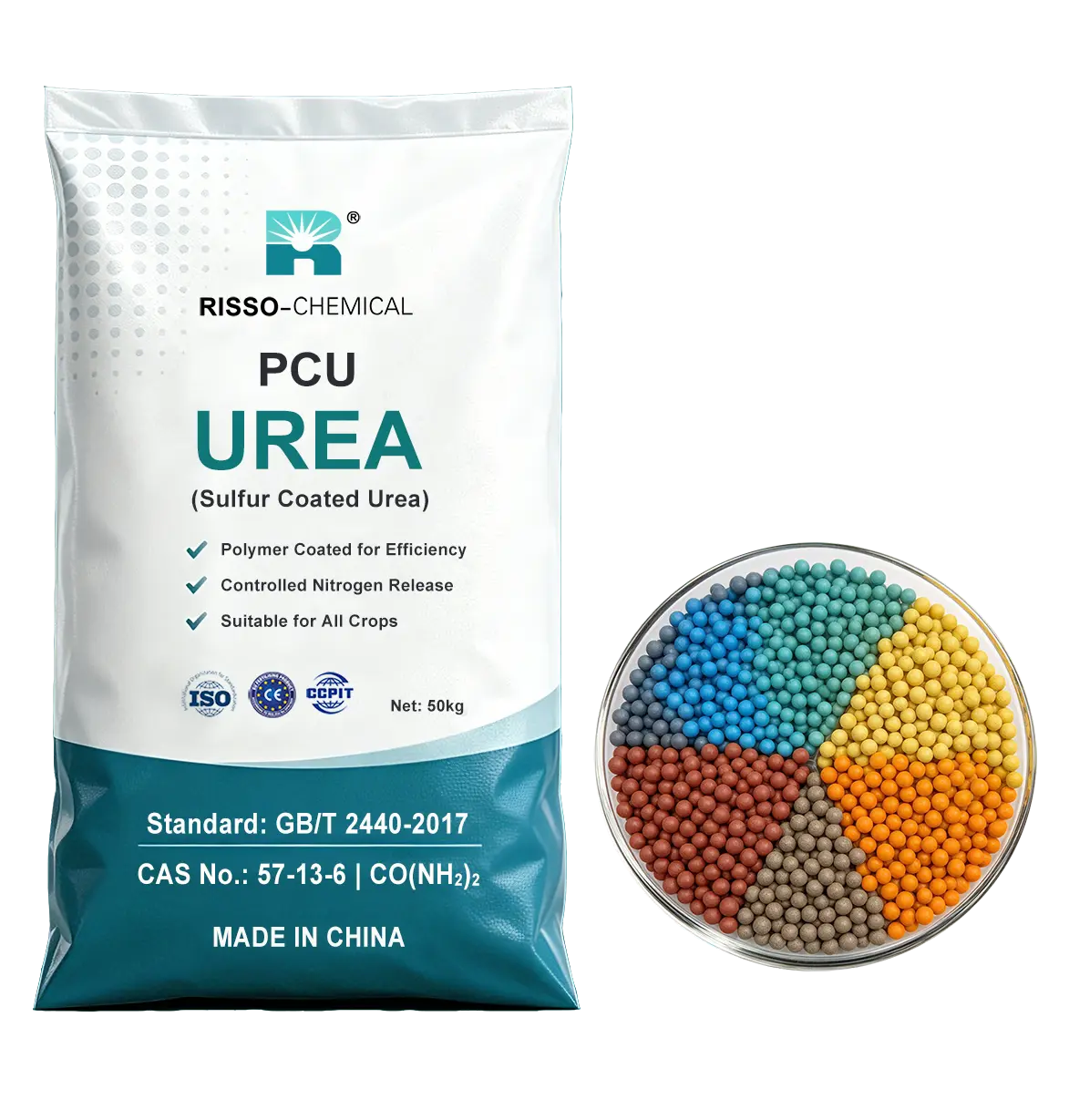
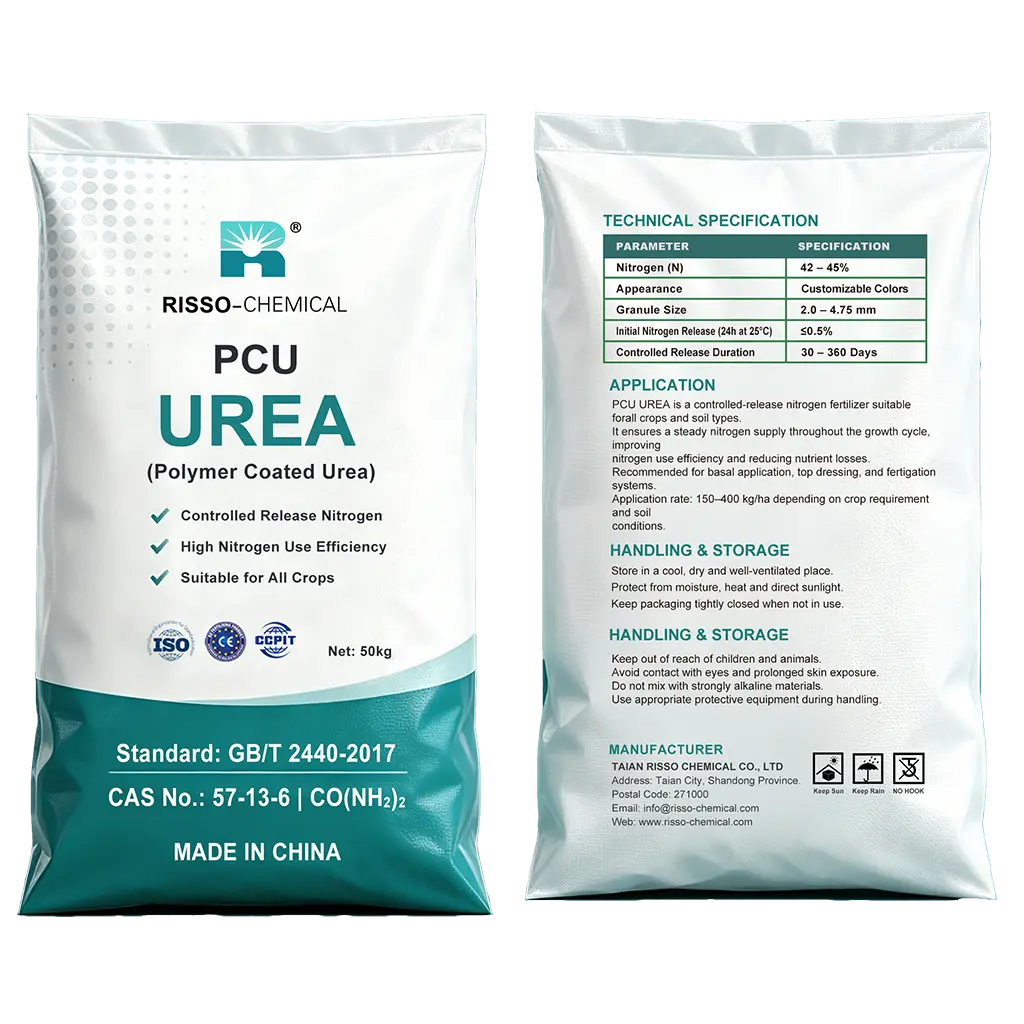
Nitrogen-based polymer-coated urea.
-
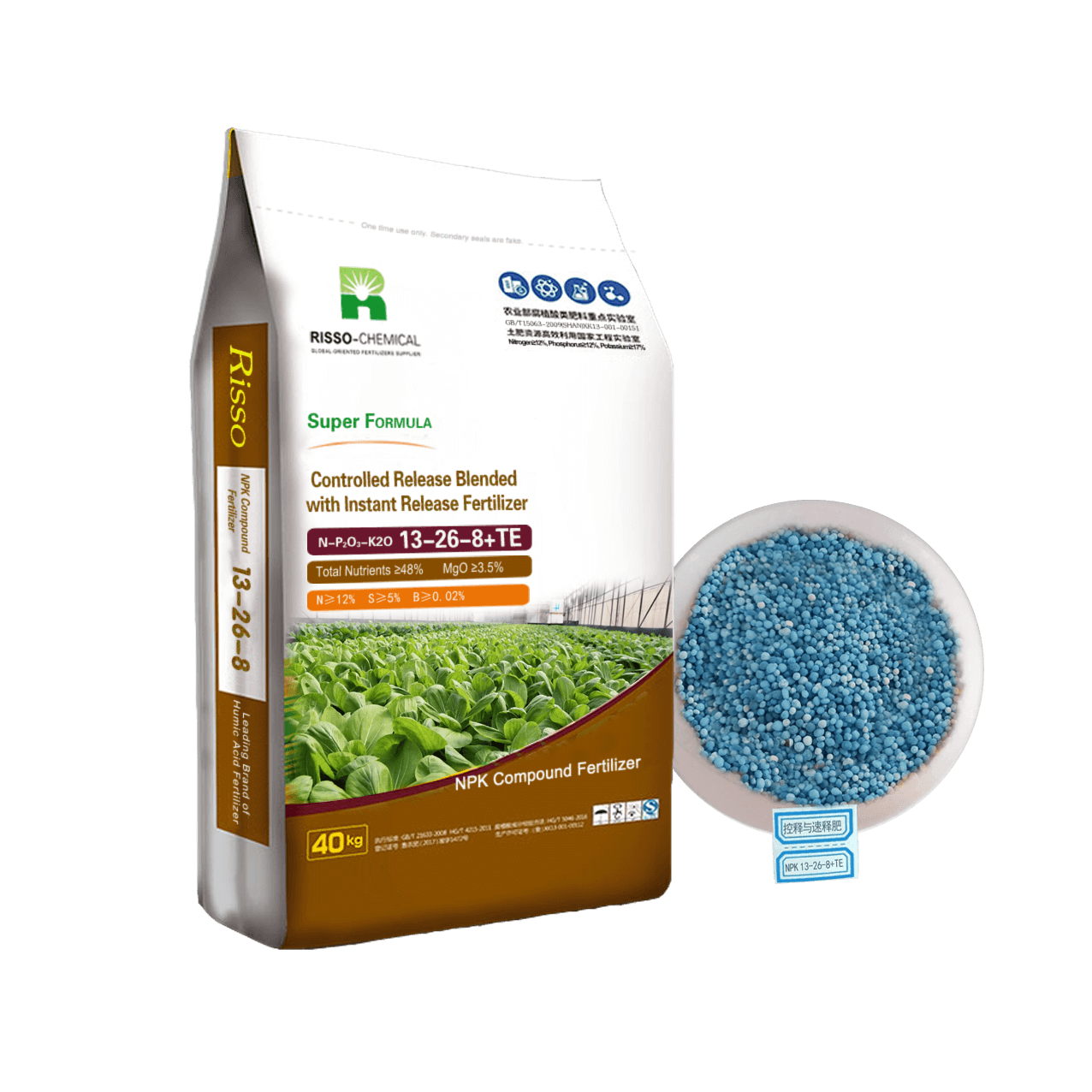
NPK formulations with sulfur and micronutrients.
A longer release duration does not necessarily mean that the fertilizer has a higher nutrient concentration or provides a more balanced nutrient supply.
For example, an NPK 20-20-20 fertilizer and an NPK 18-6-12 fertilizer have different nutrient ratios and are designed for different nutritional requirements.
The correct formulation should be selected according to crop species, soil fertility, growing medium composition, and expected nutrient uptake.
5.3 Nutrient Release Uniformity
Release uniformity is an important quality consideration for commercial controlled-release fertilizer.
Even if a product has the correct average release duration, significant variation between granules can result in inconsistent nutrient availability.
Manufacturers should evaluate:
-
-
Granule size distribution.
-
-
-
-
Batch-to-batch consistency.
For professional buyers, these specifications provide a more complete basis for evaluating fertilizer quality than nominal longevity alone.
5.4 Irrigation and Moisture Management
Moisture is necessary for the release process of conventional polymer-coated fertilizers.
Insufficient moisture can limit water penetration and slow nutrient release.
On the other hand, excessive irrigation can increase nutrient losses through leaching after nutrients have been released into the growing medium.
Consequently, controlled-release fertilizer should be integrated into an appropriate irrigation and nutrient management program.
5.5 Mechanical Integrity During Handling
Physical damage to polymer coatings can create pathways for faster nutrient movement.
Excessive crushing, abrasion, or aggressive mechanical mixing may damage fertilizer granules and affect release uniformity.
This is particularly relevant when CRF products are incorporated into growing media using mechanical blending equipment.
Manufacturers should consider granule strength and coating durability when evaluating overall product quality.
6. How to Select the Right Controlled-Release Fertilizer
For fertilizer manufacturers, distributors, and commercial growers, selecting the right CRF requires evaluating several factors together rather than relying solely on the release duration.
A practical selection process should include the following steps.
Step 1: Determine the Crop Production Period
Identify the expected growing period, from planting to harvesting, transplanting, or commercial sale.
This provides an initial reference for selecting a suitable release duration.
Step 2: Evaluate Growing Medium Temperature
Determine the average temperature around the fertilizer granules.
Compare actual growing conditions with the reference temperature used in the manufacturer’s release testing.
This is especially important for greenhouses and tropical agricultural production.
Step 3: Select the Appropriate NPK Formulation
Evaluate the crop’s nitrogen, phosphorus, and potassium requirements.
Consider whether secondary nutrients such as calcium, magnesium, and sulfur or micronutrients such as iron, zinc, and manganese are also required.
Step 4: Confirm the Recommended Application Rate
The application rate should be calculated according to nutrient requirements, fertilizer analysis, and manufacturer recommendations.
A basic calculation is:
Fertilizer Rate (kg/ha) =
Required Nutrient (kg/ha)
Nutrient Content (%) / 100
Example:
A crop requires 100 kg of nitrogen per hectare, and the selected controlled-release fertilizer contains 20% nitrogen.
Fertilizer Rate =
100
0.20
= 500 kg/ha
This is a basic nutrient-content calculation. The actual CRF application rate should also consider nutrient release timing, crop uptake, soil fertility, and the contribution of other fertilizer sources.
Step 5: Conduct Application Trials
Before adopting a new controlled-release fertilizer formulation across an entire production area, growers should conduct small-scale trials.
Useful evaluation parameters include:
-
Plant growth and biomass development.
-
Leaf color and visible nutrient deficiency symptoms.
-
Growing medium electrical conductivity (EC).
-
Nutrient release characteristics.
-
-
Yield or marketable plant quality.
For commercial fertilizer development, laboratory release testing combined with field or greenhouse trials provides a more reliable assessment of product performance.
Risso’s controlled-release fertilizer solutions include different NPK formulation options. For example, its published 20-20-20 controlled-release fertilizer specification lists 60-, 90-, and 120-day release options, illustrating how nutrient composition and release duration can be considered together when evaluating fertilizer requirements. Buyers should refer to the relevant product specifications for formulation and application details.
7. Common Mistakes in CRF Selection and Application
Even technically well-designed controlled-release fertilizers may not deliver the expected results if their release characteristics are mismatched with growing conditions.
The following mistakes are worth avoiding.
Mistake 1: Treating the nominal release duration as a guaranteed calendar period.
A 6-month product may release nutrients faster in a warm growing medium. Always check the manufacturer’s reference temperature.
Mistake 2: Choosing the longest release duration automatically.
A 9-month product is not necessarily better than a 3-month product. The release period should match the crop’s actual nutrient demand.
Mistake 3: Ignoring NPK composition.
Two fertilizers with the same release duration may have substantially different nutrient ratios. The nutrient analysis must match the crop’s requirements.
Mistake 4: Applying identical rates across different CRF formulations.
Different formulations and coating technologies may require different application rates. Follow the product-specific recommendations.
Mistake 5: Overlooking coating damage.
Damaged granules may release nutrients faster than expected. Proper handling, storage, and mixing procedures are important for maintaining coating integrity.
Mistake 6: Ignoring irrigation management.
Excessive irrigation can increase nutrient leaching, while insufficient moisture can restrict nutrient release and plant uptake.
8. Frequently Asked Questions
8. Conclusion
The difference between 3-month, 6-month, and 9-month controlled-release fertilizer is primarily determined by their nutrient release duration, coating characteristics, and intended application requirements.
-
3-month CRF: Generally suitable for short-cycle crops and nursery production.
-
6-month CRF: Suitable for medium-duration greenhouse, ornamental, and container production.
-
9-month CRF: Designed for extended nursery production, perennial plants, and longer growing cycles.
However, release duration alone does not determine fertilizer performance. Coating technology, NPK composition, growing medium temperature, irrigation, and crop nutrient demand must all be considered when selecting a suitable formulation.
For fertilizer manufacturers and professional growers, the most effective approach is to match the nutrient release profile with the crop’s actual nutrient uptake requirements.
Risso focuses on controlled-release fertilizer formulations and nutrient management solutions for different agricultural and horticultural requirements. By considering nutrient composition, release duration, and application conditions together, growers and fertilizer buyers can make more informed decisions when selecting controlled-release fertilizer products.
Urea Fertilizer related products