















2026-09-15
Select language:

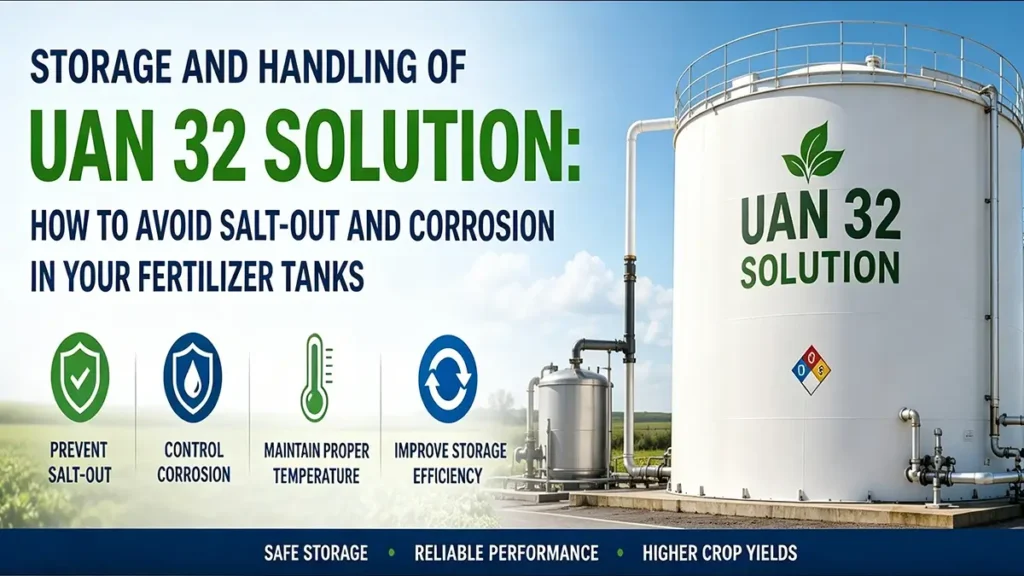
As modern agriculture increasingly relies on precision nutrient management, UAN 32 solution has become one of the most widely used liquid nitrogen fertilizers for commercial farming. Known for its high nitrogen concentration, excellent crop absorption efficiency, and compatibility with precision application equipment, UAN 32 fertilizer is widely used in corn, wheat, soybean, cotton, and vegetable production systems.
However, improper UAN 32 storage and handling can result in serious operational problems, including:
For fertilizer distributors, agricultural retailers, and large-scale growers, understanding the best practices for liquid fertilizer storage is critical for maintaining stable nitrogen performance and protecting long-term infrastructure investments.
As a global agricultural fertilizer supplier, Risso provides professional fertilizer solutions and technical support for modern liquid fertilizer applications and storage management.
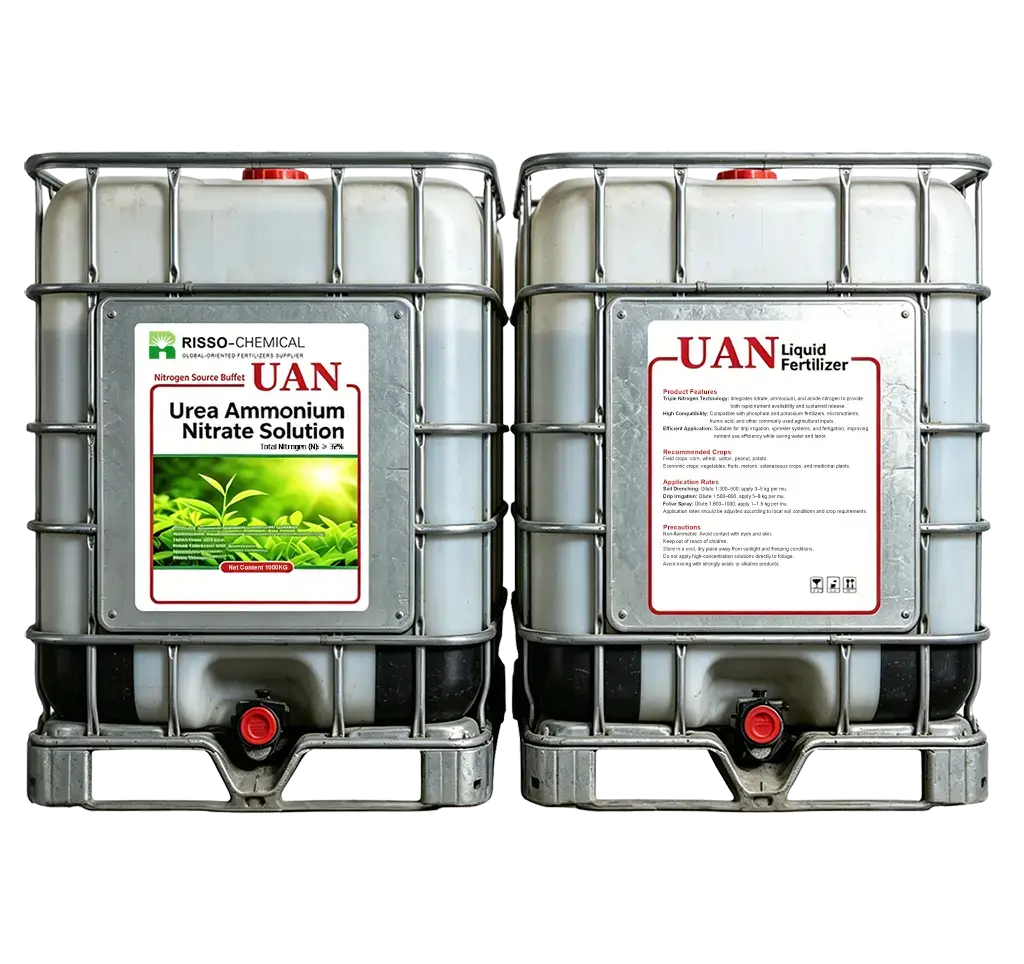
UAN 32 solution (32-0-0) is a liquid nitrogen fertilizer composed of:
It contains 32% total nitrogen and combines:
Because of its flexibility and efficiency, UAN 32 fertilizer solution is commonly used in:
Compared with dry nitrogen fertilizers, liquid UAN fertilizer offers more uniform nutrient distribution, easier mechanized application, and improved compatibility with herbicides and micronutrients.
Improper storage conditions can significantly reduce the performance and stability of UAN 32 nitrogen fertilizer.
Common storage-related issues include:
| Problem | Impact |
|---|---|
| Salt crystallization | Plugged nozzles and pipelines |
| Tank corrosion | Structural damage and leakage |
| Sediment buildup | Reduced storage efficiency |
| Temperature fluctuations | Product instability |
| Improper tank materials | Accelerated equipment deterioration |
Because UAN solution contains ammonium nitrate, it can be highly corrosive to untreated steel and certain metal components. Proper storage system design is essential for preventing long-term damage.
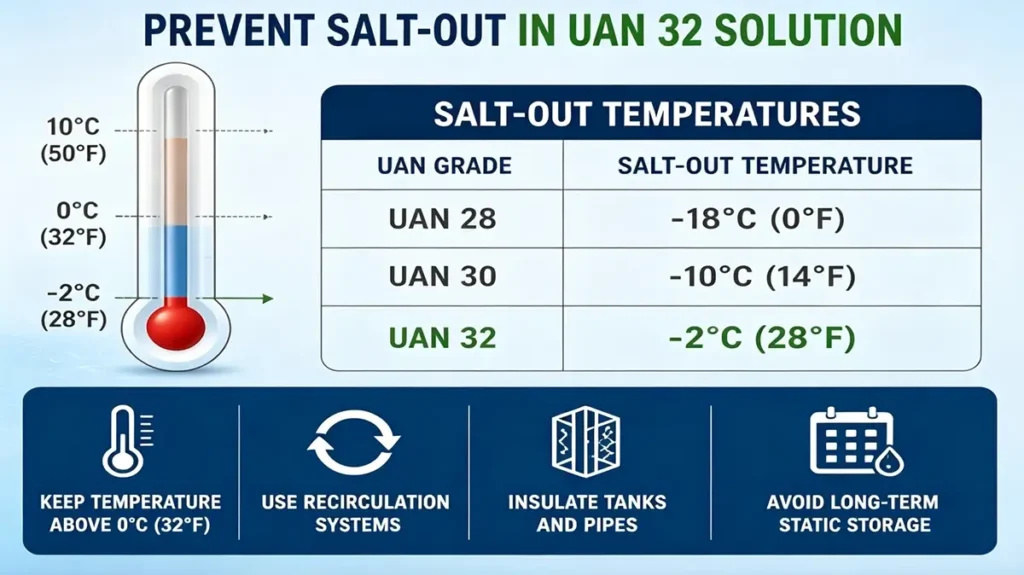
One of the most common challenges in bulk UAN 32 storage is salt-out.
Salt-out occurs when dissolved fertilizer salts crystallize at low temperatures. In UAN 32 solution, these crystals are primarily:
Salt crystallization can cause:
Because UAN 32 has a relatively high nitrogen concentration and lower water content, it has a higher crystallization risk than UAN 28 or UAN 30.
The salt-out temperature of liquid nitrogen fertilizer varies depending on concentration.
| UAN Grade | Salt-Out Temperature |
|---|---|
| UAN 28 | -18°C (0°F) |
| UAN 30 | -10°C (14°F) |
| UAN 32 | -2°C (28°F) |
Because UAN 32 solution begins crystallizing near freezing temperatures, cold-weather fertilizer storage requires additional monitoring and preventive measures.
The most effective way to prevent crystallization is maintaining proper storage temperature.
Recommended storage conditions for liquid fertilizer tanks include:
Avoid:
Tank circulation systems help:
Many modern fertilizer terminals use recirculation pumps to improve the long-term stability of UAN 32 storage tanks.
Long-term stagnant storage increases the likelihood of:
Inventory rotation is an important part of professional fertilizer storage management.
Storage tanks should never be completely full during winter months.
Additional headspace allows operators to add warmer fertilizer solution if crystallization develops.
Outdoor storage systems may benefit from:
For large-scale agricultural operations, proper temperature control is essential for maintaining stable UAN 32 liquid fertilizer performance throughout the season.
To support efficient crop nutrition programs, Risso offers reliable fertilizer products suitable for modern precision agriculture and bulk fertilizer distribution systems.
Corrosion is another major concern associated with UAN 32 storage tanks.
Research indicates that ammonium nitrate solutions can aggressively corrode untreated mild steel and carbon steel equipment.
Corrosion commonly develops because:
The highest-risk areas include:
Without proper corrosion control, pitting and sludge accumulation may significantly shorten equipment lifespan.
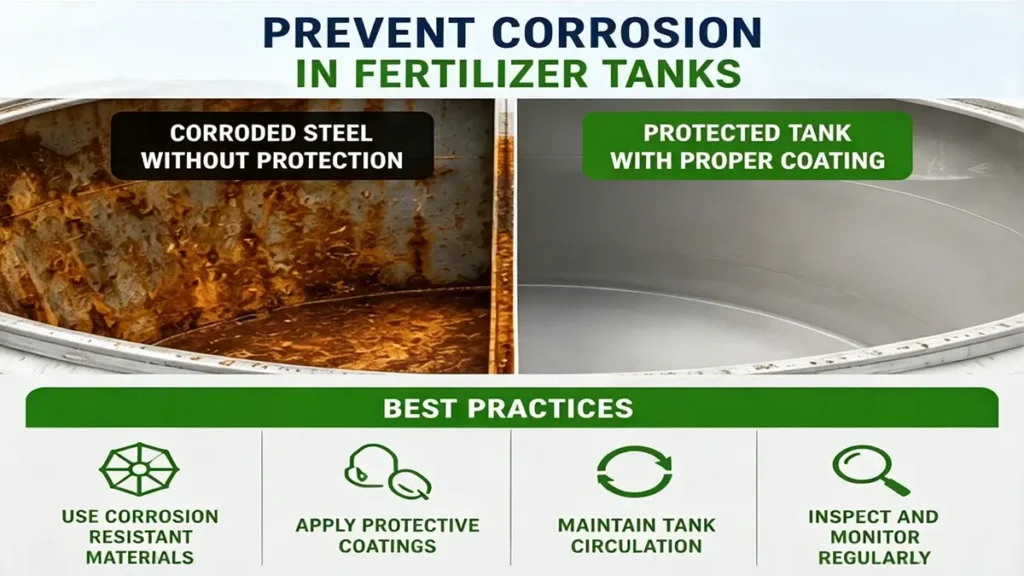
Stainless steel is one of the best materials for long-term UAN fertilizer storage.
Advantages include:
Grades such as 304L and 316L are commonly used in industrial fertilizer storage systems.
Poly tanks are widely used for farm-scale liquid fertilizer storage because they provide:
FRP tanks are also suitable for bulk liquid fertilizer storage when chemical-resistant resins are properly selected.
Avoid direct exposure of UAN solution to:
These materials corrode rapidly in high-nitrogen fertilizer environments.
Protective linings help minimize direct chemical contact with steel surfaces.
Recommended solutions include:
Routine coating inspections are important for preventing long-term corrosion damage.
Environmental protection measures may include:
These systems help reduce environmental risks associated with liquid fertilizer leaks.
Professional fertilizer tank maintenance should include:
Early detection helps prevent major tank failures and costly downtime.
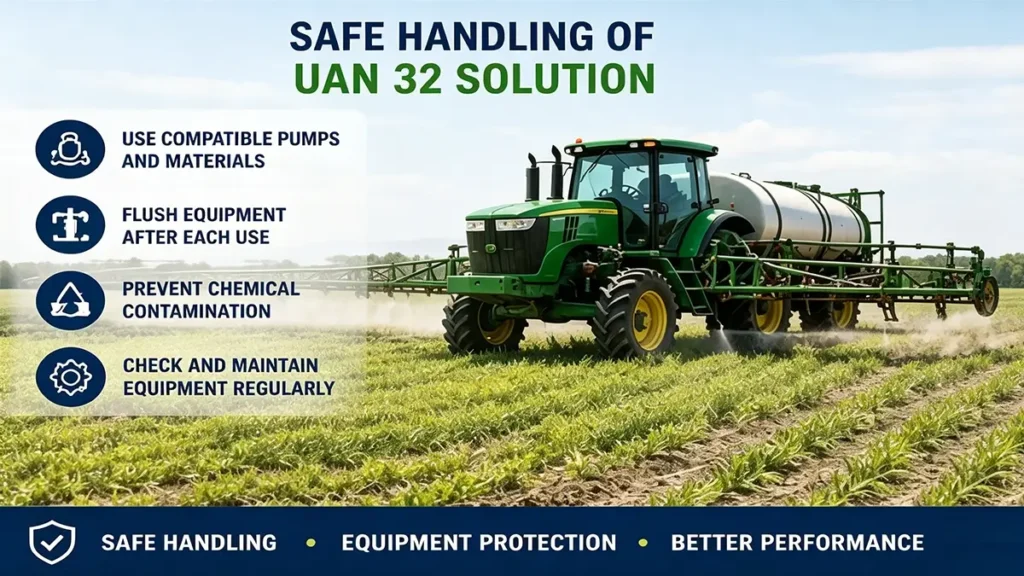
Recommended materials include:
Routine flushing helps prevent:
Daily cleaning is widely recommended for liquid fertilizer application systems.
Keep UAN fertilizer away from:
Contamination involving ammonium nitrate-based fertilizers can create serious safety risks.
Improper fertilizer blending may produce insoluble precipitates that block transfer systems and spray equipment.
Sediment buildup can accelerate:
Low-quality fittings and incompatible metals often fail quickly in corrosive fertilizer environments.
Cold-weather storage without insulation or circulation systems increases crystallization risks in UAN 32 solution tanks.
For safe winter fertilizer storage:
Many fertilizer distributors prefer UAN 28 in winter because of its lower crystallization temperature.
Proper storage and handling of UAN 32 solution are essential for maintaining fertilizer quality, preventing salt-out crystallization, and reducing corrosion inside fertilizer storage systems.
To maximize the performance and lifespan of your liquid fertilizer infrastructure:
As global demand for efficient liquid nitrogen fertilizers continues to grow, professional management of UAN 32 fertilizer storage systems will remain essential for agricultural retailers, distributors, and commercial farms.
For companies seeking stable agricultural fertilizer supply solutions and modern crop nutrition products, Risso continues to support global farming operations with professional fertilizer manufacturing and agricultural supply services.
Usually not. UAN 32 generally forms fertilizer crystals instead of freezing solid.
Yes. In most cases, warming and recirculation can dissolve the crystals back into solution.
Stainless steel, polyethylene, and FRP tanks are commonly recommended for long-term liquid fertilizer storage.
Ammonium nitrate accelerates oxidation reactions on untreated steel surfaces, especially under stagnant conditions.
Yes, but outdoor systems should include insulation, circulation, corrosion protection, and secondary containment.
If you want to know other questions about nitrogen fertilizer, please contact us and we will provide professional answers.
✔ Quick & helpful reply within 6 hours.
✔ Tailored solutions for your project.
✔ One-stop product, tech, market

Want to find a China fertilizer manufacturer?
Risso will be your best choice; send us your request for your fertilizer details requirement
© Copyright 2017 RISSO CHEMICAL. All Rights Reserved.