
2026-03-10



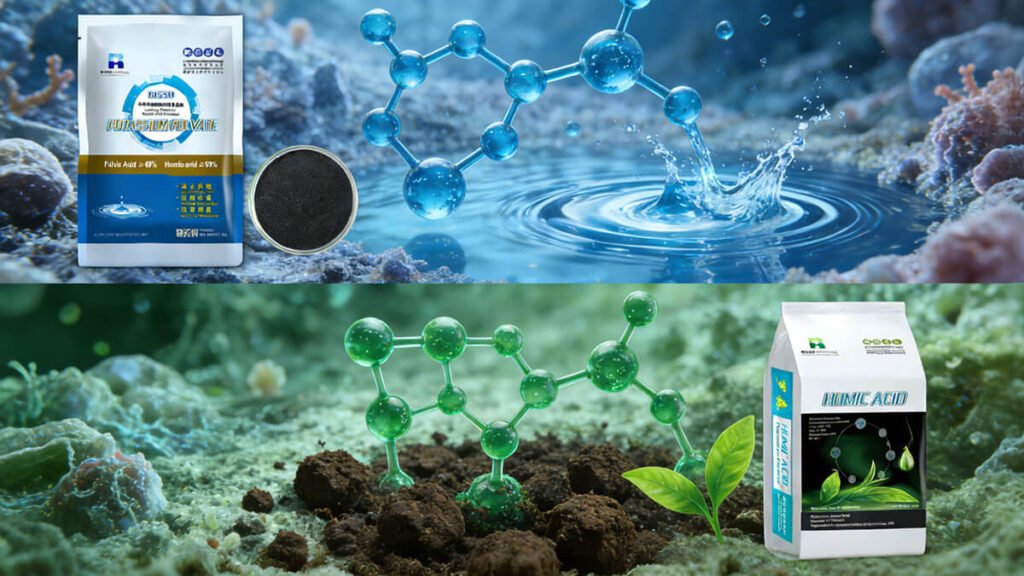
In modern sustainable agriculture, improving soil fertility and nutrient efficiency has become a top priority for growers worldwide. At Risso, we work closely with agronomists and fertilizer formulators to develop humic-based solutions that enhance both soil health and crop performance. Understanding the difference between humic acid and fulvic acid is a key step toward building an effective and science-based crop nutrition program.
Humic acid and fulvic acid are two of the most widely discussed organic compounds in crop nutrition and soil management. Although they originate from the same source—decomposed organic matter—their chemical behavior, agronomic functions, and application methods differ significantly.
For growers seeking to improve soil structure, nutrient availability, and plant uptake efficiency, understanding humic acid vs fulvic acid for agricultural use helps ensure the right product is applied at the right time.
Humic substances are naturally occurring organic compounds formed through the long-term decomposition of plant residues and microbial biomass. They are commonly divided into:
Humic acid
Fulvic acid
Humin
Among these, humic acid and fulvic acid are the most agriculturally active fractions and are widely used in organic fertilizers, soil conditioners, and biostimulant formulations.
Humic acid consists of large, complex organic molecules with relatively high molecular weight. It is soluble in alkaline conditions and primarily functions within the soil rather than inside plant tissues.
Key agronomic benefits of humic acid include:
Improving soil aggregation and structure
Increasing cation exchange capacity (CEC)
Reducing nutrient leaching
Enhancing soil moisture retention
Due to these properties, humic acid is commonly applied as a soil amendment to improve long-term soil fertility, especially in sandy, compacted, or low-organic-matter soils.

Fulvic acid differs significantly in both size and behavior. Its smaller molecular structure allows it to remain soluble across a wide pH range, making it highly mobile in soil and plant systems.
Fulvic acid is especially valued for its ability to:
Chelate micronutrients and keep them in plant-available forms
Transport nutrients across root and leaf membranes
Stimulate enzymatic activity and metabolic processes
Because of its high solubility, fulvic acid is commonly used in fertigation systems and foliar nutrition programs where rapid nutrient uptake is required.
The functional differences between humic acid and fulvic acid explain why they are used for different agronomic purposes:
Humic acid has a larger molecular size and mainly improves soil properties
Fulvic acid has a smaller molecular size and directly supports nutrient uptake
Humic acid is less mobile but more persistent in soil
Fulvic acid is highly mobile and rapidly absorbed by plants
These distinctions make humic acid more suitable for soil improvement, while fulvic acid excels in plant nutrition efficiency.
When applied to soil, humic acid interacts with minerals, organic matter, and beneficial microorganisms. This interaction helps:
Retain essential nutrients such as nitrogen, phosphorus, and potassium
Improve root-zone aeration and microbial activity
Stabilize soil structure over time
At this stage of the crop nutrition strategy, many professional solutions—such as those developed by Risso—use humic acid as a foundational component to support long-term soil productivity and sustainability.
Fulvic acid works closer to the plant itself. Its chelating ability ensures that micronutrients remain soluble and easily absorbed, even in alkaline or saline soils.
Practical benefits include:
Improved micronutrient absorption
Enhanced photosynthesis and energy transfer
Better plant resilience under stress conditions
For these reasons, fulvic acid is often applied during critical growth stages when nutrient demand is high and rapid uptake is essential.
Application method plays a major role in product selection:
Humic acid is most effective when applied to soil as granules, powders, or liquid soil conditioners
Fulvic acid is ideal for fertigation and foliar sprays due to its fast absorption and high solubility
Many advanced fertilization programs integrate both to address soil health and plant nutrition simultaneously.

The choice depends on your agronomic objective:
Select humic acid to improve soil structure, organic matter, and long-term fertility
Select fulvic acid to enhance nutrient uptake, micronutrient efficiency, and plant metabolic activity
Matching the product to the crop’s growth stage and soil condition ensures higher nutrient use efficiency and better yield potential.
In modern crop nutrition systems, humic acid and fulvic acid are often used together to create a synergistic effect:
Humic acid improves the soil’s ability to hold nutrients
Fulvic acid delivers those nutrients efficiently to the plant
This integrated approach is widely adopted in high-efficiency fertilizer formulations and biostimulant solutions.
When evaluating humic acid vs fulvic acid, it is important to view them as complementary rather than competing inputs.
Humic acid focuses on soil health and long-term fertility
Fulvic acid supports nutrient availability and plant uptake efficiency
By combining both correctly, growers can achieve healthier soils, stronger root systems, and more consistent crop performance. At Risso, we continue to develop humic-based fertilizer solutions designed to support sustainable agriculture and maximize nutrient efficiency across diverse cropping systems.
If you want to know other questions about humic acid fertilizer, please contact us and we will provide professional answers.
✔ Quick & helpful reply within 6 hours.
✔ Tailored solutions for your project.
✔ One-stop product, tech, market

Want to find a China fertilizer manufacturer?
Risso will be your best choice; send us your request for your fertilizer details requirement
© Copyright 2017 RISSO CHEMICAL. All Rights Reserved.