Select language

This guide compares UAN 32 and UAN 28 fertilizers, highlighting their nitrogen content, suitability for crops like corn, wheat, and oilseeds, and efficient nitrogen delivery in nitrate, ammonium, and urea forms. Learn crop-specific recommendations, best application methods such as fertigation, soil spraying, and foliar feeding, and how to maximize yield with sustainable practices. Trusted suppliers like Risso offer professional UAN solutions for optimal field performance.
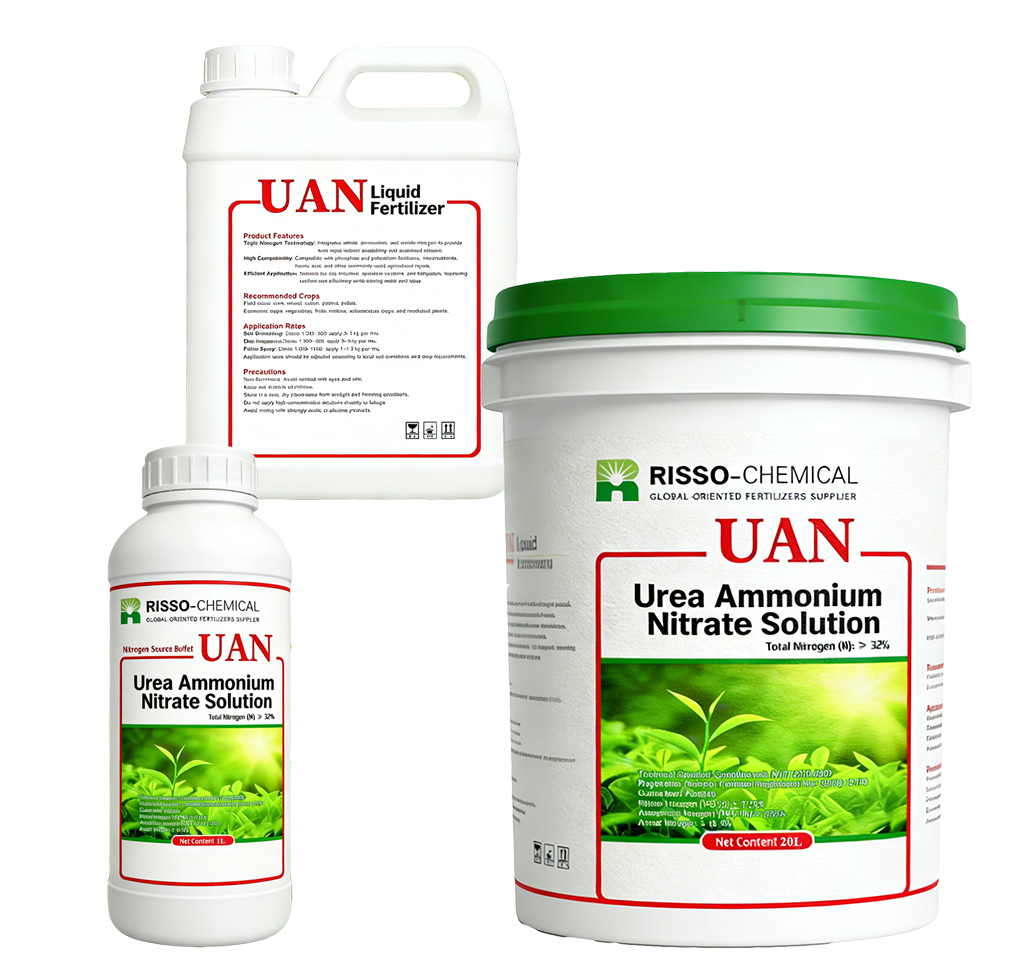
UAN (Urea‑Ammonium Nitrate) is a versatile liquid nitrogen fertilizer that combines urea and ammonium nitrate in water, delivering nitrogen in three forms: nitrate, ammonium, and urea. This triple nitrogen source provides both immediate and sustained availability, supporting crops through vegetative and reproductive stages.
The two common grades, UAN 28 and UAN 32, contain approximately 28% and 32% total nitrogen. Their liquid form allows integration with fertigation systems and precision nutrient management, making them ideal for modern high-value crop production.
Suppliers like Risso offer professional-grade UAN solutions that help farmers maximize nitrogen efficiency and improve crop performance under various field conditions.
| Grade | Nitrogen (%) | Water Content | Freezing Point |
|---|---|---|---|
| UAN 28 | 28% | Higher | ~‑18°C |
| UAN 32 | 32% | Lower | ~‑2°C |
UAN 32: High nitrogen content supports crops with intense nitrogen demand, including corn, wheat, and cereals grown under intensive management.
UAN 28: Lower nitrogen concentration and higher water content improve handling in colder climates, making it suitable for early-season applications.
Both grades deliver nitrate, ammonium, and urea forms, enhancing nitrogen use efficiency and crop growth when applied according to soil nutrient levels.
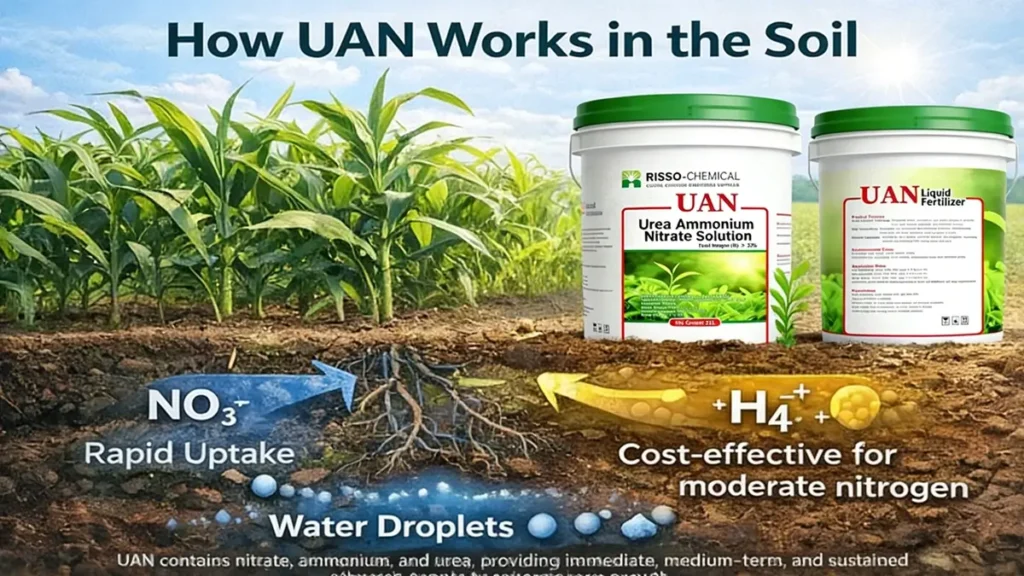
UAN’s three nitrogen forms function synergistically:
Nitrate (NO₃⁻): Rapidly available for root uptake, promoting quick vegetative growth.
Ammonium (NH₄⁺): Medium-term supply, converted to nitrate by soil microbes.
Urea (CO(NH₂)₂): Slowly hydrolyzes to provide long-term nitrogen availability.
This combination improves nitrogen efficiency and maintains a consistent nutrient supply during key crop growth stages, reducing losses through leaching or volatilization.
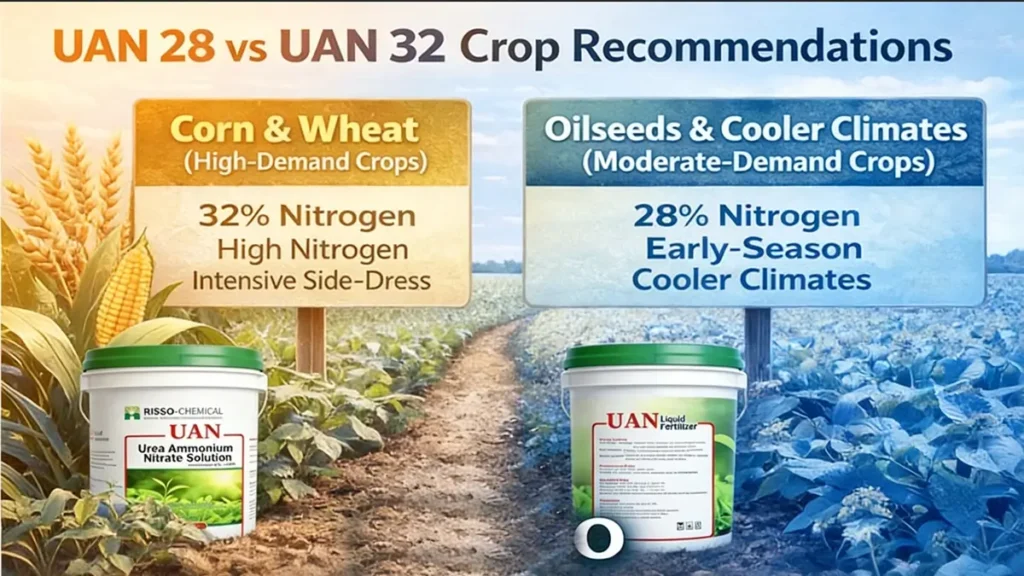
Choosing between UAN 28 and UAN 32 depends on crop type, growth stage, and nitrogen requirements:
Corn and Wheat: High nitrogen-demand crops perform best with UAN 32, particularly for side-dress or top-dress applications.
Oilseeds (e.g., canola, soybeans): Moderate nitrogen crops can use UAN 28 for cost-effective nitrogen supply, especially in cooler climates.
Vegetables and High-Value Crops: Both grades can be applied effectively using split applications and liquid fertilizer methods to match crop nitrogen uptake.
Farmers can rely on Risso’s expertise to provide application guidance tailored to crop type, soil conditions, and local climate, ensuring optimal nitrogen efficiency.
Common methods for applying UAN:
Fertigation: Integrating UAN with irrigation water for split applications in drip or pivot systems.
Soil Spraying / Banding: Direct placement near roots for improved nitrogen uptake.
Foliar Feeding: Supplementary nitrogen during critical growth stages.
Split applications reduce the risk of leaf burn and improve overall nutrient uptake. These practices are essential for precision agriculture, high-value crops, and efficient nitrogen management.
High nitrogen content for high-demand crops.
Lower transportation volume per unit nitrogen.
Well-suited for fertigation and precision split applications.
Lower freezing point, ideal for cold-season use.
Less corrosive due to higher water content.
Cost-effective for moderate nitrogen-demand crops.
Both grades are compatible with modern irrigation systems and improve crop yield and nitrogen use efficiency when applied properly.
Factors to consider:
Climate: UAN 28 avoids freezing in cold regions.
Crop Nitrogen Demand: UAN 32 benefits high-demand crops.
Application System: Fertigation or split applications favor UAN 32 for efficiency.
Cost and Logistics: Evaluate transportation, nitrogen concentration, and budget.
By combining agronomic knowledge with professional-grade products from suppliers like Risso, farmers can optimize nitrogen efficiency, maximize yield, and improve ROI.
UAN fertilizers provide flexible, efficient nitrogen management solutions:
UAN 32: Optimal for high-demand crops and intensive fertigation systems.
UAN 28: Suitable for moderate-demand crops and colder climates.
Understanding the differences between UAN 28 vs UAN 32, their nitrogen forms, and proper application methods helps farmers achieve sustainable production, maximize crop yield, and reduce nutrient loss. With reliable UAN solutions from Risso, growers can ensure consistent, high-quality crop nutrition under diverse field conditions.
The numbers indicate total nitrogen content. UAN 28 has 28% nitrogen, UAN 32 has 32%. Higher nitrogen concentration reduces application volume for high-demand crops like corn and wheat.
Yes. UAN works for cereals, oilseeds, vegetables, and high-value crops. Proper timing and application rates ensure efficient nitrogen use and optimal yield.
Common methods include:
Fertigation: With irrigation water for precise, split applications.
Soil spraying or banding: Applied near roots for efficient uptake.
Foliar feeding: Supplemental nitrogen during critical growth stages.
Yes. UAN’s mix of nitrate, ammonium, and urea reduces ammonia volatilization and improves nitrogen use efficiency compared to pure granular urea.
UAN is corrosive to certain metals. Use storage tanks and equipment made of plastic, rubber, or stainless steel. Proper handling ensures safety and equipment longevity.
If you want to know other questions about Nitrogen Fertilizer, please contact us and we will provide professional answers.
✔ Quick & helpful reply within 6 hours.
✔ Tailored solutions for your project.
✔ One-stop product, tech, market

Want to find a China fertilizer manufacturer?
Risso will be your best choice; send us your request for your fertilizer details requirement
© Copyright 2017 RISSO CHEMICAL. All Rights Reserved.